

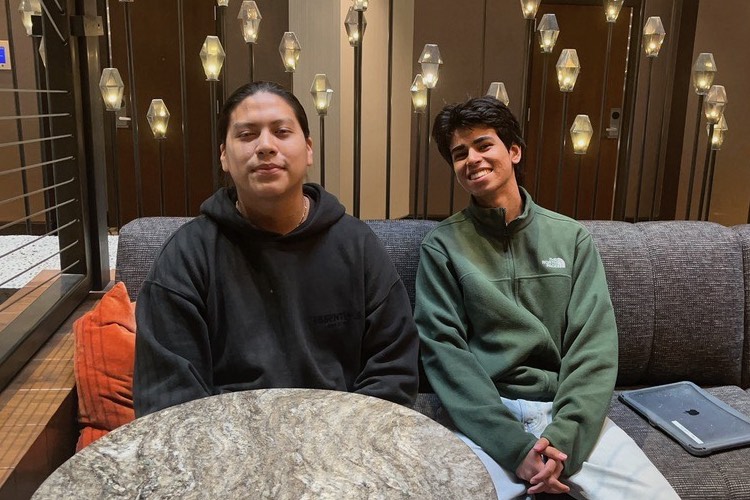

Each morning, 15-year-old Max Trujillo boards three different Muni buses to get from his home in the Mission to his Presidio private school. Peering out the window, Trujillo said he feels like he’s entering another world.
The stark difference between the two environments never sat right with him.
The parents of his classmate, Adriel Oyagata, work as Mission street vendors, selling handmade Ecuadorian jackets, scarves and hats. When the vendor ban went into effect last winter, the 17-year-old learned firsthand how city policy can change lives.
The issues plaguing District 9 were close to them, but the boys just didn’t know where they fit into the solution. Then, Trujillo and Oyagata had an idea.
In June, the high-school juniors drafted a complete proposal for a District 9 Youth Council made up of 10 to 20 high-school students representing each neighborhood in the district. They hope the council can increase visibility on the issues facing young people of color, while simultaneously offering a space for teens and youth in their community to take initiative and learn leadership skills.
“We’ve become accustomed to chaos-filled streets,” Trujillo said, describing conditions in District 9 that don’t appear in other parts of town. “There’s so many issues like gentrification and homelessness that are so profound in our area of the city. We want to be a part of the solution.”
This youth council will be the second of its kind in the city. The first launched in District 7 and is sponsored by the Community Youth Center.
Oyagata, who attended San Francisco public schools in the Mission and Chinatown before enrolling in Bay School, said a central focus for the council will be on education.
The two boys are on scholarship at Bay School, a majority-white private high school within walking distance of the waterfront, and known for rigorous academics and a $64,000 price tag. But the boys call District 9 their home.
In their June proposal introduction, describing the council’s value, they wrote: “We’re intrigued by the sheer discrepancies between the lives of students in majority-white, wealthier-resident neighborhoods, and those of students from working-class, historically marginalized communities.”
“I know there are many students out there that go to public school, and if they’re given the opportunity to go to a private school, they’ll take it,” Oyagata said, highlighting the gap in resources in schools across the city. “We’re living proof of it.”
Trujillo, who will be the president of Bay School’s Latino Affinity Club next school year, grew up in a family that never shied away from civic action. As a child, he attended local protests advocating for senior rights and rallied for protection for Dreamers. But Trujillo said his family was unusual.
“Many don’t think their voices are heard,” he said. “We want to assure that youth aren’t looked over in decision-making and that their feedback is valued.”
While the council seats are open to any high-school-aged students in the district, the boys hope the council will represent underserved Black and Latinx voices, and help to propel students into careers in advocacy or government.
“We’re going to be the future supervisors and mayors and congressmen,” Oyagata said. “This is one way for us to get more students of color in those positions.”
With Supervisor Ronen leaving office, they hope to launch the council in the fall in partnership with the new District 9 supervisor’s administration. In the meantime, they are searching for a local sponsor organization to support them with publicity and planning.
When schools reopen, they will begin the recruitment process by spreading the word at local high schools and on social media. By September, they aim to officially launch and start meeting.
“We constitute a large part of the district and we give it its livelihood,” Trujillo said. “If virtually every policy affects youth in some way, I think that it’s important for us to be represented.”
This makes my heart sing. It’s important for people to get involved with their community. I’m District 9, though I’m in Bernal and if they need help I’m in.
Good to read this. I love the Mission, I walk through it often, but when I think of the families living there and seeing all the problems every day my heart breaks. Change will help all.
This is awesome. The community will need to defend these youth from the predations of the coopting city funded nonprofit apparatus that brooks no popular competition so that they might have space to organize independently or else we know how this will end.
The left—and ML—just can’t, or won’t, see beyond identity politics. That means individuals never matter, not really, or even the community as a whole. Only groups, tribes. Sad.