
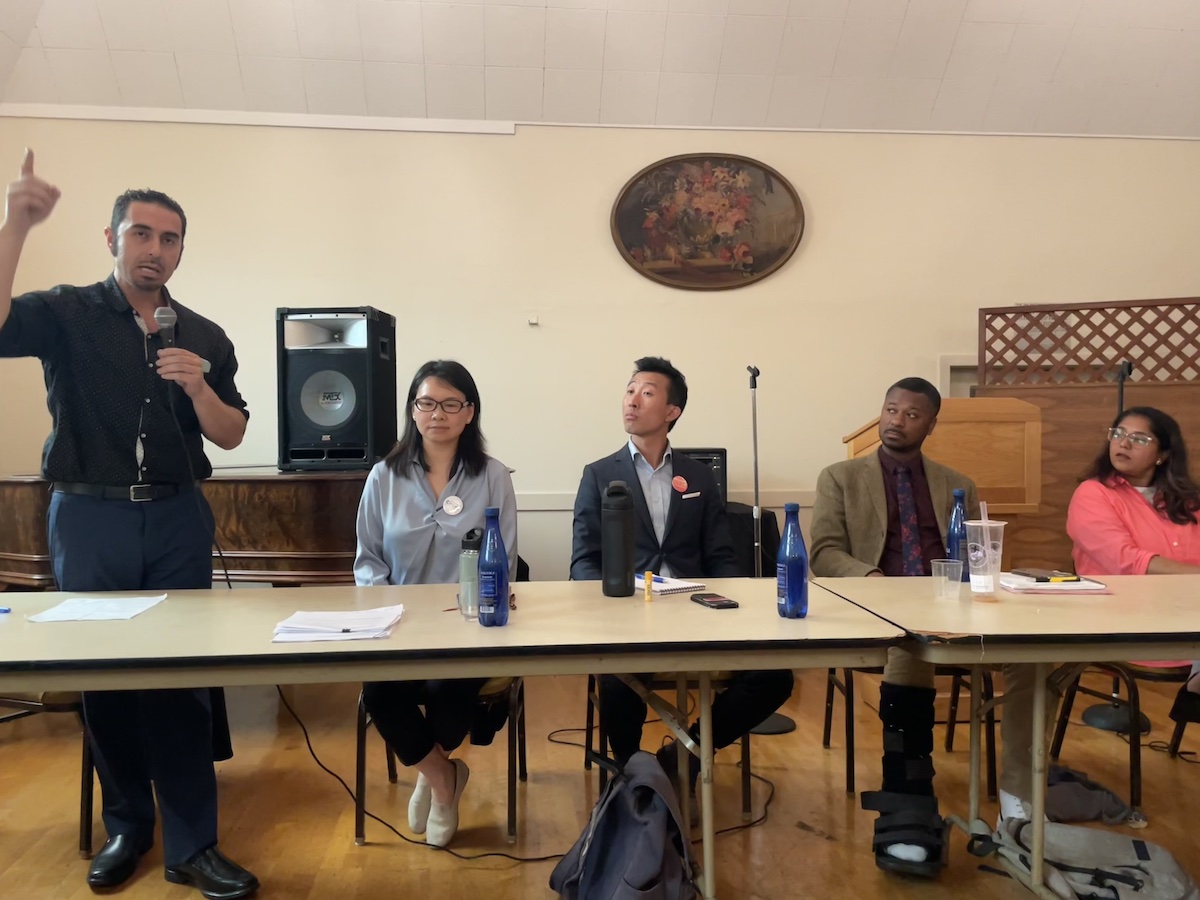

The question that most flummoxed District 11 candidates Wednesday night was who, after voting for themselves, would be their second choice.
“Oh I haven’t thought this far ahead,” candidate Ernest “E.J.” Jones blurted out.
Nevertheless, Jones and Chyanne Chen each won two votes from their competitors; the one remaining frontrunner, Michael Lai, got none. Not only that, Lai, who moved into District 11 in February, shortly before filing to run in April, could not really make up his mind and, after proposing Chen and Jones, he even suggested a write-in candidate.
“We have three qualified candidates in this race that are from the neighborhood … that understand the community needs of the neighborhood,” said candidate Adlah Chisti, referring to Chen, Jones and herself. “It’s very important that we elect people who are from District 11 to office.”
“I think that Adlah is potentially on to something,” said Jones. “It takes a special person that has had the lived experience to be able to lead.” Both Chisti and Jones ranked Chen second.
“I sense there might be a little bit of some subtweeting me here in some of these answers,” said Lai, prompting the audience to burst into laughter. Both Chen and the fifth candidate, Roger Marenco, ranked Jones second.
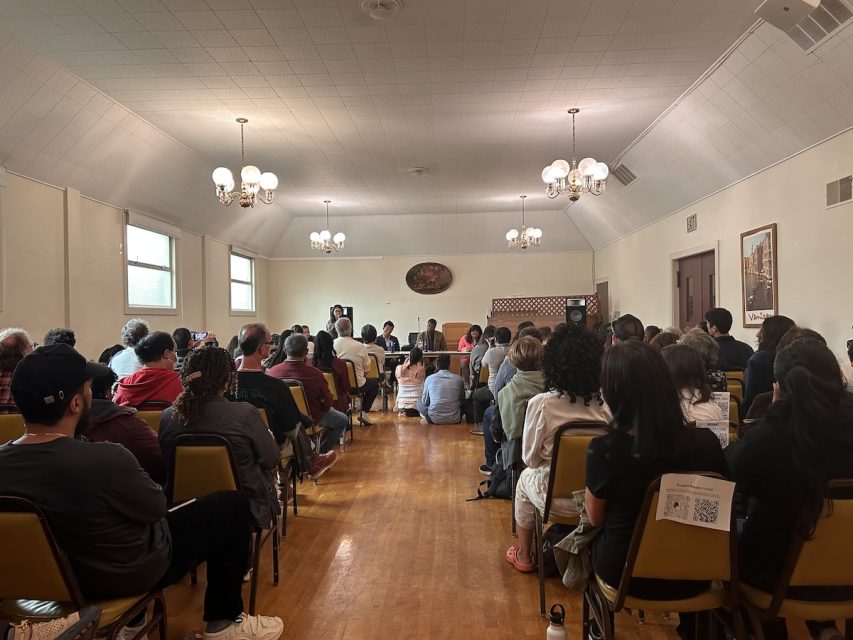
Some 80 people packed the Italian American Social Club on Russia Avenue for the debate moderated by Mission Local reporter Xueer Lu. This was the second of six planned district debates and two mayoral debates that will be hosted or co-hosted by Mission Local before the November elections.
Another notable moment came toward the end of the debate via an audience-supplied question: “You all seem to have very similar ideas; what is the one idea that distinguishes you from the other candidates?”
The question was timely. For most of the debate, except for Marenco’s focus on locking up criminals, the five candidates in one of the city’s most contested races didn’t go out of their way to differentiate themselves. They all referenced the district’s shared identity, including working families, public schools, immigrants and that they would “listen to the community.”
They also agreed on making park facilities more accessible, the importance of fighting for more resources for the often “forgotten” District 11, and improving childcare in the district that has the highest number of children in the city.
Jones’ answer was straightforward: His history distinguishes him. It is “the amount of work that I have done for this specific community … and the things that I have done and proven already,” said Jones, former legislative aide for incumbent Ahsha Safaí. “You can go to Merced Heights Playground and see the changes. You can see the speed bumps that have been implemented. You can talk to people that I’ve delivered food bags to, that I’ve worked with.”
Chen, who has lived 24 years in the district since emigrating from China at age 15, also touted her history in the district and knowledge of its ways. When Lu asked how Chen felt about the difference between being a labor organizer and district supervisor, she said “I don’t think that’s much different.” The two main jobs as a supervisor, she said, are to serve the constituents and write legislation, exactly what she did as an organizer.
Chisti reiterated her commitment to transparency, and said she’d be the supervisor who’d stay as a supervisor for the district, instead of using the role as a stepping stone into another office.
Presently an in-home support services provider for her parents, Chisti earlier worked as Jones’ campaign consultant. When Lu asked what compelled her to leave that job and run against Jones, Chisti said she had an “epiphany” one day, realizing that District 11, the community she grew up in, was an open seat and she had the capacity to represent it.
In contrast to Jones, Chen and Chisti, Lai — the newcomer to the district — offered a more forward-looking answer: The future matters more. He cited the recent presidential election, appealing to the audience’s sense that the government is broken and there’s a need for “some creative, entrepreneurial leadership to just make government work again and restore trust.”
Throughout the debate, Lai also played up his personal and political connections in and out of San Francisco. As one of the two Chinese American candidates in a district that is majority Asian American, Lai mentioned his town hall next Monday with former presidential candidate Andrew Yang, who has endorsed him.
Lai, who got elected to the San Francisco’s Democratic County Central Committee weeks after his political debut in the city, noted that he is also building relationships with the school board candidates. “I know three of the folks who are running right now for the Board of Education, so that I can be the fiercest advocate possible” to make sure District 11 doesn’t “get the short end of the stick” around school closures, he said.
Similarly, when Lu asked Lai about his plan to secure more resources for the district, “I would first be working with other supervisors — I’ve been endorsed by a few so far, Matt Dorsey, Joel Engardio, Rafael Mandelman — to prioritize our district,” he said.
Asked to counter the impression that he moved this year to District 11 solely to run for office, Lai said the diverse district with a sense of community reminded him of where he grew up in Southern California, and he’s already on Zillow, looking to buy a home in the district. Moreover, he maintained, it’s not about the history: “It’s about what someone can do in the future.”
Jones agreed, to a point: “Michael is right. It is not about how long you’ve lived here,” he said in his closing statement. “But it is about the amount of work that you have done to serve this community.”
Marenco, a Muni driver, the former president of the Transport Workers Union and a registered independent, served as an outlier in the debate, whose passionate speeches loosened up the room, occasionally inducing peals of laughter.
A solution he cited in most answers was to look into the city’s finances by “opening the book” and doing “reappropriation of funds.”
Marenco, who was born in El Salvador, again glorified the lock-em-up policies of El Salvador president Nayib Bukele (San Francisco’s jail population would grow sevenfold if the city incarcerated a commensurate percentage of its population as is the case in El Salvador). He proposed enacting an amendment to state Prop. 47. “If you steal $950 or less, you will spend 950 hours in jail,” he said.
He said his voters are those “who are thinking outside of the red or blue.”



The issue of term of residency in a district is very important, even more important now that the billionaire funded Astroturf groups are promoting (and paying for) carpet bagger candidates in the supervisor races across the city. Why does it matter? Because the grassroots local groups and neighborhood groups are comprised of knowledgeable people who are experts on their communities and neighborhoods. The Marina, Telegraph Hill, the Haight Ashbury, the Mission, Japan town, the Castro, the Portola and Forest Hill are all distinctly different neighborhoods with different histories and priorities. If a candidate hasn’t live in (or worked specifically in) a neighborhood, how can they possibly have a good sense of residential concerns and issues? A candidate for district supervisor should be required to have lived in the district they are running to represent for five years……otherwise the candidate will offer cookie cutter platitudes and gobbldygook talking points.
Three Asian American candidates, not two. South Asian are Asian!
Good point. Will rephrase.
JE