

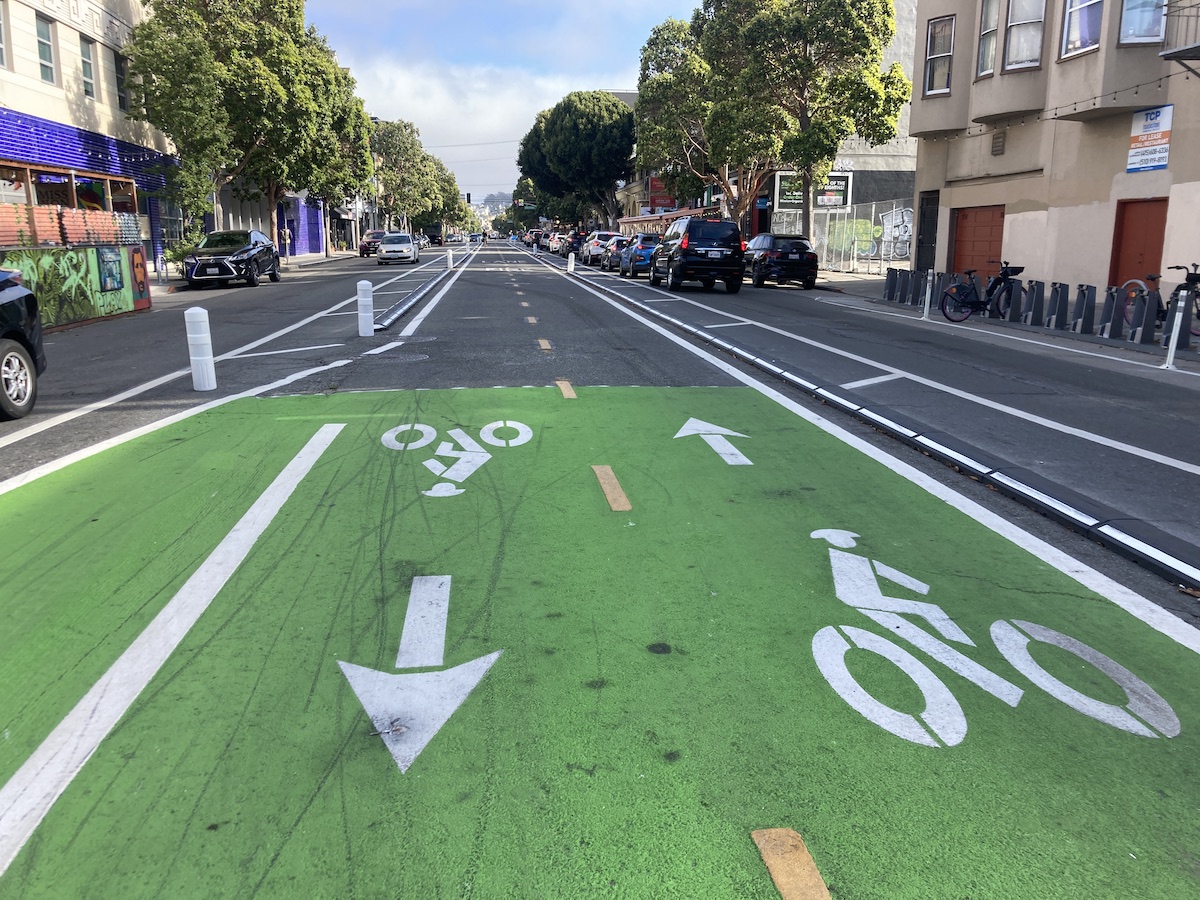

The MTA board of directors today endorsed a new curbside bike lane proposal on Valencia Street, a major shift after the department firmly stood by its pilot of the center bike lane over the past several months.
In today’s six-month evaluation presentation before the board, MTA project manager Paul Stanis said that the new curbside bike lane proposal is more intuitive, but would come with tradeoffs, including an anticipated 41 percent reduction of parking and loading spaces.
It will also take some time to design and implement. MTA’s goal is to prepare a plan by the end of the year.
Parking was a major issue of contention for the current center bike lane pilot, which already resulted in the loss of some 48 parking spots on Valencia Street. Many business owners blamed their struggling economic recovery on the center-running lane, pointing at limited parking and loading areas.
A new merchant group called Vamanos said the curbside plan is “an even worse idea” than the current center bike lane.
“That will cause the loss of more parking spots, and cause even greater damage to Valencia merchants,” read a statement from the group sent to the board on Tuesday morning. “The SFMTA should weigh all options before rushing a decision to avoid another catastrophic mistake that Valencia businesses will not survive.”
Stanis said that surveys conducted in recent months showed that, with the current center bike lane, drivers typically park two blocks away from their destination, and take about five minutes to find parking.
“So our job, through the summer, is to try to squeeze everything out of every inch along the corridor,” Stanis said, referring to parking spaces in the design of the new lanes.
And Ted Egan, the chief economist at the Controller’s Office, said that while Valencia Street has seen one of the slowest recoveries from the pandemic citywide, the center bike lane is not to blame.
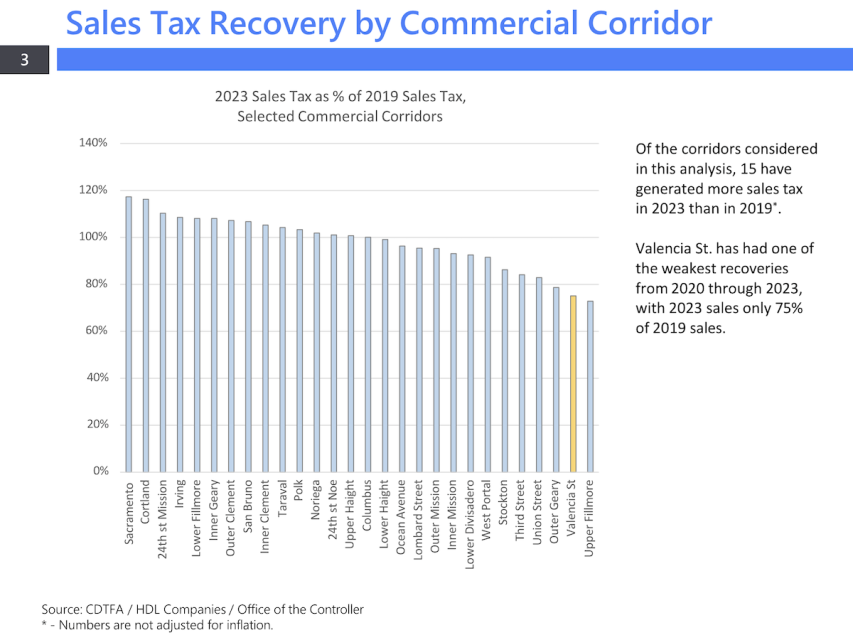
“After accounting for these other changes, those bikeway improvements do not contribute to explaining why Valencia has had weak business performance … does not have any effect either positive or negative,” Egan said.
Instead, the corridor’s struggles could be attributed to the focus on family apparel, which Egan called the “single weakest” industry in the city, or the exodus of young people who would frequent casual dining establishments.
The center bike lane, while it has not been an outright success, has brought with it certain improvements, according to Stanis’ presentation today.
Cars stopping in the bike lane, a continuous issue before the pilot program, has dropped drastically, according to MTA data. Several cyclists who gave public comment today said they prefer the new center lane, where they don’t have to navigate through vehicle or pedestrian traffic.
But, while average monthly collision rates are trending downward, left turns and U-turns, which became illegal after the implementation of the center bike lane, have continued to occur, according to Stanis’ presentation today, with three or four vehicles making these maneuvers each hour.
Stanis’ presentation today also showed that pedestrian collision rates are the same as they were before the pilot, and scooter collisions are much higher than before.
The current drafted design shows the green bike lane running along the curb, with parking spots blocking it from vehicle traffic. The green lane weaves from the curb side into the street to navigate around parklets.
This raised some concerns from MTA directors today, as did the drawn-out, confusing implementation process of the center lane, which some suggested was the reason for its failure.
“One of the things that I don’t want to repeat, this time around, is having an experience sullied again by implementation,” said Director Stephanie Cajina.
Director Amanda Eaken called for safe biking infrastructure to be in place during any future rollout.
Stanis said the MTA’s goal will return to the board with a more solidified plan by the end of the year.
The Valencia merchants’ poster calls for a return of the “historic bike lane,” that is, not a protected lane. They don’t want a bike lane at all.
The economic problems of Valencia (and SF, generally) are complex, but I have a theory about a part of it. Because retail has *generally* taken a huge hit in the era of online commerce (Amazon), there aren’t many new retail stores opening. That leaves vacancies on commercial corridors that are filled by non-retail businesses (urgent care, architects offices, preschools). The proliferation of this stuff is terrible for retail businesses, it creates non-dense retail environments. There’s no foot traffic bleeding from one business into the next. This is only going to get worse. There’s no retail ecosystem anymore, just a few hardy holdouts.
The City used to care about this. Why is 826 Valencia a pirate store instead of just a literacy non-profit? The City forced it to have a retail component because it’s in a retail area. Same with the small storefront at Valencia and 21st in front of the Sutter Health. They were *required* to have that. Of course, they’ve stopped filling that space with retail, since the City no longer cares.
Retail *would* fill these spaces if the City enforced zoning/planning rules. If they told landlords they had to rent to retail, they’d would have to lower rents to fill the spaces. (they can get more from an urgent care than from Tim’s Tchotchke Emporium).
It’s already hard enough to start and operate any kind of enterprise (profit seeking or charitable) in San Francisco. You can’t use the zoning code to strongarm business into reallocating their scarce resources (like floorspace and funds for tenant improvements) to things that aren’t part of their core business model so that they can maintain a flimsy pretext to satisfy yet another regulatory prescription, and expect to see a thriving business corridor. Or I guess you can do that, but don’t be surprised if you don’t see the results you’re hoping for. Yes, a quirky non-profit like 826 Valencia can find creative ways to adapt. A corporate behemoth like Sutter Health can absorb that kind of inefficiency. But landlords, contractors, lenders, and every other city agency that you have to seek approval from in order to open up a business in this city all want their pound and a half of flesh. How many more setbacks and obstacles do you think the business community on Valencia can take before we’re left with a flayed corpse?
I kinda think you’re missing my point. Retail zones are for retail. That’s what should be there. It should not be a preschool, like what’s apparently going in where Borderlands was. I’m not suggesting the school should have a fake retail component, I’m suggesting it *shouldn’t be there*.
Now, why IS it there? Because the landlord wants $X. No retailer is able to pay $X. Something like Super Simple cannot compete with a school for tech offspring. So the landlord leases to the preschool.
This is bad for (to reuse a phrase I used before) the retail ecosystem. That depends on people going from store to store, which the preschool does not contribute to. EXISTING rules prohibit many uses like this, but are recently flouted (was there a conditional use permit hearing here? I don’t know).
So I don’t want the City to take a “pound of flesh,” I want it to say NO. And then the landlord will have to rent to a retail establishment, even if it has to take a few dollars less.
“The green lane weaves from the curb side into the street to navigate around parklets.”
UTTERLY RIDICULOUS
Less parking and more weaving is not a solution. Hire another planning firm
That will tell the truth.
@FriscoDisco – We seem incapable of following best practices. We have two examples in this city already of how “weaving” is a bad way to implement a curbside bikeway, while literally hundreds of bikeways work very well all over the world (hint, none of them weave).
Jym, how do curbside bike lanes work with ground floor commercial uses having to cross the bike lane from business to cars with goods and equipment or with trays of plates to dining parklets?
One of the worst aspects of the 8th Street separated bike lane is very low intensity commercial incursions into the bikeway. Valencia has a much higher intensity of commercial land use as well as bars and drunk people.
The previous configuration of plain ole class II bike lane was just fine. Simplify!
Parklets are disgusting, just get rid of them.
Also, this article suggests the city knows exactly how many illegal left and u turns occur (presumably from cameras or some kind of counters). If that’s true, why are tickets not issued (as far as I can tell)?
That seems like a pretty easy way to improve safety right away.
Regardless of the final design I am glad to hear they plan to focus on the rollout period. The many-week and confusing rollout of the center lane turned many people against it before it was even in place. Drivers hated that there were cyclists both in and outside the center-lane-to-be (understandably because signs told cyclists not to use the perfectly-usable lane for WEEKS). Cyclists hated that there was actually nowhere properly closed to traffic and that illegal left turns were rampant.
Now that the center lane is complete, it is so much better and safer than what came before. Not perfect but so much better.
So the merchants want the center lane gone but want to keep their parklets and make us swerve around them? How about NO parklets on Valencia and green lanes on the side of the road like they have on Valencia between Chavez and mission?
I suspect the real reason their business is down is because they are mostly selling a bunch of high end junk and overpriced food. The bookstore being the only exception.
As someone who thought the center lane was crazy I now like it. My only objection is that it doesn’t continua the full length of Valencia. The transitions from center to side are treacherous and dangerous. Extend it the full length!
It’s high time that SF build safe infrastructure for cyclists and pedestrians and folks like me who drive learn to walk a few blocks to their destinations. I also cycle whenever I can to avoid traffic and parking. I am no spring chicken at 70.
I think the center bike lane is a good fit for Valencia; I feel much safer on it than previously. Moving it to the side will increase the possibility of right hooks from drivers. Also people and deliveries will need to cross the bike lane to access businesses. That doesn’t seem safe.
Rick G, I am glad you have seen the light. Visibility is king and the center lane is gold for cyclists who want to see what is happening ahead. I agree about extensions. It should go past the Friends School and past Dubose/Division. On the south end, keep going!
Walking through the Mission District yesterday and last weekend, it became apparent that overall foot traffic is down. My local barber, who has been in business for over twenty years, has noticed the same trend.
Pre-pandemic, rising housing prices forced many residents out of the city, impacting the socio-economic diversity of the area.
Post-pandemic, housing prices haven’t come down, which is a major issue. This has resulted in many homes sitting empty because tech workers have left, and other residents can’t afford the high costs. The lack of affordable housing for all economic levels is leaving our community fragmented and struggling to thrive.
I empathize with the frustration of local merchants. While I’m open to considering alternative solutions for the bike lane—such as making Valencia one way and Mission Street the other to better accommodate cyclists and merchants—I worry that merely moving the bike lane won’t solve the underlying issues.
Addressing these concerns requires a comprehensive approach that considers the needs of both residents and businesses. Together, we must find sustainable solutions to ensure the Mission District remains a vibrant and inclusive community.
I am in the Mission often, sometimes several times a week and the foot traffic along 24th St is about the same, and crazy busy during events, which occur often. Mission St foot traffic, however, has been adversely impacted since the red lanes were installed. Regarding Valencia St, why is SFMTA not talking about moving the bike lane to a different corridor? The City needs to think outside the box when considering transit amenities in commercial corridors. The reasoning of the economist is not very convincing frankly.
Mara, the planners at SFMTA have looked at every north south street in the Mission. The head engineer at Livable Streets section of SFMTA is an SF native. What street do you suggest? Guerrero? Just storm the hill? Mission? Valencia is the best option in my opinion. While you may not be convinced by the economist, your statement doesn’t decrease my opinion of his opinion.
I use Capp Street exclusive after this abomination ruined the ride on Valencia. But Capp Street does not go all the way through to Glen Park.
The SFMTA’s imperative in the Mission has been to cut service and access to the Mission and now Valencia neighborhood commercial districts by eliminating stops in Mission and making it difficult for cyclists to exit the bike lane to patronize businesses on Valencia.
SFMTA engineers the Mission as a pass through neigborhood for commuters, not as a destination or a stop for San Franciscans running errands.
That’s not a fair interpretation What SFMTA actually did was expand and improve service on the 14 so it comes super frequently, as befits a line that carries an enormous number of vulnerable people to/from work, school, health care, and shopping. It runs 24/7 and stops every 2 blocks in the Inner Mission, which certainly doesn’t seem like cutting service or access. The center bike lane was chosen specifically because businesses on Valencia demanded a protected bike lane design that maximized the amount of car parking, even if it made it harder for cyclists to exit the bike lane to get to businesses.
Mission Street enjoys an abundance of options. For those in a hurry, BART runs at 40mph. The 14R runs express through the Mission. The 49 and 1`4 both stop on even streets. The 14 could stop at all eliminated stops to provide more granular service to people living with mobility challenges or toting shopping. But in that last case, SFMTA found for those speeding through our neighborhood, not those who live here or are patronizing the Mission commercial corridor. Didn’t Geary BRT give the Tenderloin the similar treatment to speed people from the Richmond downtown?
The previous bicycle lane was awesome. I’d cut between parked cars to get to the ground floor business I was visiting. Whining about having to go around Ubers/Lyfts/Delivery vehicles only led to increasing complexity and with complexity, created new conflicts and delivered poor design. Instead of some humility on shitting the bed like this, we’re seeing nothing but hubris, doubling down atop Mt. Stupid on the Dunning-Kruger curve.
I am a West Portal resident, and a senior citizen cyclist (slower now than in my heyday, and with an e-assist.) I am fully in favor of reducing car use in the City, for all the environmental and community health reasons. I ride down the Valencia center lane a few times a month. I think it’s great, and I had to use it several times before I thought that. I think it should go the whole length. The worst thing is getting shunted back to the side at 23rd. We should have center bike lane all the way to Cesar Chavez and then a traffic circle. Slowing down aggressive riders/drivers is imperative. I shop several different neighborhood districts, and appreciate their services. Thanks, everyone. Please be nice.
I have used a bicycle as my primary transportation in SF for many years. I am seldom on Valencia Street, so I don’t feel I have enough experience with how it is now to offer an informed opinion. However, I ride on Polk Street almost daily, and I can say one thing with certainty: If there were truth and honesty in both signage and practice the bike lanes on Polk Street would be redefined, and signed, as Double Parking Lanes. That’s all they are. I risk my life daily, with occasional extremely close calls, getting around the double parked cars. For my own sanity I just think of them as Double Parking Lanes. I’ve abandoned all expectations of them as bike lanes.
Seriously? The plan is to plan is to drag the planning phase out till the end of the year? How many SFMTA designers does it take to screw in a lightbulb? Three to hold ladder and two to pour the Champaign and one to serve it to the design staff? Talk about a waste of public funds. By the time they get around to doing anything there will be nothing left to preserve.
As a longtime north mission resident, I am fully opposed to parklets and I find making transportation-planning accommodations around them ludicrous.
The old side bike lanes were utterly dysfunctional as bike lanes. Never mind people double parking in the bike lane, or delivery people blocking the bike lane, the meter maids often parked their little chariots in the bike lane while getting lunch at The Little Chuahua. The coroner would park in the bike lane while eating at Carlin’s, I guess in an attempt to drum up business. DPW workers would double park in the bike lane by that park at mid-Valencia and chat while there was a curbside parking space. (I have photos of all this.) So if that’s the sort of thing SFMTA wants to go back to, they should save the green paint for somewhere else, because it was pointless.
I am a very experienced urban bicyclist who has been bike commuting for 15 years in downtown SF and the Mission. Biking on Valencia before the center lane was just plain scary. The old bike lanes were utterly unprotected and were abused by drivers who apparently didn’t mind or had no realization they were risking other people’s lives and limbs for the sake of their own convenience. The center bike lane is much safer for cyclists and does not require undue effort to navigate. I understand it is hard to change ingrained habits, but it’s not a confusing ride if you follow the signage. And we should all be paying active attention when biking or driving.
I understand that SFMTA needs to be responsive to business owners, but I hardly see how the new plan will address their concerns or help their cause. A thriving and safe Valencia street is in the community’s interest. The slow recovery is a problem, so let’s actually address that.
The question of enforcement remains, as usual, unaddressed. As long as drivers, cyclists and scooters fear no consequence to ignoring laws and risking others, they will continue to do whatever suits them, whenever it suits them.
why is it so hard to make valencia a one-way street? one lane of traffic would allow for ample loading zones and parking spaces as well as protected bike lanes.
I have been riding Valencia 40 years. The center bike lane is the best version we have had yet. The reason it is in the middle is because of the narrowness of the street where the center bike lane exists. Motorists and the befuddled merchants aren’t going to like the parking protected lanes anymore after a 40% car parking reduction takes place. SFMTA is not stupid. We have the center lane because it is the best there is for the limited street width. Excellent visibility for cyclists and motorists, minimal meandering pedestrians, no right hooks by cars hitting cyclists, no cars using driveways into garages T boning/blocking cyclists, no conflicts between trucks loading and people pedaling. What is unlikely to change is double parking, pedestrians paying attention to bike lanes next to the curb, the police doing traffic enforcement.
I boycott any Valencia merchant with an anti-bike lane sign in their window.
Likewise. Some of these Valencia merchants have truly been working overtime to give the finger to their customers who don’t drive.
What are you going to not do, not go through hoops of getting out of the commuter pass-through bike lane and not walk your bike half a block on the sidewalk to patronize a merchant?
Oh good !
I clean the storm drain grates on corners along my Walking Route which includes Valencia and the Center Bike Lane forced the cars closer to the curb especially on corners and I’d rather get hit by a bike than a car but the bikes really whizz from out of nowhere on those hard right turns.
h.
@h. brown – The solution for hard right turns is a bulbout. Works for both bikes and cars, and the new “daylighting” law needs mitigation for people speeding round turns.
Sad that we have to pick between being hit by a car or a bike. I agree the latter is definitely more survivable, but it says something about MTA’s focus that we even have to think like that.
I just stopped going on Valencia because it is too confusing. I am sure other people feel the same way. The whole center bike lane is was a stupid idea and it is time for the city to get rid of Tumlin. He is a failure. Why does it take so long to fire incompetents?
I really appreciate the MTA’s efforts to make biking one of the Cities busiest bike arteries to be much safer for those who use that corridor. At 74 years young, I ride my bike down Valencia Street multiple times a week. Prior to the center lane plan, I was constantly being thrown out into oncoming traffic by people who used the bike lane for parking, making it extremely dangerous. I never really bought into claims that parking was killing businesses. Exactly where in the City is parking easy to find for any restaurant or business? If a business is currently failing on Valencia, changing the bike lane is not going to make much difference. It will still fail.
And now, the “merchants’ group” is going to try to move us away from the parking protected lane, and back to the previous dangerous situation, because they’re annoyed they can’t take advantage of illegal parking in the bike lane for deliveries anymore. Don’t let them get away with it!
I’m with you. Cyclists were much more in peril with app drivers swooping into the bike lane and stopping. It was also a convenient parking lane for drivers to idle and text in, sending cyclists into traffic.
Bike safety first, parking second!
It is not your “corridor” to speed through past neighborhood serving retail, it is one of the Mission’s neighborhood commercial districts that makes our neighborhood walkable and livable.
How can you be thrown into oncoming traffic if you need to merge back into the traffic lane going the same way as you? This post creates threats where none exist.
The previous bike lane configuration on Valencia was just fine. Get the SFPD and SFMTA to enforce against delivery and Uber/Lyft blocking the bike lanes and we’ll be good.
This is what the urbanists get when their imperative to “widen sidewalks” constrains options on the street, all while reducing sidewalk space as the additions have been colonized by sidewalk service.
Cycling north on Valencia in the parking separated bike lane by the Greek Orthodox Church this past weekend, a family was chatting on the sidewalk with a toddler swinging around the parking meter as toddlers do. The kid almost took one swing too wide, about to careen right into my path of travel before the father caught it and snatched it back.
Imagine the hilarity that will ensue when servers carry trays of plates across the parking separated working bike lane or drunken revelers who stray errantly off the curb.
The same thing has happened on JFK Drive. What once was the only continuous path through Golden Gate Park has become an obstacle course of “ameneties,” programming and toddlers darting out from behind everything. That is more stressful for cycling than on a street without a bike lane, say Harrison between 5th and 11th, having to contend with cars.
Regular bike lanes + enforcement is the simplest path forward. No more designs that are as convoluted pieces of everything as “The Homer” cars from The Simpsons and as dangerously non-intuitive.
If you’re comfortable biking down Harrison, great, all the power to you, and I encourage you to do it whenever you please. But please consider that the vast, vast majority of people in San Francisco are not comfortable biking on a 5-lane speedway with no bike lanes, and that people continually tell pollsters that they’d bike more in SF if it was safer to do so.
The protected bike lanes and and slow streets and car-free spaces aren’t designed with the kind of person who is comfortable on Harrison as the target user. They’re designed for the parent with their kids on the back of their bike, the high school freshman biking to school, the bike-curious person who doesn’t ride in the city very much trying out Bay Wheels, the power wheelchair user on their way home. I’m happy that you’re comfortable biking on Harrison or on unprotected bike lanes, but it’s clear that most of us aren’t, and our infrastructure should be safe for everyone.
Personally, if I see a toddler playing on the edge of the bike lane, I slow down and prepare to stop if needed.
Urban biking isn’t a race: You shouldn’t be having this many near-accidents.
Slow down, look around.
I know it’s useless to comment. Because from the beginning of this saga to the next stage of the bike lane, the needs of PEOPLE WHO LIVE ON VALENCIA STREET have been ignored. We are invisible and there is no response from the city, bikers or even Mission Local. There are hundreds of residents alone at 440 Valencia. The only street outlet has been a one-way street that feeds into 16th & Valencia. There is no loading zone in front of the building to drop off kids and seniors or groceries.
We know we don’t count, and that you all don’t care, especially the MTA.
The bicycle coalition and their riders care only about themselves.
How about finding a nice “Wiggle” through the Mission? Take the bike lane off, on, and around Valencia Street? The bike route through the lower Haight is a great example.
LH is a much cleaner, quieter residential neighborhood there days. I remember it fondly when it was wild.
The sidewalk on Valencia street is ridiculously narrow, after all the road signage, lighting, boxes, and other miscellaneous junk. How about double the sidewalk width on one side, put a two-way bike lane on that side with no parklets or car parking (restaurants can use part of the wide sidewalk), and push the two way road to the other side, where they can have parking and parklets with the current nasty narrow sidewalk.
Dude, it was ‘narrow’ in the 90s when Valencia was a high speed 4-lane transit corridor with Muni busses like the 26 Valencia nearly crushing the unaware on the regular. On many Val blocks the streetlight in the middle of the sidewalk marks where the sidewalk used to end. 3 people could pass one another walking. What does this mean? Nothing.
Widening the sidewalks in 2009 eliminated the center lane where delivery vehicles used to park, and that bit of vibrant urbanism constrained options moving forward.
Well said.
Hmm, I don’t see the Castro Street, Upper Market or Church Street corridors on the study list.
Why would that be?
Oh, I know why…they already know how dismal the recovery has been in those areas and don’t want to bring any more attention to it.