

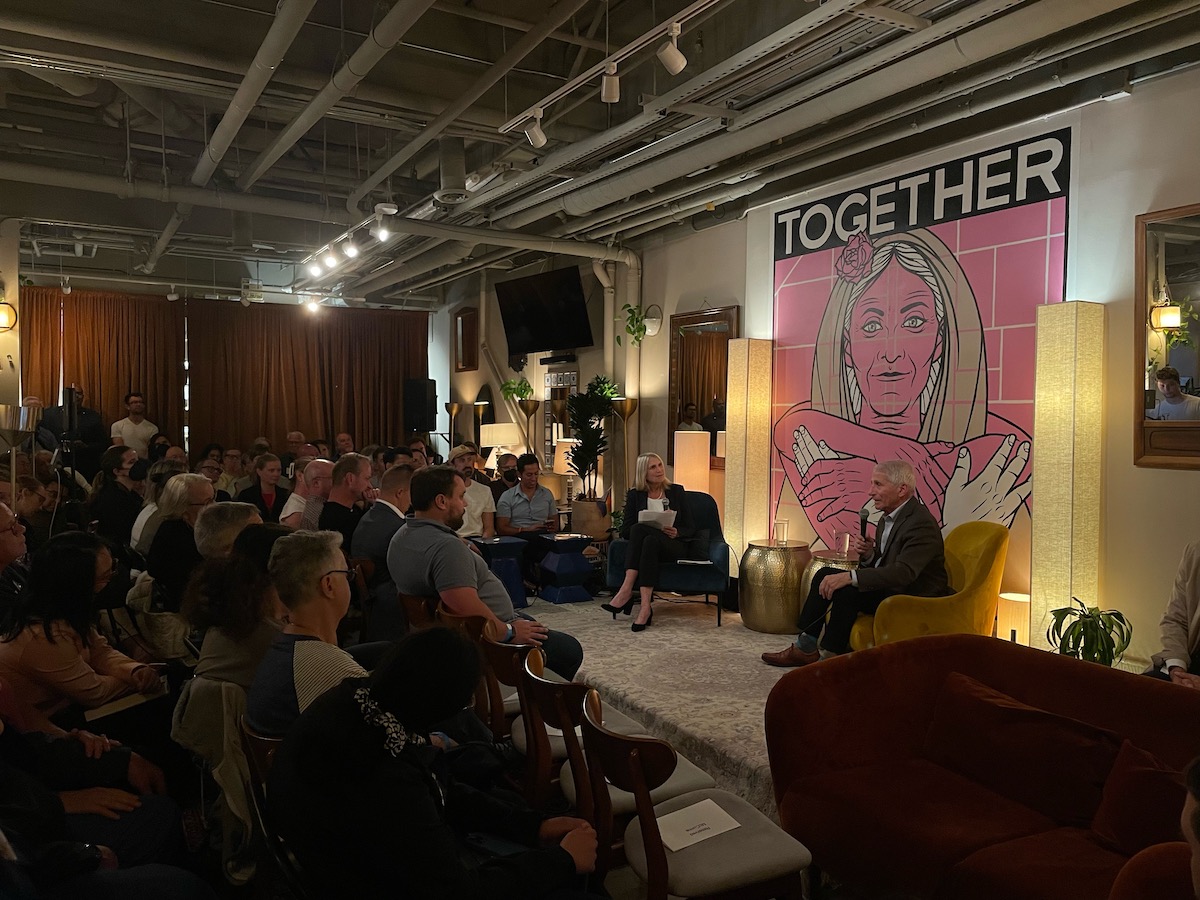
When University of California, San Francisco’s, Dr. Diane Havlir and presidential medical advisor Dr. Anthony Fauci sat down at Manny’s on Tuesday for a conversation, it was the meeting of two of the country’s most important figures in HIV research and treatment.
Though many know Fauci and Havlir for their Covid-19 work — Fauci for his role in the U.S. response to the 2020 pandemic under the Trump administration, and Havlir for her groundbreaking work in low-barrier community testing in San Francisco — it was their experiences with the HIV epidemic that prepared them for the covid pandemic.
That is where Havlir began her conversation with Fauci: A recounting of one of her favorite emails of her career, telling Fauci in 2010 that San Francisco would begin offering treatment to HIV patients upon diagnosis. It was a direct challenge to the convention of the time — waiting until a patient’s immunity had dropped significantly to begin administering HIV drugs — but Havlir and her colleagues found the side effects waiting meant to avoid were outweighed by the virus’s damage to a patient’s body.
Havlir said Fauci’s response was simple: “‘That’s a bold move, Diane.’” Treatment upon diagnosis is now the standard in HIV care. Havlir said Fauci’s support of San Francisco’s work in AIDS, and later covid, has given him a “special and revered place” in the city.
Fauci’s work in HIV/AIDS began in the ’80s. He was working at the National Institutes of Health when he learned of young, previously healthy gay men developing infections that typically occurred in immunocompromised people. “I got goosebumps,” Fauci said. “I said, ‘Oh my God, this is a brand-new disease.’”
Havlir, too, read those reports. At the time, Havlir was a medical student at Duke University, and reading the news made her call the U.S. Centers of Disease Control and Prevention, where she spent the summer taking calls from New York and San Francisco about outbreaks of the new infectious disease.
Fauci was further along in his career, and had already made a name for himself developing novel, successful treatments for vasculitis, a serious inflammation of the blood vessels. Against the advice of his mentors, he left it all behind to focus on the disease that later became known as AIDS. It was, Fauci told Havlir, “the best thing I ever did in my life.” But the first few years were “dark,” he said, with many of his patients dying, a stark contrast to his years of success in treating vasculitis patients, he said and writes in his new memoir, “On Call: A Doctor’s Journey in Public Service,” which he was in town to promote.
Havlir called Fauci’s move to engage community members one of his “underappreciated contributions” to public health, to cheers from the audience. Clinical trials for AIDS drugs were initially rigid and exclusive, Fauci said, but when activists demanded to be included in public-health conversations, he listened: “For them to be acting that way, they had to have some basis for that: Pain, fear, suffering.”
San Francisco played a special role in that change.
Fauci recounted his 1989 visit with activist Marty Delaney (“the intellectual, cerebral version of the confrontative firebrand of Larry Kramer”) in San Francisco. Delaney urged Fauci to publicly throw his support behind “parallel track.” Normally, clinical trials rigidly adhere to control groups unaware of whether they are getting the drug or a placebo. But many very sick gay men with no hope could not participate. They needed help faster, and parallel track referred to the administration of HIV drugs with informed consent to patients who could not participate in clinical trials.
Delaney asked Fauci to endorse this at a town hall planned for the next day. That was unlikely, Fauci said, and told Delaney the Food and Drug Administration would “go off the wall” if he did. But he kept listening to Delaney.
When he was to speak at the town hall, he was prepared to give “a medical speech.”
“Just as I was going out, Marty grabbed me and he says, ‘Tony, do it.’ So I went out and I looked at the audience and I put down my speech, and I came out forcefully for a parallel track.”
“Little did I know that Marty seeded the audience with five reporters,” Fauci said. His support of parallel track made front-page news; and one of his lab members warned him that he was “in trouble,” but he credits then George H.W. Bush for acting reasonably. He, too, listened, and the program was adopted by the FDA.
“It shows you that you can be a conservative Republican and still be a really good guy,” said Fauci.
Reflecting on the U.S. response to covid, Fauci lauded the decades-prior investment into HIV research that led to the breakthrough mRNA vaccines, which he called a “beautiful story of the lack of anticipation of what basic research does.” As for what we can do better next time, Fauci said public health decisions like masking and getting vaccinated should “never be a political issue.”
To young people working hard toward careers in medicine or public health, Fauci said to worry less, adding that he would tell his younger self to “chill” — to laughter from the audience.
Attendees were moved by Fauci’s dedication to community and public service.
Felicia Lipansky said Fauci’s decades-long perspective, ability to “synthesize his learnings for continued improvement in public health,” and community focus are “very powerful.” Holly Uber added it was “really powerful” to hear Fauci’s reflection on pivoting from successful vasculitis work to initially less-successful work on AIDS.
Rose said the event “underlines the magnitude that one person’s work can have when they’re very committed to public service.” A first-generation college student who has experienced a rare disease, and who is considering a career pivot to medicine, Rose said hearing Fauci’s advice to young people “opens up that possibility even more,” adding: “I think I’m literally going to become a doctor.”

My mind is sort of blown away every time I hear about the RWNJs, MAGAtards and the generally uneducated conservatives that vilify this man.
I agree with L’UrbanistaSF…..if Trump would have simply introduced Dr. Fauci –“Here’s an expert for you” –instead of trying to be smarter than him (or even wore a mask at times) sure Covid would have affected lives but not in the numbers it did
It’s time to rename Columbus Ave. to Fauci Blvd.
Dr Fauci acted courageously at a time when much of the US had turned it back on people with AIDS (as it was then called). San Francisco owes him a great debt.