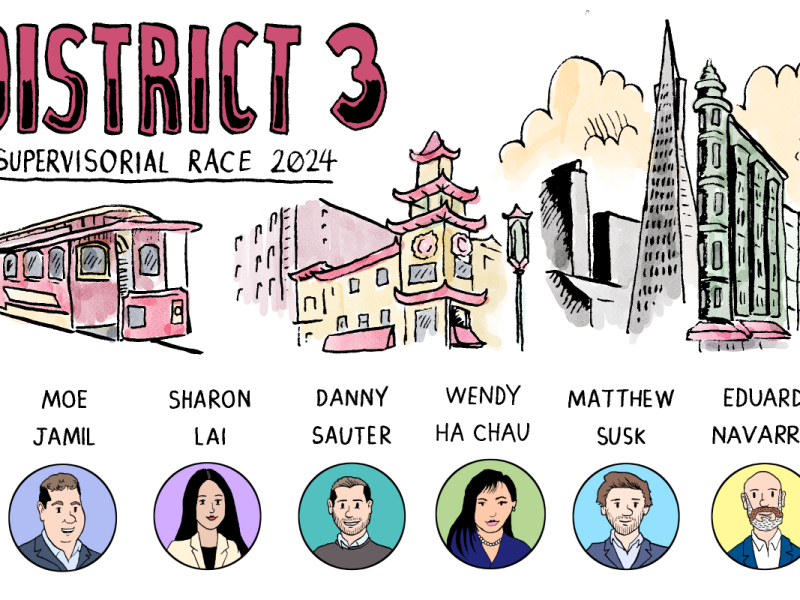

Mission Local’s Q&A series with District 3 candidates is entering its 15th week, so we are taking a break to sum up what has been said over the past three months. At present, they diverge very little on the most contentious issues citywide.
All six candidates want more police and a slight increase in housing.
By 2031, San Francisco is required by the state to plan for 82,000 homes, of which 46,000 would be affordable. That plan for more housing has met resistance in District 3, and appears likely to meet more, no matter who wins this race.
The northeast corner of San Francisco, Districts 3 and 6, are already considered the densest part of the city. Or, as the District 3 supervisor and Board of Supervisors President Aaron Peskin put it earlier this month, “We have a lot less opportunity sites than there are in other parts of the city.”
Similarly, all six candidates oppose major housing projects in District 3, or at least a large portion of it.
Candidates Moe Jamil and Sharon Lai, both endorsed by Peskin, each said during a May 8 debate that the 82,000 units goal “was set up to fail,” or “should be pushed back on.”
Jamil’s stance on housing is more about protecting and preserving existing housing. If District 3 does need to contribute to meet the city’s housing goal, he said, it needs to be done while incorporating community input and within the existing height limits, he said.
In a recent opinion piece, Jamil coined a new label that is different from NIMBY or YIMBY: SHIMBY, or Sensible Housing in My Backyard. “YIMBYs are demonizing San Francisco residents and small businesses with labels like NIMBY,” he wrote.
Similarly, Lai argued in the May 8 debate that the California Department of Housing and Community Development, in setting the goal of 82,000 housing units, didn’t give sufficient credit to all the housing projects already in the pipeline in San Francisco. “I don’t know that we should be relaxing our pursuit to try to get to a more reasonable number,” she said. “Frankly, that’s a position that the Planning Department even held, and I believe the mayor also held.”
Lai believes San Francisco needs more housing, particularly affordable housing. Growth, however, needs to be thoughtfully managed without damaging neighborhood vibrancy and causing gentrification, she said.
Among other candidates, JConr B. Ortega and Eduard Navarro suggested both building housing and protecting current residents. Navarro claimed that his background in architecture could enable him to “integrate 82,000 homes into our city without them even being noticeable.”
Danny Sauter and Matthew Susk are the two District 3 candidates most in favor of new development. But, even for them, building housing comes with a caveat: Prioritizing downtown or the Fisherman’s Wharf area. “We’ve got to reshape downtown. It’s not going to look the same. It’s got to have more housing. Absolutely,” Sauter said during the May 8 debate.
Susk suggested “strategically increasing housing units,” while Sauter wanted to make it easier to quickly build all types of housing, and advocated for a “special-use district” that would be restricted from zoning regulation for senior and familyhousing.
Despite his advocacy for housing at all income levels, Sauter, who’s backed by moderate-leaning politicos such as pro-housing devotee Sen. Scott Wiener, didn’t omit the needs of existing District 3 residents. “I’m dedicated to building more housing and strengthening protections for tenants and existing residents,” he said. He stands somewhat apart from the YIMBY pack in his caution around mass development in that regard.
In March, Peskin, who is running for mayor in November, sponsored housing legislation that would limit the development in some historic District 3 areas. The bill was later vetoed by Mayor London Breed, who’s seeking re-election, but her veto was overturned by a supermajority of the Board of Supervisors, led by Peskin.
Public safety, drug use, street safety and more
In March, 58 percent of District 3 voters voted in favor of Proposition E, which would loosen police rules, and 63 percent voted yes on welfare drug-screening bill Proposition F. Those were wider margins than the citywide numbers of 54 percent in favor of Prop. E and 58 percent in favor of Prop. F.
That is also reflected in the candidates, or at least in their messages to voters.
Three of the six candidates, Lai, Sauter and Susk, listed public safety as their No. 1 issue in this election.
Lai, however, appears interested in a different approach than Propositions E and F promised.
She was the sole no vote on Prop. E among the contenders, and said that she was concerned that passing the reforms as a ballot measure could have “unintended consequences,” and make it “extremely difficult” to change later, as it may require a decision by voters again.
The other five candidates voted to support Prop. E, seeing it “as another pathway to strengthening our public safety departments.” Moreover, Ortega said that the Police Commission, which oversees the department and is expected to lead the city’s police reform, “prevents the San Francisco Police Department from doing its job to keep our community safe.”
Lai, along with Sauter, also voted against Prop. F. The ballot measure might “displace more people from their stability and housing,” said Lai, and it might add another burden for people “busy trying to get better” by creating more bureaucracy. Similarly, Sauter said he feared Prop. F “might actually result in more people pushed onto the streets,” because “details of how the program will work are scarce.”
Nonetheless, the other four candidates voted to support Prop. F in March, generally seeing it as “a small step in the right direction.”
Once again, Sauter’s position on Prop. F differed from many in San Francisco’s moderate camp, who were wildly in favor of it.
All candidates opposed the controversial sober-living facility in District 3, on the edge of Chinatown and North Beach, which Breed proposed and shelved in February. They said it was an example of failed community engagement.
Five candidates support the concept of sober living facilities, with Susk being an exception. “The city has not proved it’s capable of operating these facilities effectively,” said Susk, who argued that the city should hold nonprofits accountable for effectiveness.
District 3 has a large concentration of high-injury streets. While most candidates envision a future where streets are safer for all, Navarro explicitly called for “a pedestrian-first urban landscape” by broadening pedestrian areas, improving sidewalks and enhancing crossings. “We must keep car accessibility throughout our city, but together, let’s make our streets a testament to our priority: people,” he said.