

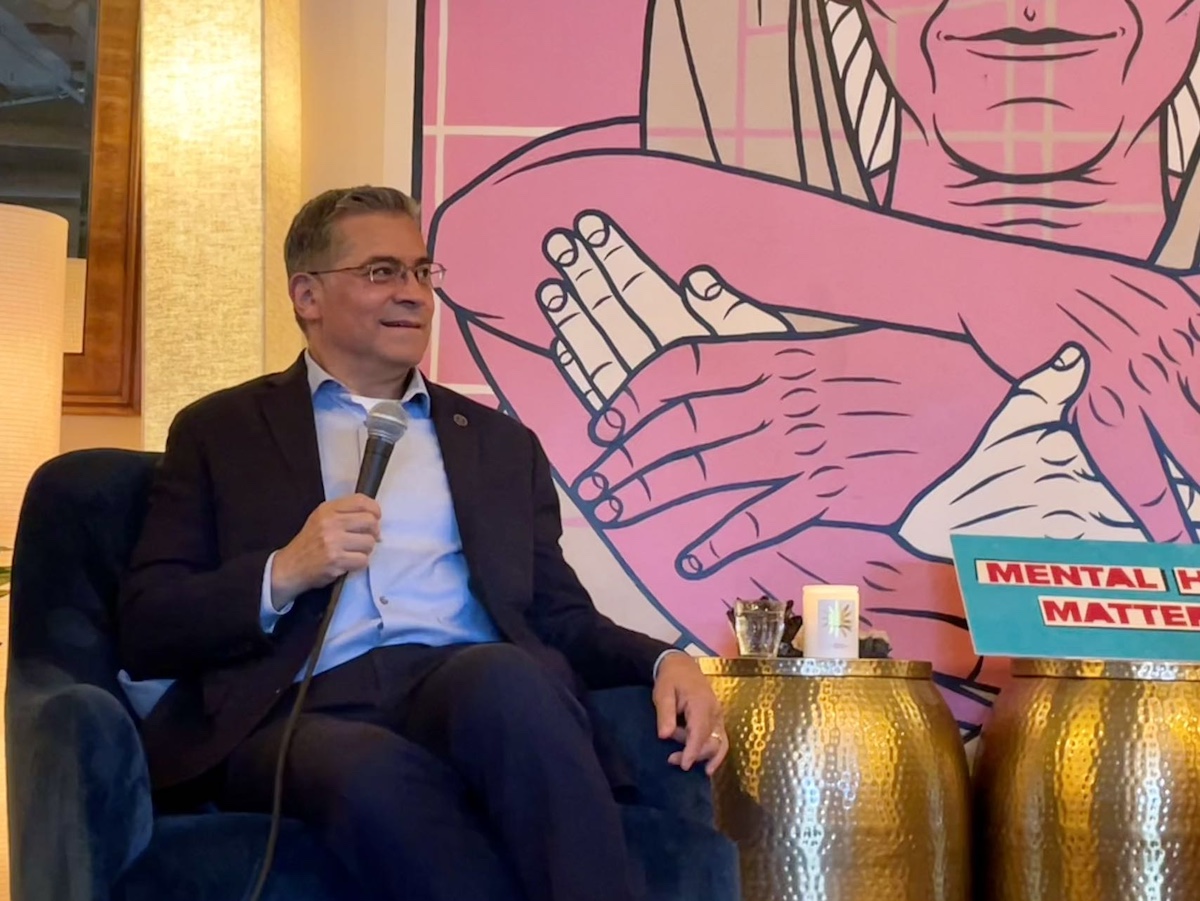

Xavier Becerra, secretary of the U.S. Department of Health and Human Services, told a Mission audience on Tuesday night that the federal health agency needed one thing above all else to better help cities like San Francisco with local health problems.
“More than money,” he said, the federal government needs the legal “authority” to resolve healthcare issues.
“We need the rules that allow us to do more, whether it’s on alcohol or whether it is on fentanyl or whether it’s on tobacco. We don’t have the authority that you think we have,” said the 66-year-old son of immigrants and former attorney general of California, speaking at an event at Manny’s on 16th and Valencia streets.
Now one of the nation’s top healthcare leaders, Becerra spoke to a full house of supporters, doctors, nurses and other healthcare practitioners. He laid out his perspective on the industry and, most important, the constraints he face. “We can only do so much on the federal level,” he said.
After being asked by multiple members of the audience for solutions to issues on a local level, Becerra said the city had unrealistic expectations of his department’s powers after the Covid-19 pandemic.
“You got spoiled by Covid,” because of all the free vaccines, masks and Paxlovid brought in by the federal government, he said, ignoring the months early in the pandemic when tests, masks and remedies were scarce. “We made it possible. [But] that’s the power of the federal government under certain conditions,” he said.
Becerra recalled that when he was sworn in, in mid-March 2021, his department was trying to get 330 million people of diverse views to recognize that they had a social responsibility to vax up and to mask up. He did a video in a mall in the middle of the day, and “there’s hardly a soul in sight,” he said.
He proudly announced that the number of Covid-19 vaccine shots is approaching 700 million. “Man, we’re swimming against the tide now on social media,” he said, referring to all the misinformation about the vaccine.
“Social media really showed how it could be a detriment to society,” he said. “I mean, why would you drink bleach to try to save yourself from covid?”
Bacerra’s stop in the Mission was, perhaps, a prelude to a gubernatorial run: Becerra is considering leaving the Biden cabinet to run for California governor in 2026, as reported by Politico. One audience member yelled “We miss you!” and another added, hopefully: “Governor!”
Becerra, who also represented downtown Los Angeles in Congress for 24 years, added that he missed the freedom that came from his elected office as attorney general.
“I do miss being AG,” he said, because as a constitutional officer, “once you get elected and you get your budget, you’re your own boss, and you do whatever you want. And as much as I’m the secretary of the department … I still have to wait ’til I hear from the White House on a number of things.”
The Department of Health and Human Services now controls a budget of $1.8 trillion and 90,000 employees, according to Becerra, the first Latino to hold this position.
During the pandemic, the country took unprecedented national measures, meaning Becerra’s department could require states to turn over covid data as a condition of sending vaccines and the treatment. “Today, we can’t do that. We have to beg them” for other data, he said when asked about HHS’s solution to the fentanyl crisis, emphasizing that HHS doesn’t have overriding authority on a national level to deal with fentanyl.
“Greater response is a single-payer system of healthcare, where we don’t have a system that’s so disoriented and dismantled” and where drug users could simply cross the state line to stay away from a great program on fentanyl, he said.
The federal government, though supporting efforts on fentanyl, doesn’t administer any drug-addiction programs. The states do. “Up until this administration, until we came in — I came in — the federal laws didn’t allow us to use fentanyl strips,” a test that reveals the presence of fentanyl within other drugs. “You could not use a federal dollar to purchase a fentanyl strip to help someone avoid OD,” said Becerra.
“Healthcare is not in the Constitution. The result is that we do healthcare 50 different ways,” he said. “That’s why today, a third of all women live in reproductive healthcare deserts, because we don’t have a national system of public health.”
The federal government gets involved in healthcare through Medicare, Medicaid, the Affordable Care Act and the Children’s Health Insurance Program; in exchange for taking the money, the states listen to what the federal government wants. “If you’re going to take Medicare money, somebody shows up in your E.R., you cannot turn them away,” Becerra said.
It’s similar with the mental illnesses that people, especially unhoused people on the streets, experience. Treatment is uneven, depending on what each state wants to do. California “is willing to put out more resources than most states,” he said.
Becerra is also the chair of the Federal Interagency Council on Homelessness, an agency tasked by the president to help state and local governments address homelessness issues. It tries to be smart and flexible about the money it gives, and remove more “unnecessary hurdles” at the administrative level, including varying definitions of homeless, Becerra said.
After leading the country out of the pandemic, HHS has taken “the biggest cuts” in its budget among all departments. Partly as a result, the department has less money for Project NextGen, a plan to prepare for medical countermeasures to address future pandemics and biological threats, which started off at $60 to $80 billion and now has to live with $5 billion.
The project works with researchers in the private sector to come up with candidate vaccines. The reason the country was able to get the covid vaccine so quickly wasn’t because some scientists, all of a sudden, brilliantly discovered how to come up with a formulation for a vaccine. “Because, for the last more than a decade, we’ve been working on, essentially, very similar viruses and how we would attack them. So, we were pretty much ready for covid,” he said.
With a pared-down Project NextGen, if another unfamiliar virus materializes and the candidate vaccines fail to hit, “then we’re back to empty national malls and folks dying at rates that we don’t want to talk about,” he said.
Along the same lines, HHS is also working on the Cancer Moonshot, a project that aims to reduce cancer by 50 percent by 2047. The federal government acts as an angel investor in good ideas, funding basic research. “There’s so many ideas percolating that aren’t getting resourced because they’re longer shots,” said Becerra.
HHS is also working on creating a healthcare system that focuses more on primary care instead of specialty care. Currently, most medical school applicants go into specialty services. “It’s unfortunate, because a family doc is the most important physician you’re going to encounter,” said Becerra, “They’re the gatekeepers.”
Also, the department is directing most of their resources towards behavioral health and early childhood health. “It’s kind of sad when suicide is now the second leading cause of death for 10 to 14,” said Becerra, who was seated next to a “Mental Health Matters” sign on the stage.
In an ideal world, the healthcare system “should not be commoditized,” and “no one is outside of the healthcare system,” he said. “If we had commoditized mail, rural America would have never been able to get any mail … There’s no money to be made there.”
He laments the current situation, in which insurance companies, as a middleman, get to make decisions about whether patients get the treatment they need. “I’ve been saying that’s not the best way to do it for a long time,” he said.
A son of immigrants, Becerra said his parents came to the United States from Mexico with only $12 in their pocket. At the age of 66, he said he’s optimistic about the future.
“I’m optimistic, because immigrants keep coming, and they are the vitality that strengthens the American fabric, because they’ve gone through the toughest times,” he said to loud applause.
So we were “spoiled” when the Federal government was uncharacteristically responsive to a health crisis with little more than aspirin and band aids?
“You got spoiled by Covid”
He seems like a nice person.
Yeah, this guy has done so well as HHS Secretary so naturally he should run for Governor of California….
He makes some good points on primary care and the need for the federal government to take authority on several healthcare matters.
His choice of words a bit unfortunate and not the best for retail politics.
Would like to hear more about how he would address San Francisco and California problems.
California “Is willing to put out more resources than most states”. Yeah, that is true, California has spent 24 billion dollars in the last five yers and the vagrancy and “homelessness” has gotten even worse, despite spending all that money. Maybe money is not the problem? Maybe efficiency and accountability is more important. We know government is full of crooks. Why let then enrich themselves and their friends, while increasing and not actually ending, the growing misery?
Oh Wilma, you will never be happy.
Hmm, I thought I was supportive of Xavier Becerra in general, but after reading this article and all the sad excuses contained herein, I will definitely be revisiting my prior assumptions.
“We need the rules that allow us to do more, whether it’s on alcohol or whether it is on fentanyl or whether it’s on tobacco.”
— One of these things is not like the others. I’d like to see some clarification on exactly what “more” he wants to do.
I took that to mean he wished the Fed Govt could do more to help those addicted to these things. What do you think he will call for new prohibition on white wine? LOL