





Updated March 15, at 5 p.m. Originally published March 5 at 6 a.m. Results will be updated as they become available from the Department of Elections.
Props | DCCC | Assembly | Superior Court | Analysis | Live updates
The last of the ballots — 4,052 to be precise — were released Friday. Final turnout stands at 233,279 out of 500,856 voters, or 46.58 percent. All that remains is for the vote to be certified.
Propositions
- Proposition A, the $300 million affordable housing bond, was winning with 70.4 percent yes to 29.6 percent no.
- Proposition B, the police-staffing measure opposed by Breed, was losing with 72.4 percent no to 27.6 percent yes.
- Proposition C, eliminating transfer taxes on office to housing conversions, was winning with 52.8 percent yes to 47.2 percent no.
- Proposition D, bolstering ethics laws, was winning with 89.2 percent yes to 10.8 percent no.
- Proposition E, allowing more police car chases and surveillance, was winning with 54.1 percent to 45.9 percent.
- Proposition F, mandating drug screening of welfare recipients, was winning with 58.1 percent yes to 41.9 percent no.
- Proposition G, urging the school district to teach algebra in eighth grade, was winning with 81.8 yes percent to 18.2 percent no.
Data from the San Francisco Department of Elections. Updated March 15, 4 p.m.
Democratic County Central Committee
- San Francisco Democrats for Change, the oppositional slate, was winning with 18 seats out of 24.
- Labor and Working Families, the progressive slate, was losing with six seats out of 24.
Data from the San Francisco Department of Elections. Updated March 15, 4 p.m.
State Assembly
- Catherine Stefani, District 2 supervisor, will advance to November’s State Assembly general election to replace termed-out Assemblymember Phil Ting, with 59.4 percent of the vote.
- David Lee, the community college administrator, will also advance, with 28.2 percent of the vote.
Data from the San Francisco Department of Elections. Updated March 15, 4 p.m.
Superior Court
- Michael Begert, the incumbent, was winning with 61.6 percent. His opponent, Albert “Chip” Zecher, held 38.4 percent.
- Patrick Thompson, another incumbent, was winning with 55.5 percent. His opponent, Jean Roland, held 44.5 percent.
Data from the San Francisco Department of Elections. Updated March 15, 4 p.m.
Analysis
Tuesday, March 5, 8:45 p.m. — Ballots drop, giving a big early lead to the Mod Squad
The conventional wisdom regarding low-turnout local elections is that they favor older, whiter, more conservative homeowners. At the same time, they also lend themselves to volatility and erratic outcomes; something as incongruous as 500 bike messengers voting in a bloc could swing a race.
This is, indeed, a low-turnout election. The first tranche of ballots dropped moments ago, and it was only 16.6 percent of the electorate — some 83,190 votes. It’s not yet clear how many more ballots remain, but it’s not going to be vast numbers; at the end of the day, the young poll worker at my neighborhood garage seemed to have gotten most of the way through the novel she was reading when I said hello in the morning.
It would be a stretch to make grand and binding statements about the hearts and minds of San Franciscans based upon the early results of a low-turnout election. In eight months’ time, vastly more city residents will go to the polls; it will be a wholly different electorate.
And yet, we can begin to see what worked in this election and what did not. And, if these results hold up, the city’s moderate power structure has, at last, found a way to crack the Democratic County Central Committee and take control of the local party.
The “Democrats for Change” currently hold all 14 top spots in Assembly District 17, and nine of the top 10 in AD 19. Of the “Labor & Working Families” slate, only Connie Chan would finish in the money if the race were called now.
Backers of the “Democrats for Change” slate had told me they hoped to win 10 seats on the DCCC. Right now, they’re at 23 out of 24.
Yes, early vote-by-mail ballots tend to lean heavily conservative — and 3,000-odd votes separate those toward the top of the pack from those hovering well out of contention — but this is an extremely strong showing from the moderate slate. Notably, with tonight’s likely low overall turnout, there may not be a late leftward shift of the sort seen in past San Francisco elections. Voters stayed home, and the young lady working the polls finished her novel. Even 500 bike messengers might not be able to make a dent in this one.
In 2016, the city’s progressives were vastly outspent and ran a slate of well-known current and former local politicians for DCCC — and won handily. In 2020, the same situation unfolded, and the city’s lefties did even better. But, this year, the script has been flipped. At least, so far.
The “why” is not yet clear. Vastly outspending your opponent by perhaps a 5:1 margin doesn’t hurt, but past moderate slates were lavishly backed by tech money and old money and outspent opponents prodigiously — and failed dramatically. After years of San Francisco, deservingly or not, being reduced in the national and local eye to Doom Loop City, the message of “change” appears to have resonated. These candidates talked about issues like the fentanyl scourge and crime and safety and other matters that are relevant to San Franciscans now. While the campaign material was reductive, it at least appears to have jibed with what’s on voters’ minds now. To paraphrase a line from “The Big Lebowski,” Say what you will, but it is an ethos.
On the contrary, as we’ve written before, it’s not so much that progressive ideas aren’t resonating with the voting public — it’s that progressives don’t seem to have any ideas right now. It’s not clear how they’d handle the drug crisis or homelessness or patch up the Giants’ starting rotation. The pitch to voters for the Labor & Working Families slate appeared to begin and end with the fact that the opponents were subsidized by tech billionaires.
That’s factually accurate. But that and a dollar gets you a cup of coffee. “Look at who’s donating to those guys,” once again, has not worked out as a viable electioneering strategy.
The push — funded by those same billionaires — to oust two sitting judges has gone far less swimmingly. Judge Michael Begert is sitting at 59 percent of the vote over Chip Zecher, and Judge Patrick Thompson is holding a far less commanding 52-48 lead over Jean Roland. The slash-and-burn approach that has, thus far, worked wonders in the DCCC race did not seem to take hold here.
The dichotomy is jarring. Perhaps vastly asymmetric spending works more in a contest with zero press.
Mayor London Breed’s ballot measures C, E and F are, as anticipated, all comfortably ahead. Proposition B, the bête noire of the mayor and Supervisor Matt Dorsey, is failing by a 2-to-1 margin.
Many political players on all sides of San Francisco’s political spectrum told me that they feared that people, driven by the polls to vote for giving police more power (Prop. E) and subjecting welfare recipients to drug screening (Prop. F), would be loath to generously approve a $300 million housing bond. Even mayoral allies bemoaned that London Breed was not just neglecting her housing bond, but undermining it (Mission Local’s Xueer Lu says the mayor dropped by at the Proposition A party tonight … for five minutes).
And yet, Proposition A is holding on by a slim margin.
It requires 66.67 percent to pass. It has 67.71. We need the extra decimal place here.
Ballot drops throughout Tuesday only marginally changed the initial outcomes. The next tranche of votes will be tabulated at 4 p.m. on Wednesday. Once more unto the breach, dear friends, once more.
—Joe Eskenazi
Monday, March 4 — No matter the outcome, this election was all about the Benjamins
As of Monday morning, the Department of Elections reports that only about 17 percent of outstanding ballots had trickled back to City Hall in advance of Tuesday’s primary. It has never been easier for San Franciscans to vote but the vast majority of us haven’t done so yet, and probably won’t: 50 percent turnout seems a wild dream. A shade over 40 percent is a more tenable goal, but even that’s optimistic.
Elections are complicated and discerning the will of the electorate even more so — but this much isn’t: Elections professionals say Californians’ apathy this election season is due to “organic reasons.” As in: A snoozer ballot.
San Francisco’s March 5 election “will have all the impact of a fart in the wind,” says veteran campaign strategist Jim Ross. “And people will move on to the next crisis in San Francisco.”
Well, perhaps so. But the impact of Tuesday’s election may hinge far less on what it decided than how it was decided. Thanks to Mission Local’s handy dandy election dashboard, we can track the dollars going into every ballot proposition or candidate race. And there are a lot of them — it’s a soft-money Saturnalia.
There has always been money in San Francisco politics, but things have gotten to the point that billionaire investors are dropping hundreds of thousands of dollars a pop on donations into municipal judge races. All told, more than $11 million has poured into this mid-year local election, with much of it emanating from the cadre of extremely wealthy donors deploying their money via the matryoshka of interconnected organizations that have dominated the last few election cycles.
In today’s column, we’ll examine some of the dynamics of Tuesday’s election and discuss some of the burning issues our data team will analyze.
But we’ll put the No. 1-with-a-bullet outcome right here at the top — and this holds true regardless of who or what wins: The stunning flow of money into a lowly midterm San Francisco election portends truly leviathan amounts of cash inundating the crowded and high-turnout November presidential election. If a baseball analogy helps, here you go: When your journeyman utility infielder gets an $11 million contract, your star slugger can expect one exponentially higher.
Wealthy backers lavishly funding a player in the political game is a move as old as politics itself. But today’s next-level spending, on races up-ballot and down-ballot and heretofore largely apolitical, is an attempt at consolidation of power.
It’s not akin to paying a single player or even fielding an entire team. It’s more like buying the league… Read more
—Joe Eskenazi
Live updates
Thursday, March 14, 4 p.m. — 2,579 newly dropped ballots
Another 2,579 ballots were released Thursday, leading to no significant changes in any of the local races or propositions. Overall turnout stands at 229,227 out of 500,856 voters, or 45.8 percent.
There are approximately 3,240 ballots still left to be counted. The next batch of votes is expected to drop on Friday, March 15, 4 p.m.
Propositions
- Proposition A, the $300 million affordable housing bond, was winning with 70.3 percent yes to 29.7 percent no.
- Proposition B, the police-staffing measure opposed by Breed, was losing with 72.4 percent no to 27.6 percent yes.
- Proposition C, eliminating transfer taxes on office to housing conversions, was winning with 52.8 percent yes to 47.2 percent no.
- Proposition D, bolstering ethics laws, was winning with 89.2 percent yes to 10.8 percent no.
- Proposition E, allowing more police car chases and surveillance, was winning with 54.1 percent to 45.9 percent.
- Proposition F, mandating drug screening of welfare recipients, was winning with 58.2 percent yes to 41.8 percent no.
- Proposition G, urging the school district to teach algebra in eighth grade, was winning with 81.8 yes percent to 18.2 percent no.
Democratic County Central Committee
- San Francisco Democrats for Change, the oppositional slate, was winning with 18 seats out of 24.
- Labor and Working Families, the progressive slate, was losing with six seats out of 24.
State Assembly
- Catherine Stefani, District 2 supervisor, will advance to November’s State Assembly general election to replace termed-out Assemblymember Phil Ting, with 59.5 percent of the vote.
- David Lee, the community college administrator, will also advance, with 28.2 percent of the vote.
Superior Court
- Michael Begert, the incumbent, was winning with 61.6 percent. His opponent, Albert “Chip” Zecher, held 38.4 percent.
- Patrick Thompson, another incumbent, was winning with 55.5 percent. His opponent, Jean Roland, held 44.5 percent.
—Will Jarrett
Wednesday, March 13, 4 p.m. — 1,242 newly dropped ballots
The vote count is slowing down; another 1,242 ballots were released Wednesday, leading to no significant changes in any of the local races or propositions. Overall turnout stands at 226,648 out of 500,856 voters, or 45.3 percent.
There are approximately 5,700 ballots still left to be counted. The next batch of votes is expected to drop on Thursday, March 14, 4 p.m.
Propositions
- Proposition A, the $300 million affordable housing bond, was winning with 70.2 percent yes to 29.8 percent no.
- Proposition B, the police-staffing measure opposed by Breed, was losing with 72.5 percent no to 27.5 percent yes.
- Proposition C, eliminating transfer taxes on office to housing conversions, was winning with 52.8 percent yes to 47.2 percent no.
- Proposition D, bolstering ethics laws, was winning with 89.2 percent yes to 10.8 percent no.
- Proposition E, allowing more police car chases and surveillance, was winning with 54.2 percent to 45.8 percent.
- Proposition F, mandating drug screening of welfare recipients, was winning with 58.3 percent yes to 41.7 percent no.
- Proposition G, urging the school district to teach algebra in eighth grade, was winning with 81.8 yes percent to 18.2 percent no.
Democratic County Central Committee
- San Francisco Democrats for Change, the oppositional slate, was winning with 18 seats out of 24.
- Labor and Working Families, the progressive slate, was losing with six seats out of 24.
State Assembly
- Catherine Stefani, District 2 supervisor, will advance to November’s State Assembly general election to replace termed-out Assemblymember Phil Ting, with 59.6 percent of the vote.
- David Lee, the community college administrator, will also advance, with 28.1 percent of the vote.
Superior Court
- Michael Begert, the incumbent, was winning with 61.6 percent. His opponent, Albert “Chip” Zecher, held 38.4 percent.
- Patrick Thompson, another incumbent, was winning with 55.5 percent. His opponent, Jean Roland, held 44.5 percent.
—Will Jarrett
Tuesday, March 12, 4 p.m. — 2,794 newly dropped ballots
The vote count is slowing down; another 2,794 ballots were released Tuesday, leading to no significant changes in any of the local races or propositions. Overall turnout stands at 225,406 out of 500,856 voters, or 45 percent.
There are approximately 6,700 ballots still left to be counted. The next batch of votes is expected to drop on Wednesday, March 13, 4 p.m.
Propositions
- Proposition A, the $300 million affordable housing bond, was winning with 70.1 percent yes to 29.9 percent no.
- Proposition B, the police-staffing measure opposed by Breed, was losing with 72.5 percent no to 27.5 percent yes.
- Proposition C, eliminating transfer taxes on office to housing conversions, was winning with 52.8 percent yes to 47.2 percent no.
- Proposition D, bolstering ethics laws, was winning with 89.2 percent yes to 10.8 percent no.
- Proposition E, allowing more police car chases and surveillance, was winning with 54.3 percent to 45.7 percent.
- Proposition F, mandating drug screening of welfare recipients, was winning with 58.3 percent yes to 41.7 percent no.
- Proposition G, urging the school district to teach algebra in eighth grade, was winning with 81.8 yes percent to 18.2 percent no.
Democratic County Central Committee
- San Francisco Democrats for Change, the oppositional slate, was winning with 18 seats out of 24.
- Labor and Working Families, the progressive slate, was losing with six seats out of 24.
State Assembly
- Catherine Stefani, District 2 supervisor, will advance to November’s State Assembly general election to replace termed-out Assemblymember Phil Ting, with 59.6 percent of the vote.
- David Lee, the community college administrator, will also advance, with 28.1 percent of the vote.
Superior Court
- Michael Begert, the incumbent, was winning with 61.5 percent. His opponent, Albert “Chip” Zecher, held 38.5 percent.
- Patrick Thompson, another incumbent, was winning with 55.5 percent. His opponent, Jean Roland, held 44.5 percent.
—Will Jarrett
Monday, March 11, 4 p.m. — 6,332 newly dropped ballots
The vote count is slowing down; another 6,332 ballots were released Monday, leading to no significant changes in any of the local races or propositions. Overall turnout stands at 222,612 out of 500,856 voters, or 44.45 percent.
There are approximately 9,100 ballots still left to be counted. The next batch of votes is expected to drop on Tuesday, March 12, 4 p.m.
Propositions
- Proposition A, the $300 million affordable housing bond, was winning with 70.1 percent yes to 29.9 percent no.
- Proposition B, the police-staffing measure opposed by Breed, was losing with 72.5 percent no to 27.5 percent yes.
- Proposition C, eliminating transfer taxes on office to housing conversions, was winning with 52.9 percent yes to 47.1 percent no.
- Proposition D, bolstering ethics laws, was winning with 89.2 percent yes to 10.8 percent no.
- Proposition E, allowing more police car chases and surveillance, was winning with 54.3 percent to 45.7 percent.
- Proposition F, mandating drug screening of welfare recipients, was winning with 58.4 percent yes to 41.6 percent no.
- Proposition G, urging the school district to teach algebra in eighth grade, was winning with 81.9 yes percent to 18.1 percent no.
Democratic County Central Committee
- San Francisco Democrats for Change, the oppositional slate, was winning with 18 seats out of 24.
- Labor and Working Families, the progressive slate, was losing with six seats out of 24.
State Assembly
- Catherine Stefani, District 2 supervisor, will advance to November’s State Assembly general election to replace termed-out Assemblymember Phil Ting, with 59.6 percent of the vote.
- David Lee, the community college administrator, will also advance, with 28 percent of the vote.
Superior Court
- Michael Begert, the incumbent, was winning with 61.5 percent. His opponent, Albert “Chip” Zecher, held 38.5 percent.
- Patrick Thompson, another incumbent, was winning with 55.5 percent. His opponent, Jean Roland, held 44.5 percent.
—Will Jarrett
Saturday, March 9, 4 p.m. — 22,898 newly dropped ballots
Another 22,898 votes were released Saturday, leading to no significant changes in any of the local races or propositions. Overall turnout stands at 216,280 out of 500,856 voters, or 43.18 percent.
The Democratic Central County Committee races have been dominated by candidates from the Democrats for Change slate, who are on track to win 18 of 24 available seats. Props C, E, and F are tighter than initial results suggested, but are all set to win 52.9 percent, 54.4 percent, and 58.5 percent in favor respectively.
There are approximately 16,400 ballots still left to be counted. The next batch of votes is expected to drop on Monday, March 11, 4 p.m.
Propositions
- Proposition A, the $300 million affordable housing bond, was winning with 70.1 percent yes to 29.9 percent no.
- Proposition B, the police-staffing measure opposed by Breed, was losing with 72.5 percent no to 27.5 percent yes.
- Proposition C, eliminating transfer taxes on office to housing conversions, was winning with 52.9 percent yes to 47.1 percent no.
- Proposition D, bolstering ethics laws, was winning with 89.3 percent yes to 10.7 percent no.
- Proposition E, allowing more police car chases and surveillance, was winning with 54.4 percent to 45.6 percent.
- Proposition F, mandating drug screening of welfare recipients, was winning with 58.5 percent yes to 41.5 percent no.
- Proposition G, urging the school district to teach algebra in eighth grade, was winning with 81.9 yes percent to 18.1 percent no.
Democratic County Central Committee
- San Francisco Democrats for Change, the oppositional slate, was winning with 18 seats out of 24.
- Labor and Working Families, the progressive slate, was losing with six seats out of 24.
State Assembly
- Catherine Stefani, District 2 supervisor, will advance to November’s State Assembly general election to replace termed-out Assemblymember Phil Ting, with 59.7 percent of the vote.
- David Lee, the community college administrator, will also advance with 27.9 percent of the vote.
Superior Court
- Michael Begert, the incumbent, was winning with 61.6 percent. His opponent, Albert “Chip” Zecher, held 38.4 percent.
- Patrick Thompson, another incumbent, was winning with 55.5 percent. His opponent, Jean Roland, held 44.5 percent.
—Will Jarrett
Friday, March 8, 4 p.m. — 61,291 newly dropped ballots
On Friday, a whopping 61,291 additional ballots were tallied, bringing the total up to 193,382. That is 38.6 percent of registered voters — and with only 37,500 ballots left to be counted, the margin for races to flip is quickly vanishing.
The main changes today were in the Democratic Central County Committee races. In Assembly District 17, Michael Nguyen and Peter Gallotta of the progressive Labor and Working Families slate are now in line to win seats. In Assembly District 19, former District Supervisor Gordon Mar — also a member of the progressive slate — is in line to win a seat as well.
The Democrats for Change slate is still firmly in the lead though, with 18 projected seats versus Labor and Working Families’ six. What is more, the elected officials with votes on the DCCC — such as Sen. Scott Wiener and treasurer Fiona Ma — tend to lean moderate, meaning that the progressive DCCC members are likely to find themselves heavily outvoted on future endorsements.
There is no change in the results of any proposition. Prop. A is now firmly above the 66.67 percent requirement, with 70 percent of voters in favor. Prop. E has lost ground, moving from 58.3 percent in favor to 54.6 percent. Prop. F has followed a similar pattern, moving from 61.6 in favor to 58.6. Although the races will be tighter than originally anticipated, the results are unlikely to shift.
The latest batch of votes was slightly favorable to both incumbent Superior Court judges, who are still winning against their tough-on-crime challengers, by a margin of 20 points for Begert and 8 points for Thompson.
The next batch of 37,500 votes is expected to drop on Saturday, March 9, 4 p.m.
Propositions
- Proposition A, the $300 million affordable housing bond, was winning with 70 percent yes to 30 percent no.
- Proposition B, the police-staffing measure opposed by Breed, was losing with 72.3 percent no to 27.7 percent yes.
- Proposition C, eliminating transfer taxes on office to housing conversions, was winning with 52.7 percent yes to 47.3 percent no.
- Proposition D, bolstering ethics laws, was winning with 89.2 percent yes to 10.8 percent no.
- Proposition E, allowing more police car chases and surveillance, was winning with 54.6 percent to 45.4 percent.
- Proposition F, mandating drug screening of welfare recipients, was winning with 58.6 percent yes to 41.4 percent no.
- Proposition G, urging the school district to teach algebra in eighth grade, was winning with 81.8 yes percent to 18.2 percent no.
Democratic County Central Committee
- San Francisco Democrats for Change, the oppositional slate, was winning with 18 seats out of 24.
- Labor and Working Families, the progressive slate, was losing with six seats out of 24.
State Assembly
- Catherine Stefani, District 2 supervisor, will advance to November’s State Assembly general election to replace termed-out Assemblymember Phil Ting, with 59.5 percent of the vote.
- David Lee, the community college administrator, will also advance with 28 percent of the vote.
Superior Court
- Michael Begert, the incumbent, was winning with 61.6 percent. His opponent, Albert “Chip” Zecher, held 38.4 percent.
- Patrick Thompson, another incumbent, was winning with 55.6 percent. His opponent, Jean Roland, held 44.4 percent.
—Will Jarrett
Thursday, March 7, 4 p.m. — 27,300 newly dropped ballots
Some 27,300 more ballots dropped on Thursday afternoon, taking the total up to 132,091 – or around 26.4 percent of registered voters in the city. But despite the hefty additional voters, the vast majority of results remain unchanged.
There was some movement in the Democratic Central County Committee race, with Peter Ho Lik Lee taking one of ten available seats in Assembly District 17, supplanting Laurance Lem Lee. Both are members of the Democrats for Change slate – and with only a few dozen votes in it, the seats may well switch multiple more times as votes are counted.
Each proposition is in a similar spot now compared to initial results on Tuesday. The passage of Prop. A is looking slightly more secure with 68.5 percent in favor. Prop. B is even further underwater than on Tuesday, with nearly 70 percent against. On props E and F, the no votes made ground by a percentage point or two, but they are still winning comfortably.
The latest batch of votes was slightly favorable to both incumbent Superior Court judges, who are still winning – by a margin of 20 points for Begert and 8 points for Thompson – against their tough-on-crime challengers.
The next batch of votes is expected to drop on Friday, March 8, 4 p.m. Some 98,500 still remain to be counted.
Propositions
- Proposition A, the $300 million affordable housing bond, was winning with 68.5 percent yes to 31.5 percent no.
- Proposition B, the police-staffing measure opposed by Breed, was losing with 69.3 percent no to 30.7 percent yes.
- Proposition C, eliminating transfer taxes on office to housing conversions, was winning with 53.9 percent yes to 46.1 percent no.
- Proposition D, bolstering ethics laws, was winning with 88.6 percent yes to 11.4 percent no.
- Proposition E, allowing more police car chases and surveillance, was winning with 58.3 percent to 41.7 percent.
- Proposition F, mandating drug screening of welfare recipients, was winning with 61.6 percent yes to 38.4 percent no.
- Proposition G, urging the school district to teach algebra in eighth grade, was winning with 83.4 yes percent to 16.6 percent no.
Democratic County Central Committee
- San Francisco Democrats for Change, the oppositional slate, was winning with 21 seats out of 24.
- Labor and Working Families, the progressive slate, was losing with three seats out of 24.
State Assembly
- Catherine Stefani, District 2 supervisor, will advance to November’s State Assembly general election to replace termed-out Assemblymember Phil Ting, with 59 percent of the vote.
- David Lee, the community college administrator, will also advance with 27.2 percent of the vote.
Superior Court
- Michael Begert, the incumbent, was winning with 60 percent. His opponent, Albert “Chip” Zecher, held 40 percent.
- Patrick Thompson, another incumbent, was winning with 53.9 percent. His opponent, Jean Roland, held 46.1 percent.
—Will Jarrett
Wednesday, March 6, 12 p.m. — No new tally today, totals from Tuesday hold
As of Tuesday at 11:45 p.m., voter turnout stood at a shade under 21 percent of San Francisco’s electorate, and results from earlier in the night were almost unchanged.
Progressives were bruised, likely trounced for control of the powerful Democratic Central County Committee and badly losing on two major ballot measures, Propositions E and F, which would loosen police oversight and mandate drug screening and treatment for some welfare recipients.
Proposition A, the affordable housing bond, was a hair’s breadth above the two-thirds approval required for passage. The rest of the measures had comfortable margins.
Both Superior Court judges were likely to retain their seats.
Propositions
- Proposition A, the $300 million affordable housing bond, was winning with 67.74 percent yes to 32.36 percent no.
- Proposition B, the police-staffing measure opposed by Breed, was losing with 67.41 percent no to 32.59 percent yes.
- Proposition C, eliminating transfer taxes on office to housing conversions, was winning with 53.89 percent yes to 46.11 percent no.
- Proposition D, bolstering ethics laws, was winning with 88.03 percent yes to 11.97 percent no.
- Proposition E, allowing more police car chases and surveillance, was winning with 59.9 percent to 40.1 percent.
- Proposition F, mandating drug screening of welfare recipients, was winning with 63.02 percent yes to 36.98 percent no.
- Proposition G, urging the school district to teach algebra in eighth grade, was winning with 83.9 yes percent to 16.1 percent no.
Democratic County Central Committee
- San Francisco Democrats for Change, the oppositional slate, was winning with 21 seats out of 24.
- Labor and Working Families, the progressive slate, was losing with three seats out of 24.
State Assembly
- Catherine Stefani, District 2 supervisor, will advance to November’s State Assembly general election to replace termed-out Assemblymember Phil Ting, with 58.53 of the vote.
- David Lee, the community college administrator, will also advance with 26.73 percent of the vote.
Superior Court
- Michael Begert, the incumbent, was winning with 59.51 percent. His opponent, Albert “Chip” Zecher, held 40.49 percent.
- Patrick Thompson, another incumbent, was winning with 53.37 percent. His opponent, Jean Roland, held 46.63 percent.
—Joe Rivano Barros
Tuesday, March 5, 11:45 p.m. — Final Election Day results show mods’ DCCC victory eroded, but still dominant
The Department of Elections released the last of its updates for tonight, and trends from earlier in the night largely held.
The oppositional Democratic Central County Committee slate — the San Francisco Democrats for Change — still dominated, 21 seats to three; the progressives’ Labor and Working Families Slate had picked up two more seats, Jane Kim and John Avalos, since 8:45 p.m., bringing up its total.
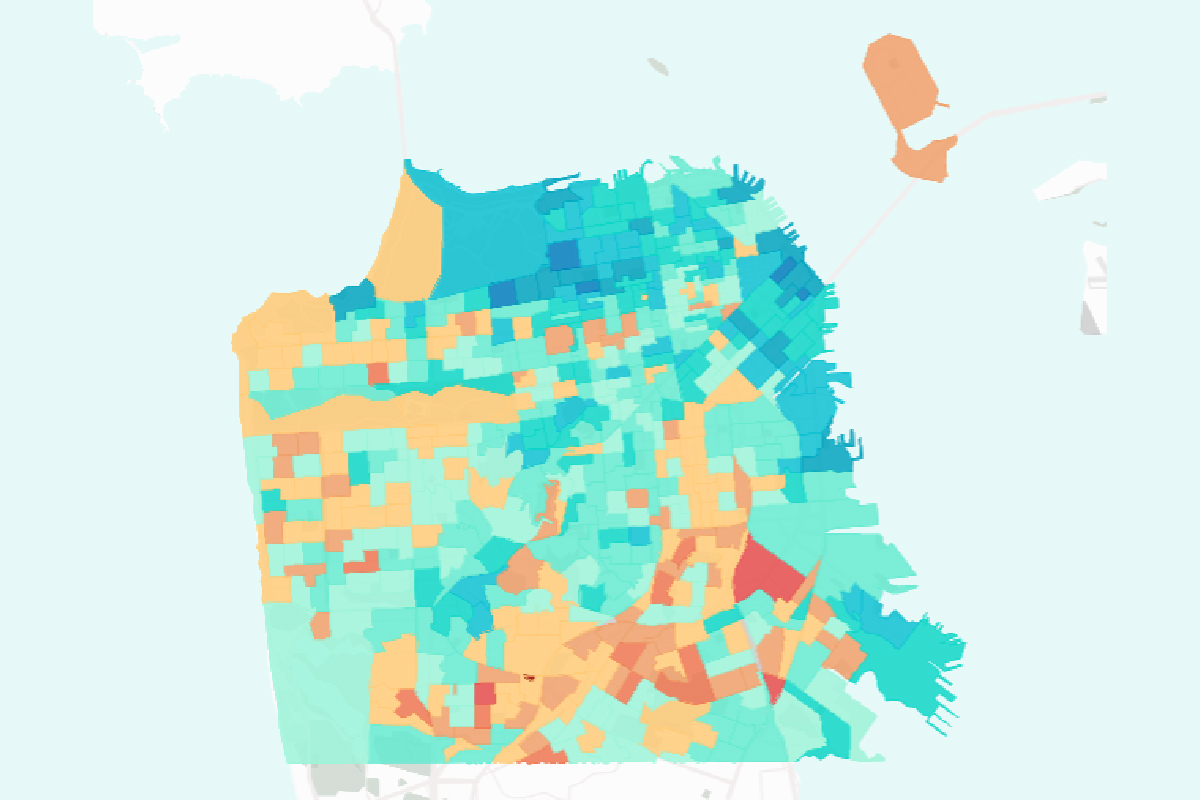
Labor and Working Families had its strongest support in the traditional bulwark for progressives: The Mission and Bernal Heights; parts of the Excelsior and Richmond also voted in favor. The Democrats for Change was popular city-wide, but its top supporters lived in tonier neighborhoods: The Marina, Pac Heights, West of Twin Peaks, Mission Bay and Rincon Hill.
The DCCC outcome could change: Only 104,760 votes have been counted so far, 20.92 percent of the electorate.
The next drop is Wednesday at 4 p.m., and DCCC races are decided by a few hundred votes. That’s about how much separates those at the bottom of the winners’ list from the candidates nipping at their heels. But a lot of those bottom vote-getters would have to ascend quickly for control of the body to remain in progressives’ hands.
Proposition A (the $300 million affordable-housing bond) was also holding, just: It had 67.74 percent of the vote, up from 67.71 at the beginning of the night. It can’t pass if it slips below 66.7 percent.
The outcome of the rest of the measures is clear: Proposition B (police staffing) will be defeated; Proposition C (office transfer tax) is very likely to pass; and Propositions D (ethics), E (police powers), F (drug screening) and G (algebra) will all pass. They all decreased their “yes” votes as the night went on, but only slightly.
E and F were most contested in the Mission and Bernal; both neighborhoods were also least supportive of Prop. G.
The two Superior Court judges, Michael Begert and Patrick Thompson, will all but certainly stay in their seats.
—Joe Rivano Barros
Hayes Valley, 10:40 p.m. — Mods, victorious, call it a night
There is breathing room now at Anina; it appears many supporters have already left, including Mayor London Breed. Perhaps they have taken the results as certain and called it a night, or perhaps they, too, have been informed that the patio closes 10 minutes, which is when the next set of results should come in.
— Kelly Waldron
SoMa, 11 p.m. — Labor and Working Families looks up, barely
When the 10:45 p.m. results dropped, the Labor and Working Families Slate’s watch party was already over, its members joining friends from the Prop. A campaign at Slate Bar. Still, they were excited that two more members, former supervisors Jane Kim and John Avalos, had won their seats.
“Things are definitely shifting. So over the next few days, I expect that things will definitely change,” said campaign consultant Daniel Anderson. “I’m optimistic that we will come out at least on par with the other slate.”
“Honestly, I think it’s anybody’s game. I think we could get as many as 20ish, or as few as five,” he added. “Because if you look at the results, everyone’s bunched together.”
—Yujie Zhou
Mission District, 10:20 p.m. — Proposition A party ends, optimistic for a win
The crowd at Slate Bar started to shrink soon after Supervisor Aaron Peskin spoke, celebrating the passage of Proposition A, the $300 million affordable-housing bond measure.
“Three hundred million is not a lot,” commented Erick Arguello, the council president of Calle 24, who showed up a little after 9 p.m. from the No on Propositions E and F party at Bissap Baobab nearby, and missed Peskin’s speech. “But it’s a good start.”
— Xueer Lu
Hayes Valley, 10 p.m. — Democrats for Change celebration picks up steam
At Anina’s, the candidates seem to have left the caution behind. Now, it’s full steam ahead. “Let’s win,” said Joe Sangirardi, one of the presumed victors, following the second announcement of results.
“You are saving the democratic party from itself,” said District 8 Supervisor Rafael Mandelman. “I never believed this was possible.”
“San Francisco is ready for change,” added Nancy Tung, the second-highest DCCC vote-getter thus far.
The room is buzzing — so much so that you can’t hear the music that is apparently playing.
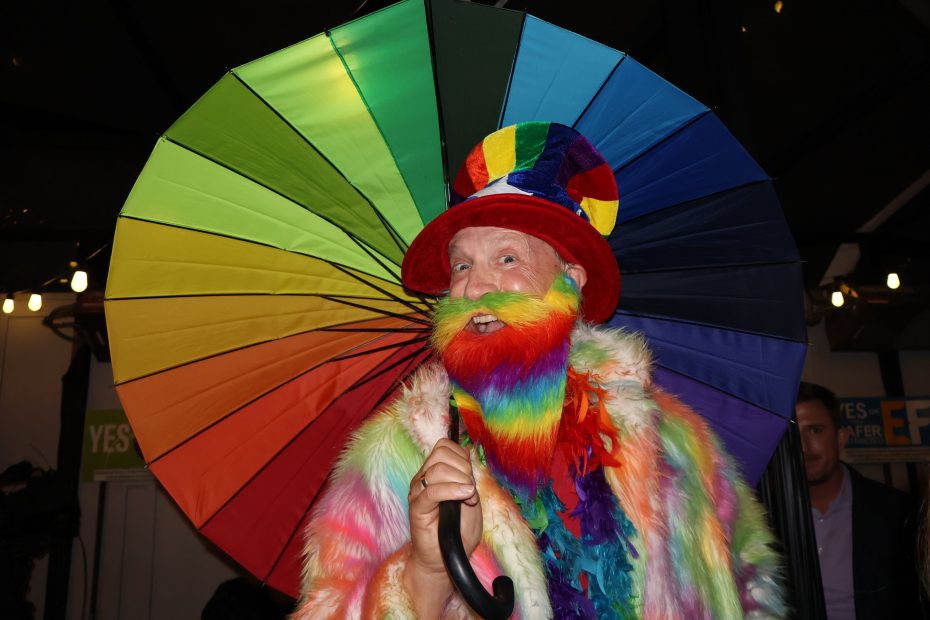
Someone is walking around, taking selfies and wearing rainbow-coloured everything: a tutu, beard, fuzzy coat, platform boots, even an open umbrella. I suppose there is no bad luck in here tonight. He said his name is Gaybraham Lincoln, a satirical character born during the 2022 school-board recall.
For supporters in the room, many say this is the change they want to see in San Francisco. “Change” appears to be the word of the hour.
“What I think is that the SF Dems for Change are the progressive group,” said Barak Gila, a local advocate who has volunteered with YIMBY Action. This is a sign that people recognize that we need a progressive city, he said.
But already, Gila is looking ahead to the next election: “This is just the beginning,” he said. “It’s going to set us up for success.”
—Kelly Waldron
SoMa, 10 p.m. — No words, just a sad song from the Labor and Working Families Slate
The Labor and Working Families Slate didn’t share comments after the second batch of results dropped at 9:45 p.m. The progressives were being tanked.
Instead, they sang a song, “Somewhere over the Rainbow.” Candidate and drag queen Michael Nguyen sang the lead.
—Yujie Zhou
SoMa, 9:30 p.m. — Progressive DCCC candidates look dour
The crowd at the open-air event space adjacent to Costco tried to cheer up.
“These early results might not work great. Progressive voters vote late,” said Peter Gallotta, co-president of the Harvey Milk LGBT Democratic Club, and one of 24 candidates on the Labor and Working Families slate. The slate was losing — badly. It had picked up just one seat out of the 24 it sought, meaning control of the Democratic Central County Committee was in moderates’ hands.
“We feel confident that the results will be moving in our direction,” Gallotta said regardless.
“If anything, I hope it’s a lesson for progressive voters,” said Supervisor Connie Chan, the only Labor and Working Families candidate who had won a seat at that time. “Money definitely has its influence in an election.”
The San Francisco Democrats for Change Slate outspent the Labor and Working Families slate 3-1, possibly 5-1 when counting slate mailers. But Chan also mentioned the nationwide ripple effect caused by former president Donald Trump. “San Francisco is no different,” she said. “We’d like to think we are in a bubble. We are not.”
“This is a movement. We are gonna keep going,” said Natalie Gee, Supervisor Shamann Walton’s chief of staff and a candidate with the Labor and Working Families slate. As of 9:30 p.m., Gee had not won a seat.
—Yujie Zhou
Mission District, 9 p.m. — Thompson and Begert talk like victors
“How do you feel?” asked Patrick Thompson, addressing the crowd at the Dahlia Lounge. “Being at a victory party should feel like victory! You should all feel awesome.”
Indeed, it was an early victory for the two San Francisco Superior Court judges, Michael Begert and Thompson. Both were comfortably leading their races.
Winners’ speeches were given: Begert and Thompson thanked their colleagues — including other judges — and their donors, as well as the Democratic clubs that endorsed them.
The audience cheered and let out an “Awww” every now and then, as the judges shouted out the names of their supporters.
“A lot of us have a sense of who we are,” said Begert, citing his principles of “respecting everyone’s dignity and humanity.” The victory, he said, came down to “how hard I was willing to work to protect those values,” Begert said. “The answer is, ‘pretty hard.’” He paused. “Actually, the answer is ‘pretty fucking hard.’”
The second preliminary report, confirming the victory, dropped as the two judges wrapped up their speeches. “I’m so fucking relieved, man,” a woman in the crowd said.
“Folks can go home and decompress,” said Michelle Tong, a Superior Court judge. “It’s over.”
—Junyao Yang
Early results, 8:45 p.m. — Groans from the No on E and F campaigns
A quiet “Oh no … ” and a collective groan emerged from the crowd as the initial results were projected onto the projector at Bissap Baobab at 8:45 p.m.
Props E and F had strong leads.
Scrolling past the initial results for both — each with well over 60 percent of the votes — Geoffrea Morris went to the DCCC candidates, which showed a series of moderate candidates’ names in green.
“You can see that money is buying our election right now,” she said. But then she took a different tack: Results are still coming in. “We gon’ say, ‘Early voters suck.’”
After a few minutes, organizers tried to rally the crowd. Then, they turned on “I Don’t Fuck With You” by Big Sean and the small crowd began chanting to the beat, “I don’t / give a / fuck.”
—Eleni Balakrishnan
Early results, 8:45 p.m. — Begert celebrates. ‘It’s over.’
One minute past 8:45 p.m., the atmosphere in Dahlia Lounge had not changed dramatically, but crowd members had started taking out their phones. Some were still talking, but snuck a glance or two at the TVs bearing election results.
Then, a few minutes later, faces were glued to blue screens.
Someone passed his phone to Michael Begert — the incumbent judge hoping to keep his seat — followed by claps, applause and high fives.
“That’s right!” Begert said, seeing his vote totals: 58.82 percent to Albert Zecher’s 41.18 percent — a handsome lead.
A few minutes and some scrolling later, “You’re done! You’re done! You’re done!” said San Francisco Superior Court judge Michelle Tong to Begert, excitedly. “It’s over.”
—Junyao Yang

Early results, 8:45 p.m. — Yes on A, and Peskin, cheer
“I think we have a winner!” shouted Supervisor Aaron Peskin at 8:49 p.m., as he saw the first round of results. The crowd cheered fervently.
“I wanna be very candid,” Peskin said. “In my mind, all day long, I could not prepare that it’s gonna be a winner’s speech.”
Peskin then climbed onto a bar stool to get to a vantage point over the crowd.
“This goes to show that, even in tough times, San Franciscans care a whole lot,” Peskin continued. “They care about janitors. They care about working families. They care about women experiencing trauma. They care about affordable housing.” The crowd cheered again as Peskin extended his gratitude to everyone who worked on Prop. A.
“This is a heartening moment to know that San Francisco is still a city that cares, and still the city that knows how,” Peskin said.
—Xueer Lu
Early results, 8:45 p.m. — Democrats for Change (and Yes on C, E and F) victorious
There was quite the crowd at Anina on Hayes Street. A couple hundred people gathered under an outdoor canopy — under the fairy lights, cocktails in hand — in support of the San Francisco Democrats for Change Slate and Propositions C, E and F.
The energy was frantic as organizers sifted through the crowd to set things up. At the last minute, signs were posted and a wobbly “stage” (a table) was removed.
It was so packed that there was barely any space for Mayor London Breed — who had just arrived a little before the 8:45 results deadline — to make her way through the room.
No one had announced the results out loud yet, but there were screams in the crowd and everyone appeared to be checking their phones, including Breed.
The results were loud and clear: The San Francisco Democrats for Change were doing remarkably well.
Steven Buss, the co-founder of GrowSF, which backed the candidates and spent heavily on them, announced the good news to the buzzing crowd. Shortly after, Breed took to the mic herself.
“Proposition E is leading,” she shouted, almost in song, repeating herself for each of her other measures.
So far, so good for those at Anina. For now, it’s grins all around and time for another round of drinks.
“Party, but don’t get ahead of yourselves,” said Buss.
—Kelly Waldron
Tuesday, March 5, 8:45 p.m. — Early results are in, and progressives are having a terrible night
The first batch of votes are in: 17 percent of San Francisco’s electorate has cast a ballot and we have initial standings based on mail-in votes.
Propositions C, D, E, F and G all had comfortable margins in favor; Proposition A was ahead, but barely above the two-thirds threshold required for bonds, while Proposition B was two-thirds against.
Both incumbent judges for San Francisco Superior Court were ahead, though one with just a 4.4 percent lead.
The biggest upset by far: The race for Democratic Central County Committee, which saw an exorbitant campaign — $3 million has been spent thus far — largely fueled by an oppositional slate aiming to wrest control from progressives.
That slate, the San Francisco Democrats for Change had, in early results, taken all of the seats for the eastern half of the city, and nine of the 10 seats in the western half. These are all mail-in votes, however; no in-person votes have yet been tallied, and no ballots that were mailed but had not yet arrived at the Department of Elections.
Results in the DCCC race will likely come down to just a few hundred votes. Still, the Democrats for Change slate was deservedly celebrating.
At Anina in Hayes Valley, at the slate’s official election party, there were screams in the crowd as the results rolled in; even Mayor London Breed was scrolling through her phone.
“We have some early, but very encouraging, results,” said Steven Buss, one of the leaders of GrowSF, which spent handsomely to elect the slate.
“Party, but don’t get ahead of yourselves,” he cautioned.
Breed was generally having a good night so far: Her four measures — Propositions A, C, E and F — were all doing well, as is the moderate slate she favored for DCCC.
Proposition A, the $300 million affordable housing bond placed on the ballot by Breed, had 67.71 percent in favor and 32.29 percent against; it needs 66.66 percent to pass.
Supervisor Aaron Peskin, who has been stumping for the measure and was chiefly responsible for its fundraising, was cheering.
At Slate Bar, where the campaign held its election-night party, Peskin climbed onto a bar stool and began speaking.
“This gets to show that even in tough times, San Franciscans care a whole lot,” Peskin continued. “They care about janitors. They care about working families. They care about women experiencing trauma. They care about affordable housing.”
The crowd cheered as Peskin extended his gratitude to everyone who worked on Proposition A.
Proposition B, the police staffing measure that was initially backed by Breed but then taken over by Supervisor Ahsha Safaí, her mayoral rival, is losing badly: 66.02 percent against and 33.98 in favor. It was opposed not only by Breed’s allies, but also progressives who did not want to fund more police officers.
Proposition C, which would eliminate transfer taxes on offices converted into housing, is ahead 55.44 percent to 44.56 percent. The city controller said it would do little to incentive conversions but would hurt the city’s tax base.
Proposition D, bolstering local ethics laws, is mightily ahead — 88.67 percent to 11.33 percent. No contest.
Then there were Propositions E and F, Breed’s two measures loosening police oversight and requiring the drug screening of welfare recipients, respectively. Both are coasting to victory: Prop. E with 62.62 percent of the vote in favor to 37.38 against, and Prop. F with 65.39 percent for and 34.61 against.
At Bissap Baobab, the mood was somber: The combined No on E and F campaign held its “party” at the Senegalese restaurant, with very little in the way of reveling.
A quiet “Oh no … ” and a collective groan came out from the crowd as the initial results were displayed on the projector screen at 8:45 p.m.
Scrolling past the initial results, Geoffrea Morris went to the DCCC candidates, which showed series of moderate candidates’ names in green.
“You can see that money is buying our election right now,” she said. But then she took a different tack: Results are still coming in. “We gon’ say, ‘Early voters suck.’”
After a few minutes, organizers gave speeches to rally the crowd. Then, they turned on “I Don’t Fuck With You” by Big Sean, and the small gathering began chanting to the beat, “I don’t / give a / fuck.”
Finally, the symbolic Proposition G, asking the school district to reintroduce algebra in eighth grade, is far ahead: 85.44 percent to 14.56 percent.
Perhaps the most intense contest was the all-out fight for the Democratic Central County Committee, the official chapter of the Democratic Party responsible for endorsements. It has been controlled by progressives for eight years, and a slate of oppositional candidates is hoping to change that.
They seemed well on their way to doing so, although results here could take some time: The race is split into two districts — the eastern half of the city, Assembly District 17, elects 14 candidates, while the western half of the city, Assembly District 19, elects 10 candidates. Each slate put up 24 candidates, aiming for majority control.
And then the judges: Two San Francisco Superior Court incumbents, Michael Begert and Patrick Thompson, faced insurgent campaigns from two candidates, Albert “Chip” Zecher and Jean Roland, who ran on a wave of tough-on-crime rhetoric — and money: The race attracted more than $2 million total, with Zecher fundraising more than $700,000 and Roland more than $400,000.
Begert was up 58.82 percent to 41.18 for Zecher, and Thompson was up 52.2 percent to 47.8 for Roland.
This was, all in all, an extremely expensive election: Candidates and committees spent more than $11 million on city races — the seven ballot measures, the DCCC and the two judges. Mission Local will have a full analysis of exactly how much your ballot cost in the coming days, but expect a hefty sum.
More soon.
—Joe Rivano Barros, with reporting from Eleni Balakrishnan, Kelly Waldron, and Xueer Lu
Mission District, 8:40 p.m. — Breed, Chan, Safaí, Peskin and Wiener drop in on Yes on A fest
Soon after the party kicked off at Slate Bar, key players in the bond started arriving, including Mayor London Breed, Supervisors Connie Chan, Ahsha Safaí, and Aaron Peskin, and Senator Scott Wiener.
“It’s gonna come down to the wire,” said Safaí, who arrived at the party with his staffers. “I’ve heard it will be close.”
Safaí, who us running against Breed in November, said it was unfortunate the mayor had not put more energy into the affordable housing bond. “Hopefully it will pass and it will come through,” the candidate said.
Peskin said he “doesn’t know yet” how the the bond will go, mostly because the voter turnout has been “very low” for the primary election. “It might not be a good thing,” Peskin said. “But we will see as the night progresses.”
“Regardless of the result, I’m very proud and grateful for the fact that we’ve all come together,” Peskin added. “The board and the mayor, to put policy above politics.”
Breed, for her part, stayed less than 10 minutes. She is off to Hayes Valley, where a party is being held for her other measures.
—Xueer Lu
Mission District, 8:30 p.m. — Worry about Props E and F ahead of returns
“I’m really concerned about the potential to over criminalize Black, brown and poor people, and the amount of money that’s being put behind the outcomes of elections,” said Tinisch Hollins, the executive director for Californians for Safety and Justice, and a representative for the Alliance for Action fund that jump-started the No on Propositions E and F campaign.
A native San Franciscan, Hollins said she knew from her own family experiences — and decades of policy — that the proposals in E, which relaxes rules on police oversight, and F, which would mandate drug screening and compulsory treatment for welfare recipients who use drugs, would not be the answer to issues the city is facing. Prop. F, for example, does not have the resources to be implemented.
“To mandate people to test, and give them a requirement for treatment that doesn’t exist,” Hollins said, could be damaging. The average citizen, she said, does not know courts are backlogged, police are understaffed and resources for drug addiction treatment are not readily available.
Tonight’s results, Hollins said, will be “a good temperature check” for the state of the city, and reveal how much work needs to be done before November’s election. She said she hopes the campaign against Props E and F has sparked a new interest in the city’s policies, because “What happens in San Francisco has a direct correlation to what happens at the state level.”
And at the state level, proposals she called Props E and F “on steroids” are coming down the pike, she warned.
—Eleni Balakrishnan
Mission District, 8:20 p.m. — Incumbent judges party at Dahlia
The gates of the Dahlia Lounge at Mission and 13th streets opened at around 8 p.m. About 30 people trickled in, some in suits and heels, and some in hoodies and crocs.
Instead of the usual Warriors’ game at the bar, KRON 4’s election coverage was playing on both TVs.
About 25 minutes before the first round of election results dropped, the room was filled with chitchat and laughter.
Danial Lemire, a Castro resident, showed up to support Michael Begert, one of the two incumbent judges running to retain their seats. “I know him personally, I like his work ethic,” Lemire said.
Lemire is optimistic. “It should be a win.” But if not, he believes it shows “people behind the scenes use money to take control of government issues,” referring to the money pouring into the race.
Lemire is also enthusiastic about voting in person — he did today despite having to go to work. “I love the ritual of it. And it’s so reaffirming having some say in the future of the city.”
Hopefully it’s a nice celebration, Lemire said, crossing his fingers.
—Junyao Yang
Mission District, 8:20 p.m. — Yes on A party starts near 16th Street
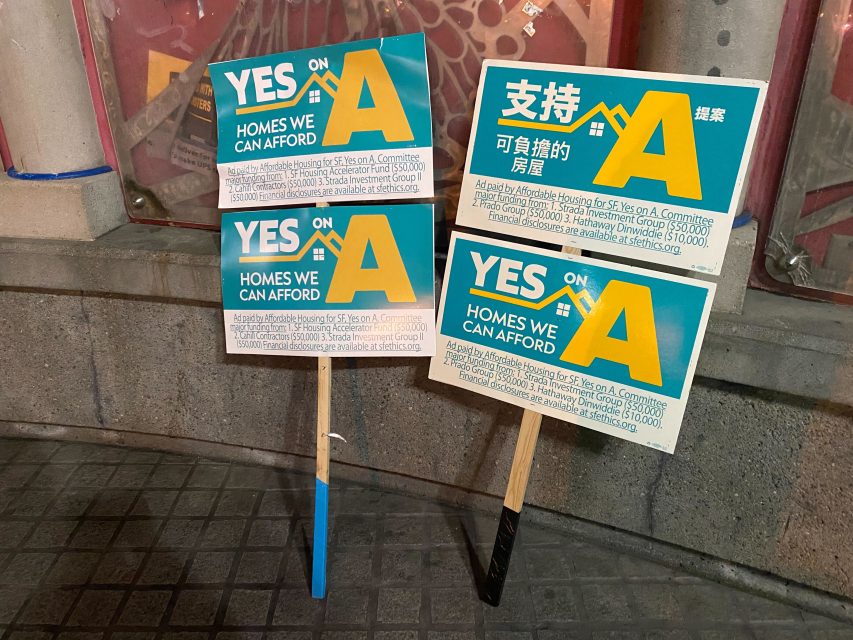
Outside of the 16th. St Mission BART plaza, four Yes on A signs rested against a wall. A block away, the party for the measure — a $300 million affordable housing bond — started at Slate Bar right as the polls closed at 8 p.m.
Jesse Garcia, 52, a Yes on A campaign staffer, was among the first to arrive. “I feel very confident,” said Garcia, who speaks Spanish and has canvassed extensively around the Mission. The measure is, after all, backed by all corners of the city’s political establishment. But, he added, he was curious what the electorate would look like. “I’m hoping we can get our youth voters,” he said.
—Xueer Lu
Mission District, 7:30 p.m. — Music starts at the No on E and F party
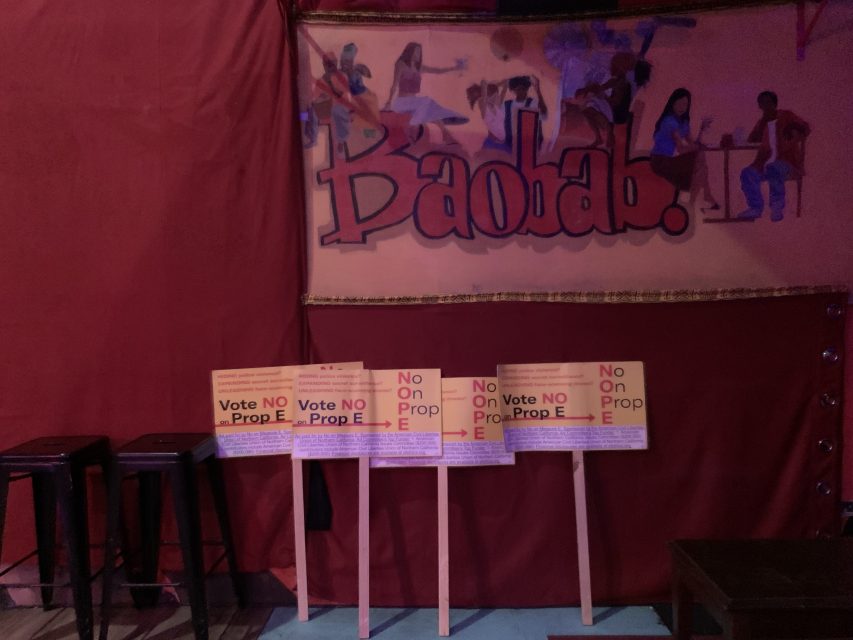
Soul music kicks off right at 7:30 p.m. at Bissap Baobab for the No on Prop. E and F party, where organizers with the Latinx Democratic Club and SF Black Wall Street take a brief break on the couches before the festivities — and initial results — come in.
The campaign and partnership between two Latino and Black groups came together in just the last couple weeks, said Kevin Ortiz of the Latinx Democratic Club. The joint team distributed 12,000 door hangers and hit 7,000 households that requested a Spanish ballot with bilingual mailers.
The campaign went up against deep pockets backing Prop. E, Mayor London Breed’s police ballot measure, which drew $1.5 million from wealthy donors, many of them tech executives.
Meanwhile, the No on E group was working with $25,000. Geoffrea Morris, cofounder of SF Black Wall Street, called it an “uphill battle” — financially, but also a fight against what she called propaganda and fear-mongering.
“Our campaign was for the poorer districts,” Morris said, ones that would face more scrutiny from more policing and surveillance. She said she was happy to see news outlets across the city covering the potential problems with Prop. E in the weeks leading up to the election.
— Eleni Balakrishnan
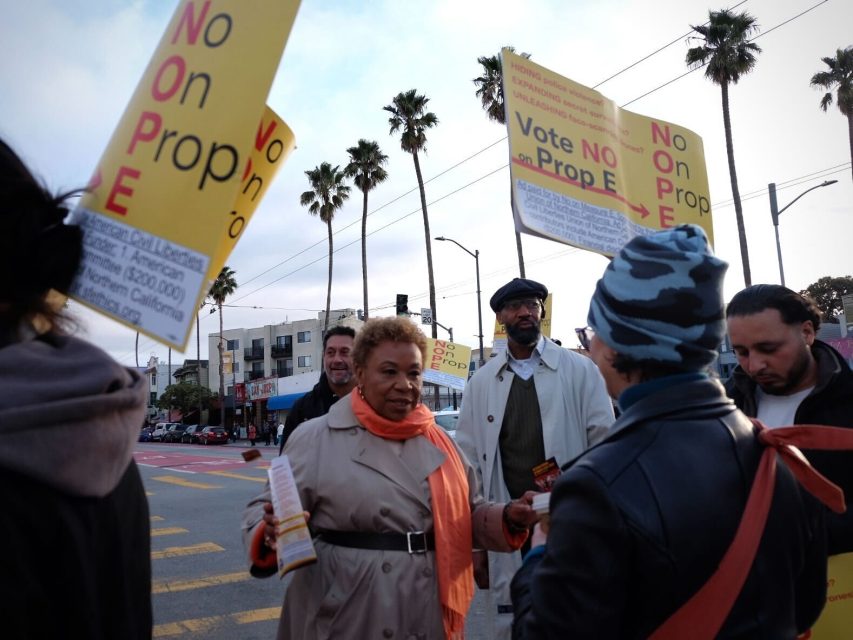
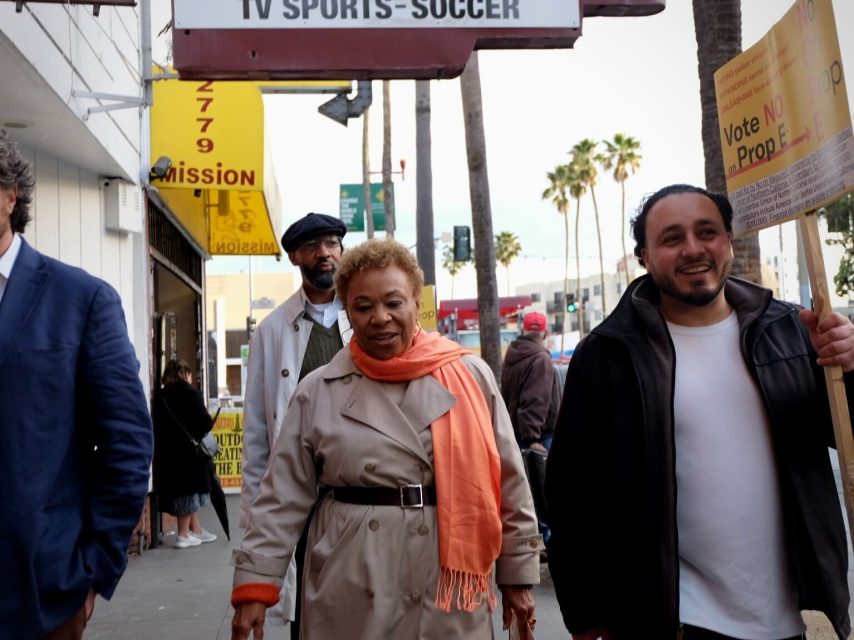
Mission District, 5:30 p.m. — Barbara Lee visits 24th St. BART
Barbara Lee, the Oakland congresswoman running in today’s primary for U.S. Senate, dropped by the 24th Street BART plaza this afternoon to talk with those who have been holding signs there since 7 a.m. this morning.
Workers holding yellow “Vote NO on E” signs were scattered across the plaza, urging voters to go against Mayor London Breed’s policing measure.
Lee did not speak about the measure one way or another; Breed endorsed Lee’s race for Senate. She spoke generally about the importance of turning people out to the polls instead. “It’s getting people to believe their votes count,” she said.
“We know people need that reminder [to vote],” added Deldelp Medina, organizer and co-president of the San Francisco Latinx Democratic Club.
A woman on her way to work was thrilled to see Lee. “You fight, you keep fighting. You are the only one,” she said before embracing Lee.
In a trench coat and coral scarf, Lee walked up Mission Street to 23rd Street, passing taquerias and clothing stores. Seeing suitcases neatly placed in front of a business, she said she might buy one. “I have like 30 suitcases,” she said, “Whenever I see a suitcase I’m supposed to buy one right?”
Back at the BART plaza, Michael Rouppet was holding a sign critical of Prop. E, reminding people of “forty years of policy on criminalization of people of color, people who are poor and marginalized.”
“That’s what concerns me,” he continued, as he tried to get attention from commuters with his sign. “We are changing back to what didn’t work.”
Not everyone was optimistic about the outcome, though. “Looks like we are gonna lose,” said Mariam Ali, another worker with the Latinx Democratic Club. Ali said many voters she talked to were ignorant of the content on their ballots. “To get people really engaged, it takes so many years. We tried our best.”
But organizers were not defeated. If anything, they saw the primary election as a drill for the general election in November.
“Even it doesn’t turn out what we would like it to,” said Kevin Ortiz, president of the Latinx Democratic Club. “We are gonna run it again in November.”
—Junyao Yang
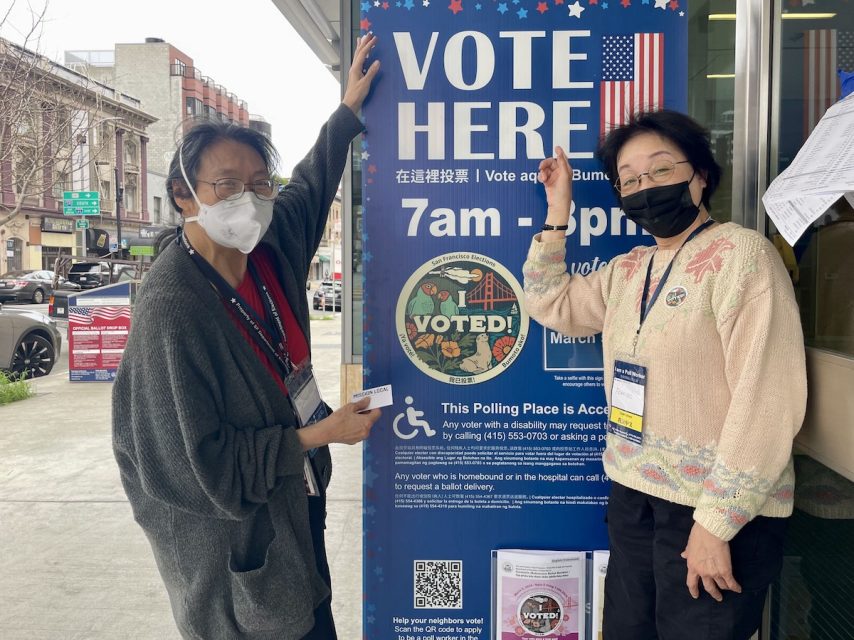
City College Chinatown and North Beach campus, 4 p.m. — Two regular Chinatown poll workers
For Sandra Fong and Frances Leung, Election Day is one of the happiest times of the year. Since the 1980s, Fong has been a poll worker 38 times, and Leung has not missed a single election since she first volunteered 12 or 13 years ago. Both are regulars at Chinatown voting stations.
Leung usually prepares pastries for her 16-hour of work on Election Day, because there’s “no microwave, no hot water” at the City College polling station, she said. In a way, she sees being single as a blessing: It spares her the burden of caring for kids or grandkids, and allows her to keep Election Day free.
Both regard the day as a way of giving back to the community; they revel in the practice of democracy. Both were excited to share their encounter with an Italian woman this morning — a new voter who just became a U.S. citizen yesterday. They congratulated her, gave her a voter information pamphlet and watched her sit in the back and spend an hour-and-a-half reading through it. “She was not so familiar with the propositions,” said Fong.
Throughout the years, Fong especially has enjoyed the moments when 18-year-olds take selfies with their parents after casting their first vote. Leung, who speaks proficient Cantonese, Mandarin and English, loves helping senior voters and is often amazed by their seriousness in democracy.
The so-called political apathy of Asians is imperceptible in Leung’s polling station. During the conversation, some six seniors came in to vote. “They are very anxious to vote,” she said. “After I help them, they’re done. Then I open the door for them. Sometimes I don’t feel comfortable for them to cross the street, so I walk them over there. ”
— Yujie Zhou
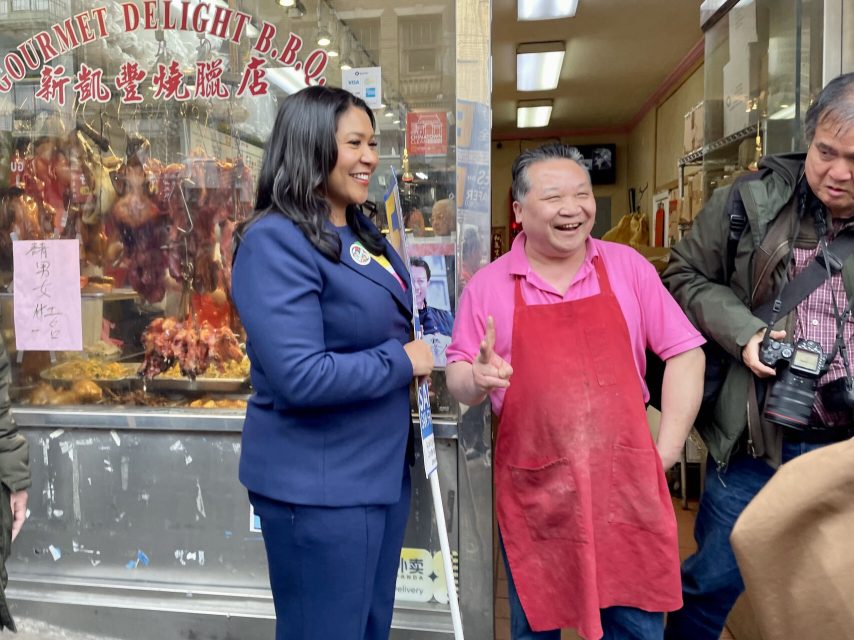
Chinatown, 3 p.m. — Mayor Breed visits shopkeepers, supporters campaign for E and F
Mayor London Breed walked down Stockton Street visiting businesses one by one, flanked by a large number of Asian seniors holding signs that read “Yes on E+F for a safer San Francisco” or “Yes on C for a revitalized downtown.”
Breed’s reelection bid is in serious trouble, especially from Asian voters. In a recent San Francisco Chronicle poll of 812 respondents, a mere 10 percent of likely Asian voters preferred Breed the most.
And small business owners on Stockton showed mixed reactions to Breed’s visit. “I’ll support her, and that’s what I just told her,” said the owner of Chang Shing Co.
Zhu, owner of Mei’s Groceries, said she met Breed just for the sake of courtesy.
Wei Xie, owner of Chuu Chuu Meat, said she avoided meeting with Breed because she does not like her. She’s especially concerned about a sober living site that Breed planned on the fringes of Chinatown, a plan Breed scrapped in late February after a torrent of opposition from the Chinatown community. “I’m sure she’ll continue the program once she gets reelected as mayor,” said Xie.
—Yujie Zhou
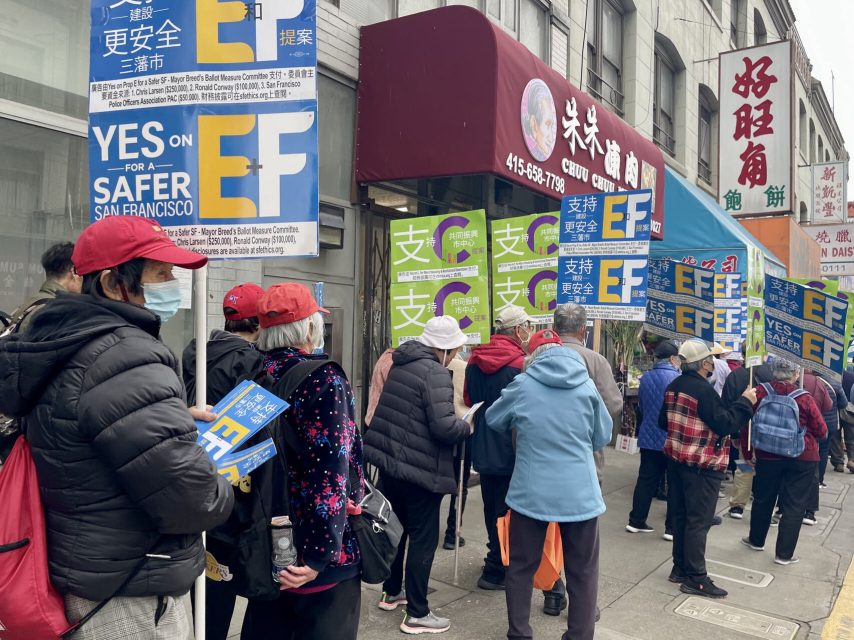
Richmond Branch Library, 12:15 p.m. — Slow-going, and few hiccups
Things are slow-going out in the Westside, but polling workers at the library branch in the Richmond hoped that voting would pick up during lunch and after 4 p.m..
Mark Passell, who’s on his second election as a poll worker, said there were just a few hiccups: someone marked too many choices, or the “boxes are too short to handle the long ballots.” Someone also asked how to spell Trump, Passell added.
—Junyao Yang
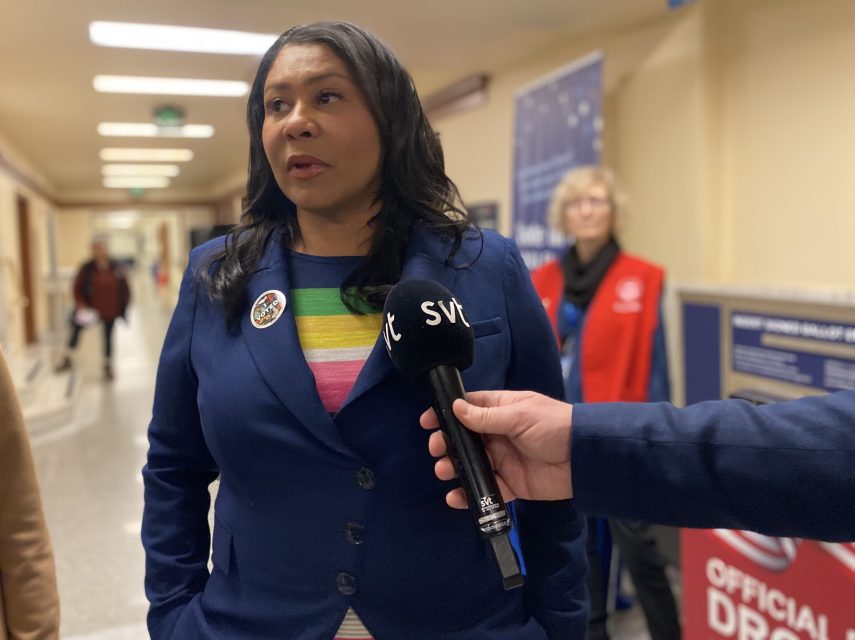
City Hall, 12 p.m. — Mayor London Breed casts her ballot
Around noon, Mayor London Breed showed up at the City Hall Voting Center to drop off her own ballot, accompanied by two of her staffers.
She turned in her voting slip, got a sticker and turned around and spoke about voting as civic pride — and privilege.
“I remember going with my grandmother when she would cast her ballots. And she took a lot of pride in doing so,” Breed said. “She comes from a time where people like her were not allowed to vote and couldn’t even get to the polls.”
Eight hours remain until the poll closes at 8 p.m. and the City Hall Voting Center is now seeing a bigger influx of voters.
— Xueer Lu
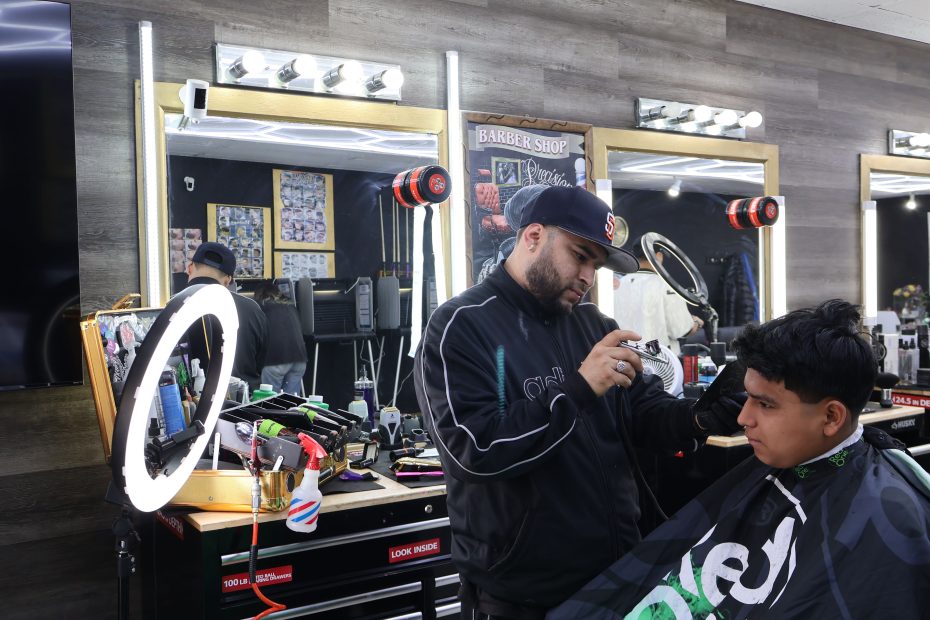
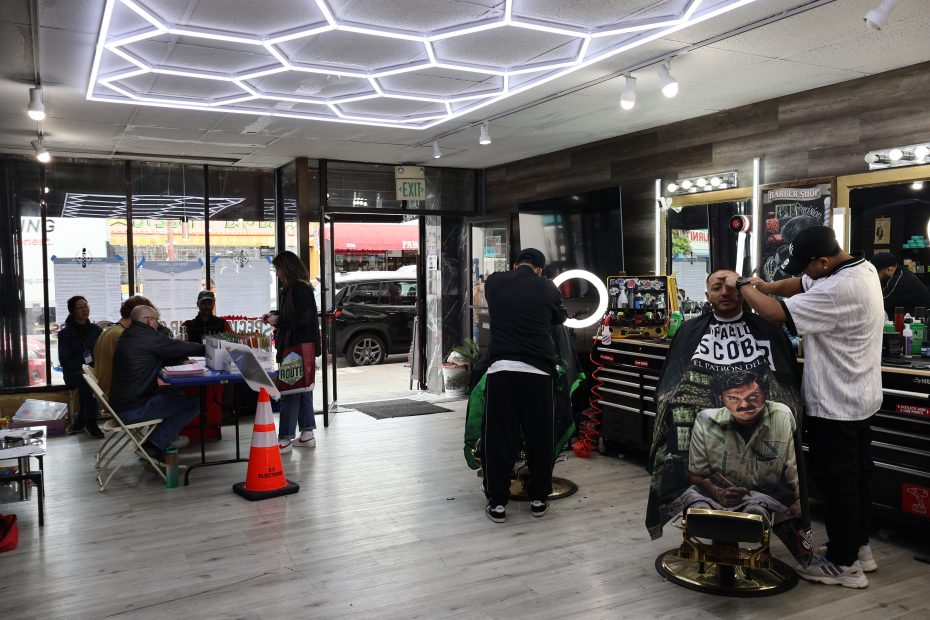
Mission District, 12 p.m. — Ana’s Salon hosts barbers and ballots alike
At Ana’s Salon on Mission Street, there are ballots and there are barbers, but the two don’t seem to mix.
I walked into the salon and was greeted by Aaron, one of the poll workers, sitting back with his feet up in a salon chair.
“We’ve had more haircut requests than voters,” said Sofia, another of the poll workers. “Instead of handing out stickers, we’ll just hand out shampoo bottles.”
The six poll workers here have hedged their bets on how many in-person votes they will get today. Aaron chose the highest number: 75.
“He’s feeling optimistic today,” said Sofia.
Around noon, the ballot-screening machine shows six registered votes.
While the poll workers twiddle their thumbs by the salon door, behind them, it’s business as usual.
Kevin, one of the barbers, who is from Peru, said he isn’t a citizen and can’t vote. The same goes for the other salon workers there: They are Mexican, Peruvian and Colombian citizens.
Carlos, who is getting his hair cut, said he hasn’t voted yet. The same goes for Arturo, sitting beside him.
But, as the two sit to get their hair shaved and watch some voters trickle in to cast their ballots, they appear to be getting some ideas.
“I’m going to read the proposals that have been sent to me,” said Carlos.
I will vote, said Arturo. “Sería la primera vez,” he said. It would be his first time.
—Kelly Waldron
Mission District, 11:30 a.m. — One voter at 24th and Folsom does his research
When Matt McClean arrived at the garage of 2774 Folsom St. to drop off his ballot, he had done his research.
Some of the propositions on the ballot seemed merely “symbolic” to him. For example, Prop. C’s conversion of office space into housing “sounded good on the surface,” he said, but didn’t appear to have a guaranteed outcome of “who was going to develop, or how much, or when.” Same with Prop. B’s proposal to set minimum police staffing levels: “It’s another case of, ‘Well, when? What tax? And how much?’”
Prop. E, the mayor’s policing ballot measure expanding police powers, “bothered” him. “I just didn’t like how it seemed like the police might have a chance to use technologies without approval first,” he said. “It just seemed like overkill.”
As for the proposal to drug-screen welfare recipients, he was confused. “I thought it was settled that drug testing wasn’t helpful — that people weren’t taking advantage of benefits.”
McClean didn’t necessarily vote with one particular slate, however. When it came to Democratic County Central Committee candidates, he said he went through the candidates individually, and decided who seemed likely to work with other people.
—Eleni Balakrishnan
Sunset, 10:50 a.m. — Voting for the first time at St. Anne of the Sunset Church
Jules Castaneda, 25, moved to San Francisco from Pennsylvania seven years ago. She had never voted in the city until today.
“I wasn’t gonna vote, because people in the Bay are always like, ‘we don’t care for your vote,’” she said.
She got a call from a nonprofit called San Francisco Rising, and realized she could actually vote. Although she admitted she “doesn’t always understand politics, and feels anxious talking about it,” she hoped “more young people realize the value of their voice.”
“Do I love the Bay Area? Do I want the city to be better? Yes,” Castaneda said. “If I want to see changes, I have to actually do something … I want the city to find its beauty again.”
A victim of assault and violence in the city herself, she said the police didn’t do much at the time. She voted against Propositions B and E. “There’s already not much accountability in the city,” Castaneda said.
—Junyao Yang
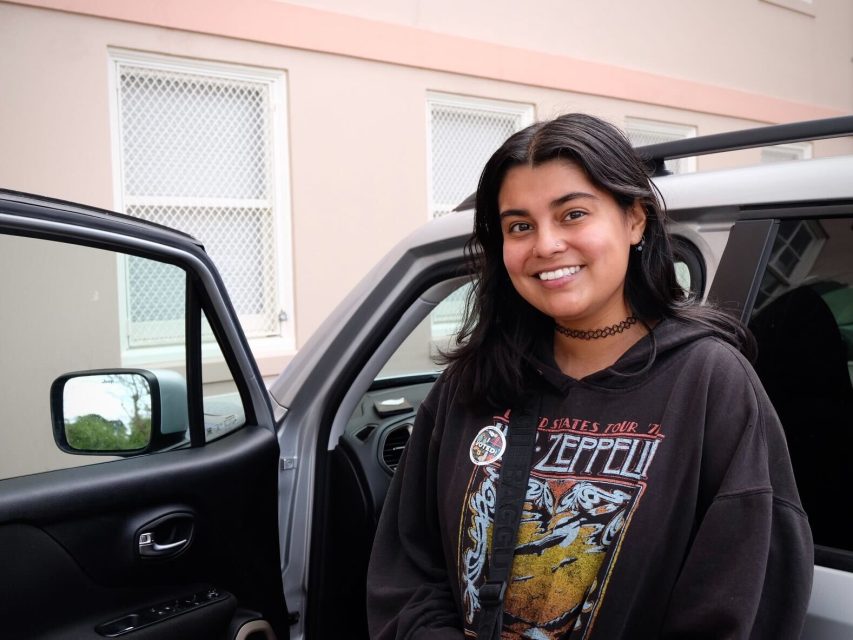
Mission District, 10:15 and 10:40 a.m. — Voting at End Games Improv and Garfield Square
At End Games Improv at Mission and 26th streets, poll workers explained the voting process in Spanish to Laura, 41, a first-time voter who just became a citizen. Not many people have come to vote in-person here on Tuesday morning, but some are looking for some extra assistance. After a few confusing exchanges, Laura’s ballot is in the box.
“Just exercising my rights — and learning to do it the right way,” Laura says with a chuckle as she leaves the station with her baby in a stroller.
Riley Manlapaz, a first-time clerk, says the morning has been slow, “but I think the bulk of people, we’ve been told is going to be evening rush hour.”
At Garfield Recreation Center, where a polling station has taken over the main room, there’s brief mayhem: As the morning’s mist turns into rain, families doing a “story time” with a librarian outside run for shelter, only to realize their typical space indoors is taken.
“Election Day March 5th. No tots,” reads a dry-erase board inside.
But in the polling room, all is quiet.
“I forget what year, [there was] one election or another that’s been busy, which was exciting!” said Edward, a clerk who has worked 13 elections. But typically, he said, most people mail their ballots early.
—Eleni Balakrishnan
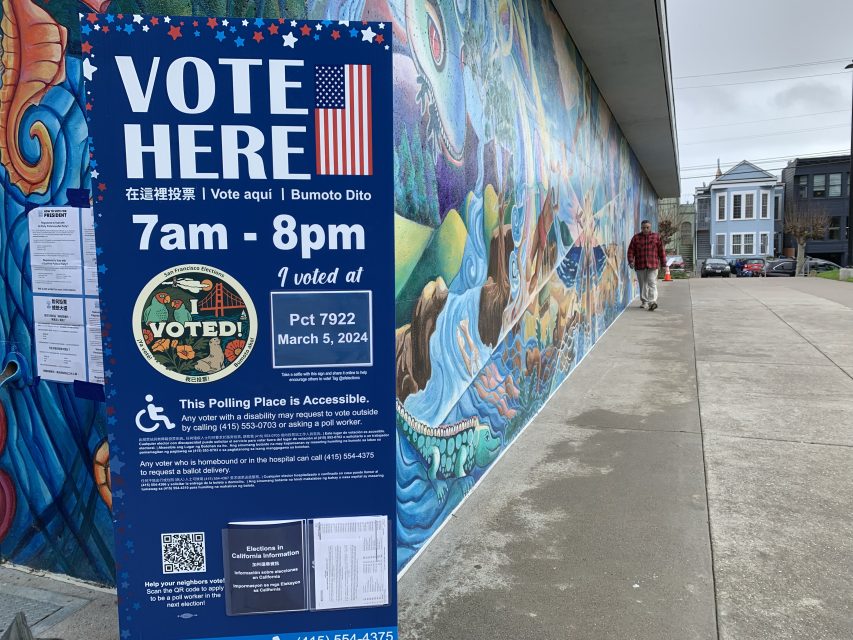
City Hall, 10:40 a.m. — Voters trickle in
Voters slowly trickled into City Hall, and some 10 ballot-quality control staffers worked the morning shift to make sure the envelopes and the ballots were properly unfolded.
“They are making sure there is no damage to the ballots, and prepping them for counting,” Cuong Quach, a ballot distribution manager, explained.
As of 10:30 a.m., only about half of the voting booths were filled. Only one or two voters filled out their ballots at the overflow area.
Heather Wang, 36, said this was her first time coming to City Hall to submit her ballot. She happened to be in the area for jury duty.
“I’m surprised it’s all the way down here instead of in the front, which is more accessible,” Wang said.
—Xueer Lu
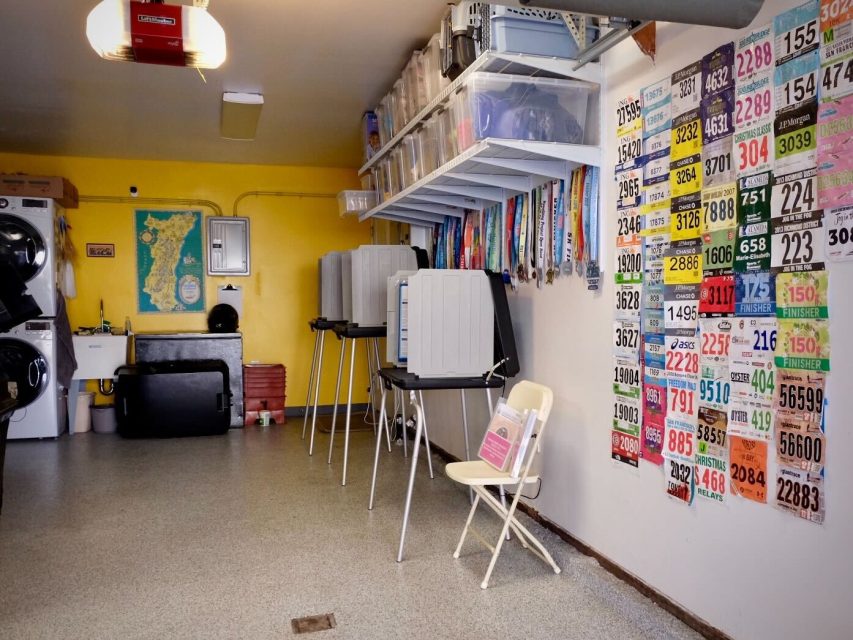
The Sunset, 9:30 a.m. — Race bibs and medals at Funston and Judah
Hannah, a poll inspector working her seventh election, has a long day ahead of her at 731 Judah St., a garage-turned-polling center. But she enjoys her work helping people to navigate the voting process. “It feels like a moment of democracy,” she said.
Around 9:30 a.m., as the N-Judah passed by, two voters stood in the booths next to a wall of race bibs and medals from 5Ks and half-marathons.
A young couple dropped off their ballots, put on their stickers and took off in less than 10 seconds.
Three poll workers, all working their first election, set up a table in front of stacked containers with towels and extension cords.
They helped an elderly Chinese voter, who had to fill out the second page of his ballot three times because he was confused about the number of candidates he could choose.
“Ten here, one here and one here,” a Cantonese-speaking worker showed him.
As he fed his ballot into the machine for the third time, the polling workers held their breaths and bodies still, waiting for the ballot scanning machine’s “pleasant ding.”
“So complicated,” the voter said as he left the garage.
—Junyao Yang
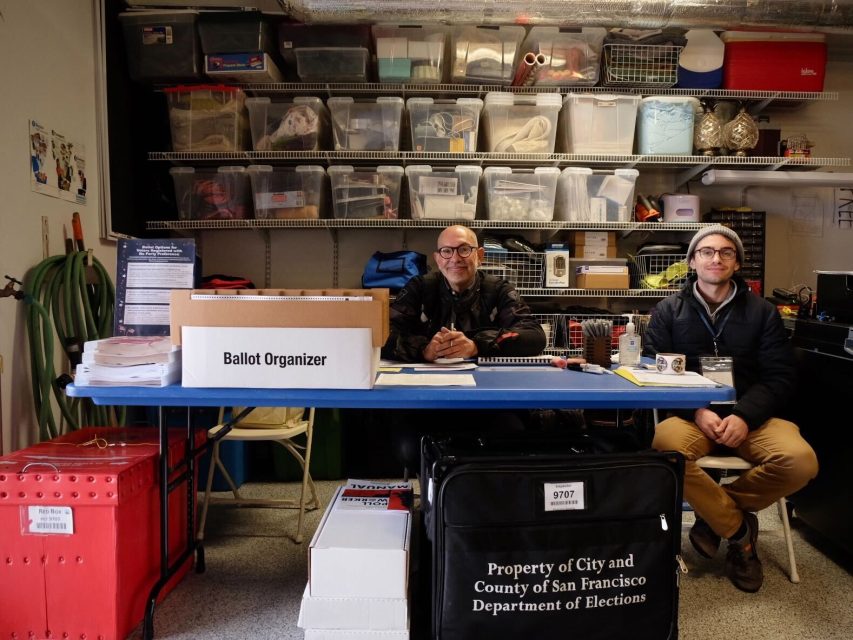
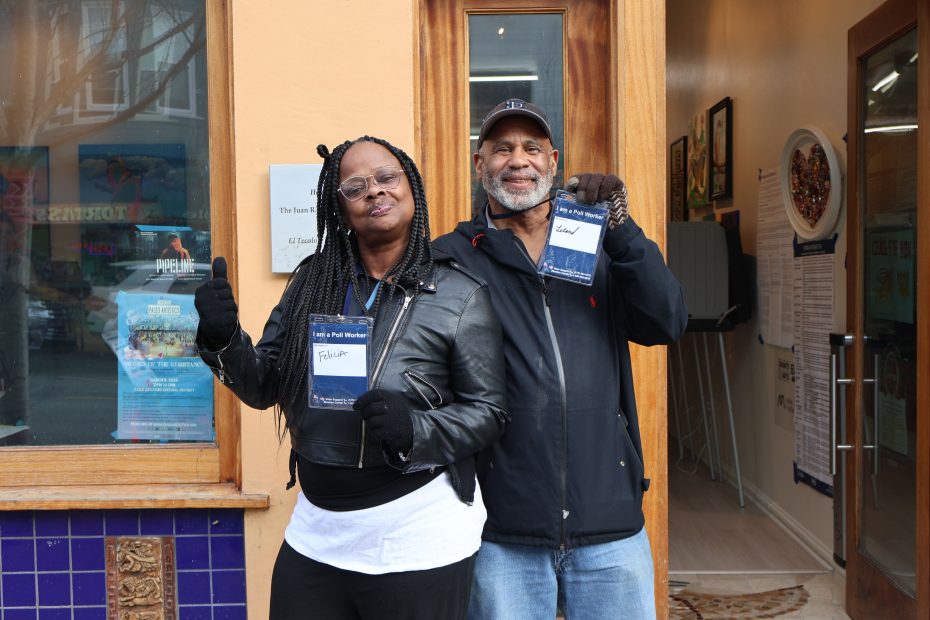
Mission District, 9:30 a.m. — Felicia and Leland beckon voters
It was a leisurely start to the day here at 24th Street near Alabama Street, where the ballot-screening machine showed single digits.
But spirits were high. Felicia and Leland, who were manning the door, did their utmost to lure voters inside.
“Come on in! Come on in! Come on in!” shouted Leland, pointing towards the station, which is in the office of Acción Latina.
“We bring ‘em in,” he said.
“We show each person how happy we are to see them,” said Felicia.
—Kelly Waldron
City Hall, 9.a.m. — Voting center just getting started, and a first-ever selfie booth
About 40 poll workers are helping voters at City Hall today from 7 a.m. to 8 p.m.
John Arntz, the director of the Department of Elections, said that the voting center at City Hall has definitely gotten busier over the past couple of days. “It’s picking up as we get closer to Election Day,” he said Tuesday morning.
Juliet Rios, 54, a first-time poll worker, said her job is to help voters as they come in, and get them a new ballot if they make a mistake. “It’s great to be a part of it, to see it in action,” Rios said.
Rios pointed to the “I voted” stickers arranged neatly on the table next to the official ballot drop-off box and explained that, unlike those given out in previous elections, this year’s are decorated with San Francisco staples, like hills, Karl the Fog, a sailing boat, Golden Gate Bridge, a pair of parrots, flowers and a sea lion.
And, keeping up with the times, the Department of Elections has set up a selfie booth, its first, where those who just cast ballots can snap pictures of themselves holding giant “I voted” signs — or “I am a future voter,” for those under 18.
—Xueer Lu


Golden Gate Park, 8:45 a.m. — Quiet morning and bragging rights for the wife
The polling place at the County Fair Building near the 9th Avenue entrance of Golden Gate Park is quiet on Tuesday morning. Only a handful people have come to vote, a poll worker said.
“I didn’t even follow the issues close enough to comment,” said Mark, who lives near 14th Avenue and was the only voter at the site. He voted anyway.
He might have skipped it entirely if not for his wife who, he said, follows elections more closely and had asked him if he had voted yet. When he saw the polling site on his morning walk, he went in and cast his ballot.
Pointing to his “I voted” sticker, he can now brag: “I can show her that.”
—Junyao Yang

Mission District, 8:30 a.m. — Poll worker stipend doesn’t quite cover $260 for a Madonna concert
Things are off to a slow start at the polling station at 22nd and York streets. The station, a garage, has been open since 7 a.m. When I walk in around 8:30 and ask how many people have voted, I was told, “Maybe five.” That’s the same as the number of polling workers here.
Most of those votes were drop-off ballots; only one vote was registered on the ballot-scanning machine.
With the garage door open, it’s chilly and everyone has their hands in their pockets. I ask one of the workers, Sara, why she’s here: “Civic duty,” she said. “And a tiny bit of extra cash.” The stipend the workers get for the day is $225, and $245 for those who speak another language.
Cesar, another worker, who speaks Spanish, said he was under the impression he was getting $260, he said. “Now I’m $15 short for that ticket I bought.” He paid $260 for a ticket to Madonna’s concert at the Chase Center last Tuesday, counting on this extra income.
They’re in for a “very long day,” says Sara. She expects they will stay until at least 9 p.m. “In 11 hours, we might get 15 [votes],” she joked.
In the next half hour, some 10 people pass by to vote, most of them dropping off ballots, and many accompanied by a dog on a leash.
—Kelly Waldron


Props | DCCC | Assembly | Superior Court | Analysis | Live updates
Useful links
All data is from the San Francisco Department of Elections. More information can also be found at:
- California state election results
- Voter information pamphlet
- Find a ballot box
- See the money in this election
- Explore the results in a custom area
If you spot any errors, please let us know at will@missionlocal.com.

Whatever happens, thanks to the entire ML staff for your tireless work so far (and yet to come before November).
Couldn’t agree more – while I don’t always agree with their politics ML is a local gem and I am so grateful for a free press. I will continue to donate monthly despite our often differing political opinions. Well done ML and thank you!
First I noticed Annika is no longer on the roster. Good luck to her in her new venture.
RL,
ML’s to SF Political Novices what Triple A ball is to the Giants top prospects.
Or, the School Board is to the BOS and higher.
No better teachers in ANY Journalism School than Eskenazi and Chavez.
Go Niners !!
h.
Regardless as to how anyone leans politically, we can all agree this is the best local elections coverage for all of San Francisco. Job well done ML!
Your thorough and thorough reporting not only keeps me abreast of the latest developments but also provides the depth and context necessary to truly understand the issues at hand. Whether it’s local news or political analysis, I know I can rely on Mission Local to deliver accurate and insightful content every time. Please accept my heartfelt thanks for your dedication to journalistic integrity.
On Twitter, ML posted a quote from someone patting herself on the back after voting, saying “I wasn’t gonna vote because people in the Bay are always like, ‘we don’t care for your vote.’ ”
Good for her (I suppose) for doing her civic duty, but it goes without saying that this didn’t happen. No public official says they don’t care about your vote.
Note that the Dept of Elections just said that they have approx. 111,000 votes yet to count — more than double the vote that has already been reported. That number does not include any votes that come in by mail today and in the future. So this election is not over yet.
But love the maps and graphics you all have so far.
In past elections, there’s definitely been results that flipped after all the votes were counted. will be interesting to see if anything like that happens this time.
Same.
No disrespect meant to H. Brown, but I fully agree. Most of us who opposed the “SF Progressives” support most progressive causes at the national level. Heck, I agree with Bernie Sanders on most things.
It is the toxic local progressivism of SF and their do-nothing approach to major crises which caused me to go with the Change slate.
Joe,
DCCC endorsement hasn’t been worth anything since Barney Rubble delivered their mailers.
Democrats aren’t even Majority of SF voters.
Independents are, along with ‘Decline to State’ by a good bit.
Go Giants !
h.
SHAME on SF for 40% turnout. They MAIL YOU the ballot, you do not even have to leave your home to vote! Pitiful
I was a bit confused with the graphic about State Assembly as the graphic shows Matt Haney being the overwhelming winner but the verbage refers to Catherine Stefani.
Our ballot counters continue to be a national embarrassment. What was their reasoning for skipping the promised update at 4 pm today?
Sorry but,
I just had to add this Will Rogers gem from gettin’ to be a hundred years back …
“I don’t belong to an organized party. I’m a Democrat.”
Joe,
All of this bullshit like the ‘D-Triple C’ is important cause it has a neat name ?
It is many a moon since the Democratic Party ran this town.
Most people are like myself (registered as Green but ronan at heart) and ID as ‘Independent’ or ‘Decline to State’.
In the Olden Days (ten years ago) when they only slaughtered half the trees for an election the Democratic Party’s Mailer was a friggin’ major event.
No more cause it’s lost in the splinters of billionaire logging.
Only thing important about them now is that there’s so many of them (two dozen ??) that most oldtimers around town have a relative either on the D-Triple C or used to be on the D-Triple C or knew someone who used to shudda, cudda, wudda, iffa and useta.
I value my dog’s picks over Jade Tu’s any day and he’s cuter.
lol
Go Niners !!
h.
“Most people are like myself (registered as Green but ronan at heart) and ID as ‘Independent’ or ‘Decline to State’.”
That’s the thing. No they aren’t like you. You might think they are because you’re in you own little bubble. It’s a Democrat town so the backing of the DCCC is absolutely important in which flavor of Democrat we get in positions that matter. Even the ‘right wing’ perspective of the DCCC is progressive nationally, I look at this as a sensible dialling back of extremism while still remaining solidly Democrat.
I totally agree. Apparently that mailer that H. Brown is dismissing typically sways about 10-15% of the vote precisely because people can’t distinguish among Democrats and have no clue who to vote for. That is a meaningful percentage of the vote and Team Reasonable (it seems funny to call them the moderates, given that, as you point out, the moderates are more liberal than most of the country) will now control who is endorsed by the SF Dems, which will have a greater influence on the outcome of our elections.
I totally agree that this dialing back is sensible. The progressives controlled the DCCC for the last 8 years and I don’t think anyone feels that those years have gone well. It’s time for a change.