

When I arrived at Uptown, it felt like the living room of a family of Dickensian characters in mourning. The main room was darker than I ever remembered it. The TVs were off. The Halloween decorations were still up, so there was a skeleton hanging on the wall above the restroom; the incidental lights cast a creepy red glow, and the pinball machine and Ms. Pac Man games on the other side of the bar were both covered in cobwebs.
Dolly Parton was singing sad songs on the jukebox. A regular came in and asked the bartender how she’s doing. She responded “well … ” and trailed off.
“Yeah, I know,” he said.
By now we all know: Uptown’s closing in January. We’ve had about a week to get used to it.
We’re not used to it.
“Before the pandemic, people would describe Uptown as a community center,” said Clark Emmet, one of the bartenders. “Since the pandemic, one of the bosses would say, ‘Oh yeah, we’re not making any profit at this point,’ so we described it as a nonprofit community center.”
It was funny because it was true: Uptown is exactly the kind of shared community space that San Francisco celebrates — but doesn’t adequately patronize. And then it shuts down.

What Uptown means to someone depends on what era of its 39-year history they arrived in, and who they arrived with. Its founder, Scott Ellsworth, was a member of San Francisco’s Cacophony Society, a truly “made in San Francisco” assemblage of weird artists and hilarious anti-artists. So for many people like me, Uptown was a “Cacophony bar:” A place to discuss hijinks past and future. I was introduced to it by one of the founders of SantaCon. I’m not saying SantaCon was first planned in this bar, but it realistically could have been.
But Uptown is also a working-class ’80s bar run by a guy formally trained in philosophy. Ken Cohen, one of the current co-owners, remembers that back when the Mission had more manufacturing, Ellsworth used to run the bar himself during the day (he couldn’t afford to pay someone to work those shifts) so that some of his regulars who worked factory jobs could come to drink beer and play pool over their lunch hours.
“I owe it to them to keep it open,” Ellsworth told Cohen. They belonged there as much as the weird artists and pranksters. He didn’t just take their money, he made space for them.
Uptown still has a unique “San Francisco in the ’80s, community center, we’re having mischievous fun here, and assholes are not welcome,” vibe, because Ellsworth was a unique personality who founded it and was personally involved in running it for so long.
“I know a lot of other bars and their owners. Scott, because of his nature and the amount of time he spent there, imprinted more on it in a way that’s unusual, and it’s lasted,” Ken said.
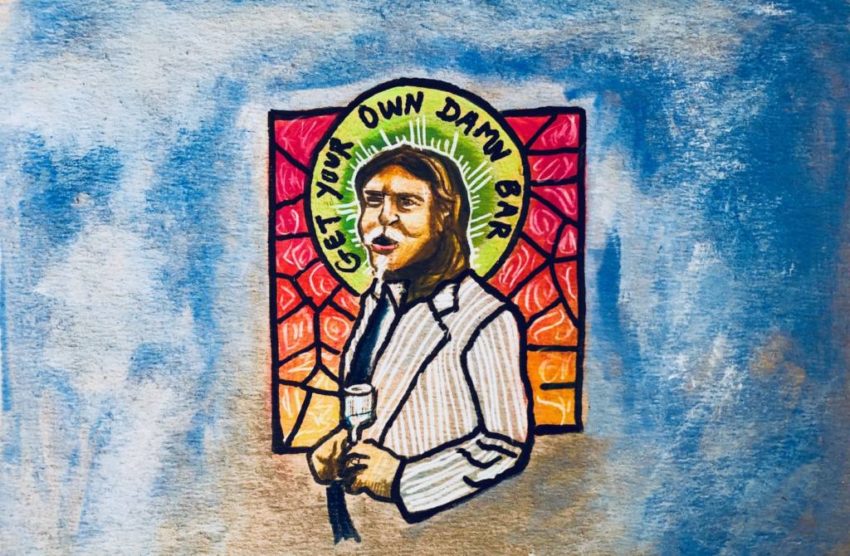
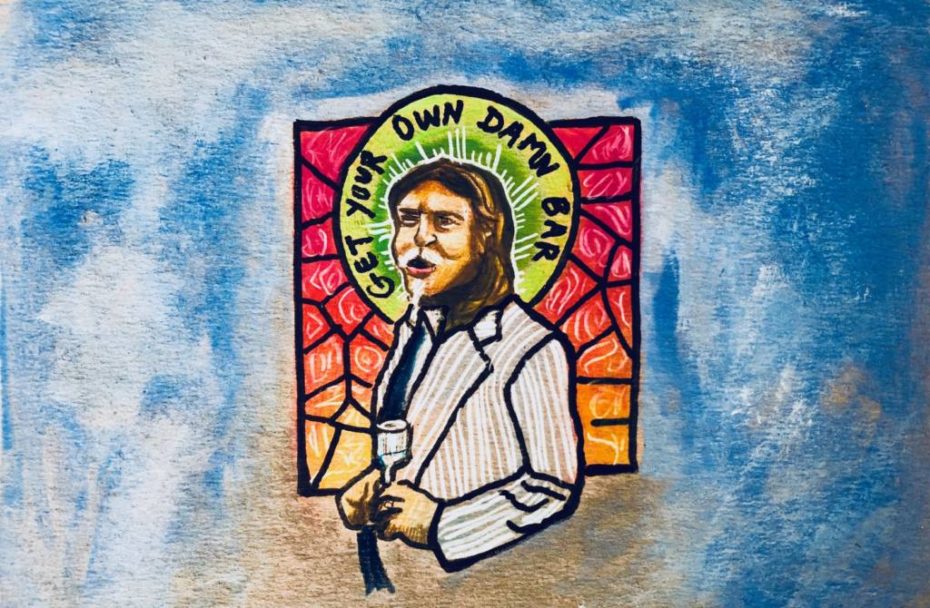
For those who complained, who clearly didn’t belong, Ellsworth had a motto: “Get your own damn bar.” Those words are written on the halo of a stained glass depiction of Ellsworth that hangs above the door. He died in 2014, and his sister sold the bar to its employees.

Most recently, Uptown was a new home for the queer community displaced when The Lexington Club closed at the end of 2015. Once again, space was made.
Clark, who tended bar at The Lexington, was the first new staff member hired after Ellsworth died.
“After the Lex closed, we were all wondering where we were going to go,” he said. “After a couple of months of feeling displaced in the city — queer people feeling displaced in a queer city! — it occurred to us to go and ask if we could be part of Uptown. Uptown was never a gay bar, but it was always queer, and they were happy to host us. It felt really organic, and it’s been going strong ever since.”
Uptown was recognized as a legacy business in 2019. That’s part of what makes the loss so shocking.
“We’re a three-decades-old establishment! We’re legacy status! We’re as above-board as queer spaces get!” Clark said. “We have an actual notice from the city, declaring we’re irreplaceable! That we made a positive impact on the community as a dive bar! You think you’re protected! And to still lose this … to have this valued less than another fancy cocktail bar, or a gym with $200 monthly memberships … it’s a big hit.”
The community that lost a home when the Lex closed is losing a home again.

I was sitting at the bar, stewing in these thoughts, until the doors swung open and a small crowd of people came in, spreading around the main room and clearly ready to enjoy themselves on a weeknight. Lively conversation filled the bar. Which happens, sometimes, in living rooms where families are sitting shiva. Grief can be momentarily transcended by the pleasure of seeing friends.
The bartender warned the customers that they were out of several beers that night. I ordered a house margarita ($12, cash only). The party was getting started.
After ordering some rounds, the Latino man next to me started to settle up with the bartender. “Now,” she said before he could pay her, “I’ve charged you for her drink, and for his. But your margarita is free because you’re always buying drinks for people here. Enjoy it.” He was embarrassed and flattered and happy.
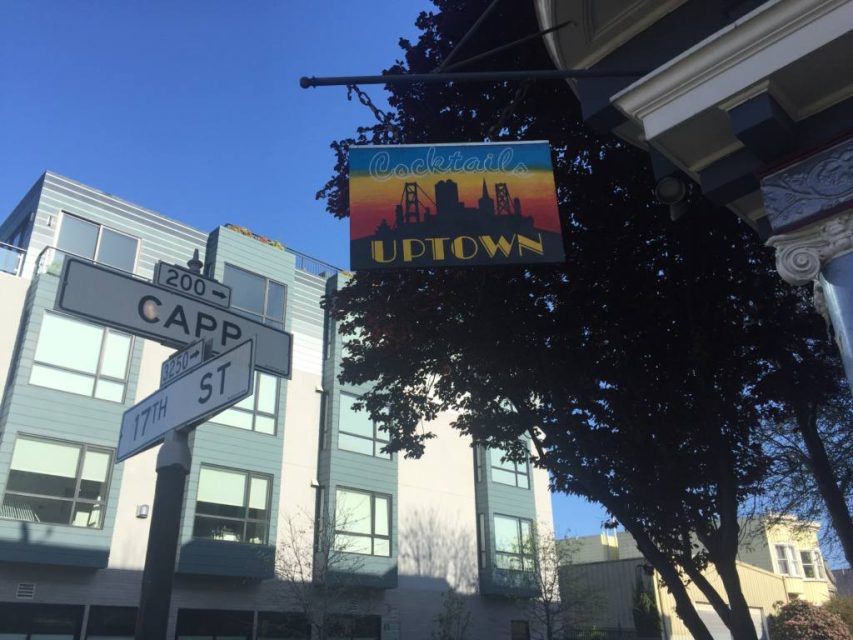
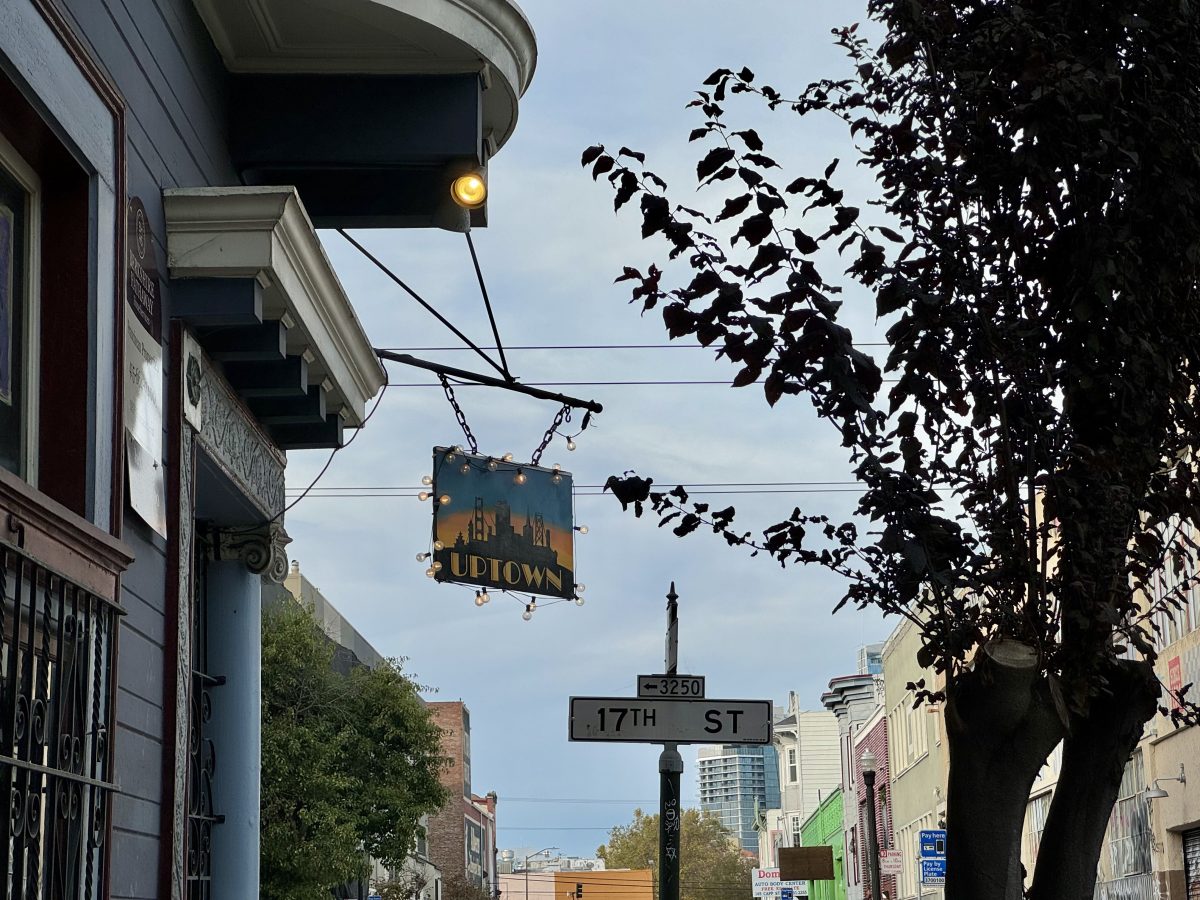
Uptown is dying because San Francisco’s all about the money. Uptown — which pays $11,000 a month in rent for an off-the beaten path spot at 17th and Capp streets — is dying because it wasn’t.
As I drank my margarita, the bartender turned on the TVs and gave one remote to a customer sitting next to me. He flipped through the channels and settled on ladies wrestling. The other TV was set to a black and white film. It was perhaps the strangest TV juxtaposition I’ve ever seen in a bar. Motown started playing on the jukebox.
Conversation was lively all across the main room. “You’re loopholing around my thought experiment!’ I heard a man on the other side of the bar declare to a woman during a pause in the music. When the music picked up again, it was punk, and I lost the rest of the conversation.
Two guys who look like working-class hipsters were debating Biden’s polling numbers. “Are you worried?” one asked.
“The choice is going to be between a guy who people don’t think is doing enough to support the Palestinians and a guy who wants to deport the Palestinians,” the other said. “People will come home.”
“The Democrats do like to wet the bed,” the first one agreed. “But it is important that they take Trump seriously, unlike in 2016.” They talked about politics all night.
Spaces like this are fun. Spaces like this are powerful. Spaces like this can change lives.
“I was still drinking when I got hired here,” Clark said. “I was slowly killing myself.”
But because he wanted top surgery, he needed to get sober, and because he was working at Uptown, he felt supported in both.
“After top surgery, I had all this euphoria, and I didn’t know whether I was feeling this way because I have a body that felt like mine or because I’m sober, but I was like: it’s working great, and I’m not changing either one!’”
He’s been sober seven years now, the longest stretch in his life, “and I don’t know if I could have gotten sober and stayed sober at any other bar.”
Clark now runs the monthly “Uptown Homo” events, and has turned being a sober trans masc bartender into a series of joyful rituals. “When I first started sobriety, people were like, ‘we’re going to order shots, and would like you to join us, but we don’t want to trigger you,’ and I said, ‘like shit you’re excluding me! I’m coming in! And now, everybody knows that I drink soda water shots, and they love it, and they insist that I join them. And when people order soda water because they don’t want to drink, I don’t roll my eyes at them, I get excited for them! I tempt them ‘are you sure you don’t want fresh lime? Can I add a splash of cranberry to that? Can I garnish it with a little umbrella?’ It makes that person feel included, instead of like they’re doing it wrong. It’s a space they can belong in. That’s what Uptown did for me, and what I’ve become able to do for others.”
He paused, enthusiasm mixing with profundity, resulting in tears. “I wouldn’t be sitting here if it weren’t for the way this bar changed the trajectory in my life.To have the support of a community … I think a lot of us know for queer folks bars are so much more than bars … ” he needed to take a moment.
Every bar that I’ve ever truly loved is gone. I know that grief.

A man came in and sat down next to me. The bartender came over “A beer?” she asked him.
“Yes please.”
“And a little friend?” she asked.
“And my little friend,” he agreed, laughing.
She brought him a beer and a shot. “Your little friend drinks for free,” she said, as he got out his cash.
While it is an extraordinary place, Uptown is closing for the most mundane of reasons, Ken told me. The rent is too high, and the landlord wants more. They burned through their reserves during the pandemic, when they had to pay full rent while they were closed. And, most disturbingly, people just aren’t going out the way they used to. There are so many beloved San Francisco institutions, like Stage Werx and The Exit Theater, whose business models were only viable in a city this expensive when they were packed.
Uptown still has plenty of customers, but it’s not packed the way it used to be, because San Franciscans aren’t who they used to be.
I talked to several customers that night who said they thought Uptown could be saved. Ken says anything is possible, but is skeptical. Maybe a white knight can be found, or maybe the worker-owners can find another, cheaper location, and open again there. Anything can happen, but it won’t be easy, or simple.
In the meantime, they are taking their time. There will be nights for the community to gather. There will be parties. Uptown’s anniversary is Boxing Day, and it’s likely there will be a big anniversary party to celebrate. There will be two more “Uptown Homo” events. There will be a grand farewell.
“The community is taking this chance to coalesce again,” Ken said. They’re going out with their flag flying.
Uptown will go out on its own terms. And something beautiful, if intangible, will remain. “Uptown Homos stemmed from the Lex closing,” Clark said. “My sobriety stemmed from coming here. Good things can come out of these devastating losses.”
I looked over at the stained glass portrait of Ellsworth above the door. Something holy happened here. They got their own damn bar.

Who is the landlord? Has anyone reached out to him or her (or them? Or it?) It seems that there will not be another tenant able to pay anywhere near this amount – let alone more! – for the next foreseeable decade or longer – so why can’t this person/entity come to the table and be reasonable? Rather than lamenting the loss, let’s work together to find a solution! I live around the corner, and have gone to the Uptown since 1992. If it dies, a part of me dies, too! Please, Distillations, my friend, let’s not hold the funeral so soon…the patient is still alive, and the cure is obvious!
With love, Morticia
Sad, but will never happen. Most landlords would rather their units sit vacant than lower the rent. Lowering the rent leads to a lower appraisal value. My guess is this old building is a prime target for ellis act eviction/emptying, tear-down and “redevelopment.” Expect to see a condo just like the one across the street in 10 years time.
There are no more dive bars left in SF. This will soon be an upscale cocktail bar with a velvet rope and doorman.
The days of upscale cocktail bars may have passed tbh. Inequality is so bad and the symptoms of it (homelessness, “crime”) are ever more visible. This is all unpalatable to the velvet-rope crowd. San Francisco will not be able to incarcerate its way out of these unpalatable symptoms. Meanwhile, gentrification has expanded to virtually every city in the country and there are far more comfortable places for the gentry class to go– tens of thousands already have, SF population declined by about 60k during the pandemic.
It’s possible they don’t return and we are looking at a good 10 years of high-rent blight (vacant dilapidated buildings hoarded by real estate groups waiting for the market to change), and government austerity due to the lower tax revenue. All of this will drive even more of the gentry class away.
Perhaps the only potential light at the end of the tunnel would be all of this leading to a change in power (finally) from the Willie Brown lineage of City Government that we’re still living in under Breed and her allies. A collapse of the finance/tech/real estate dominance of SF economy and a switch to a more diverse economy that actually serves the needs of local residents could transform everything. Not likely, but could happen!
I went to the Uptown bar a lot in the 1990s and 2000s. But then I moved away and have not been there. So this is sad news.
But in all the time I went there it was never a gay bar. It was 100% hetero with PDAs. So this was a change. Could it be that changed the demographic sufficiently that it affected the economically viability of the place?
In any event I guess the city making it a “landmark” is worth zip if that does not mean any cash from the city.
I will never understand when places are having a rough time but maintain a cash only policy
I’m sad to hear about the closing. I don’t drink so I never went to Uptown but I bike through it very frequently and my only, and very fond, memory of it is this one time when some patrons were sitting on the parklet with an air horn and honk it at every car that would roll at the stop sign. Appreciated the help of the best traffic enforcers this city ever had.
Reading this makes me want to go and get the fancy soda water drink!
Another tragic loss for SF’s nightlife legacy..