

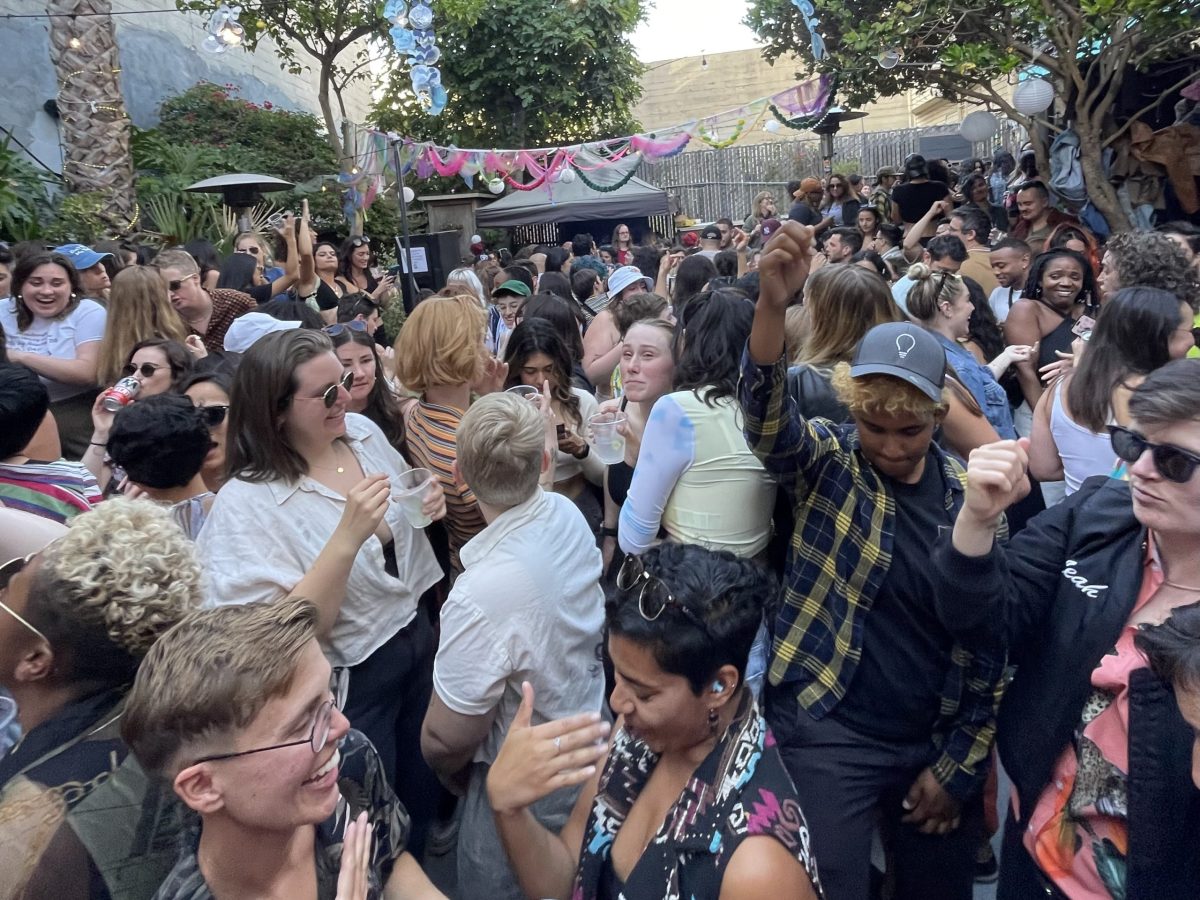

On the fourth Saturday of every month, a line gathers outside El Rio, stretching a block down Mission Street towards Fair Avenue. Those in line sip drinks, bunched up in front of storefronts, as an organizer from the bar walks the sidewalk. “Make sure to share the sidewalk with people trying to get by!” they say.
The crowd buzzes with anticipation: Though the line is long, it is a familiar wait to those who know what awaits inside.
From 2 p.m. on, those in line — mostly queer women and nonbinary people — squeeze through El Rio’s narrow front room at 3158 Mission St. and emerge into a sunny backyard. Like students on the first day of school, they mill about, greeting old friends, avoiding enemies and scanning the sea of faces for any unfamiliar gazes.
The new kids proceed more tentatively, their eyes wide as they take in the scene: A kaleidoscope of tattoos and colorful hair. “It felt like a lesbian frat party,” said Ella Altamirano-Iniestra, who first attended this party in August. “One of the first things I noticed is how much fun everyone was having. You don’t see that at other bars and clubs.”
Soon, bodies begin to gyrate and grind as hip-hop and Latin beats fill the air. Toto, we’re not in the straight bar anymore.
The event is Mango, a popular party that’s been around so long — 27 years — that it has become a legendary and vital part of San Francisco’s lesbian community, where attendees have created a community of regular party-goers.
“There was definitely this sense that, even if you don’t see these people all the time, you see them every month,” said Amelia Nahman, who has attended the event since its early days in 1996. “I definitely have people in my life that I’ve known from Mango.”
For its largely lesbian attendees, Mango provides a space that other events do not. Maya Gorgas, a regular attendee, said Mango played a role for the lesbian community akin to the Castro for the gay community.
“I cherish it in a way that I feel like a lot of gay men cherish a lot of the Castro or specific bars in the Castro, in that it feels like ours, in a way,” she said.
Carol Hill, the event’s current promoter, has helped organize the event since its inception, 27 years ago. When Hill and Chantal Salkey, Mango’s original promoter, arrived in San Francisco in the 1990s from their native Washington, D.C., they both missed the dance scene in which they had come of age as Black queer women.
“The Bay Area at that time had its own way of being, and for us it wasn’t necessarily that welcoming to women of color, especially black women, especially in terms of the music,” said Hill. “You could go to Club Q, but your music wouldn’t come on until 3 o’clock in the morning.”
But for some, that all-encompassing party atmosphere can be overwhelming.
Playing host to San Francisco’s lesbian community every month, in a party that involves flirting and dancing and drinking, means Mango often becomes the site of romance, sex and everything in between.
As attendees crowd the dance floor or gossip at the bar, others remain on El Rio’s wooden porch, talking and sizing up the crowd. The bolder attendees will eventually dive into the crowd, snaking through the pulsating masses to sidle up to an attractive prospect. Along the way, they might flash smiles to various parties, enjoying the game of the dance-floor flirtation.
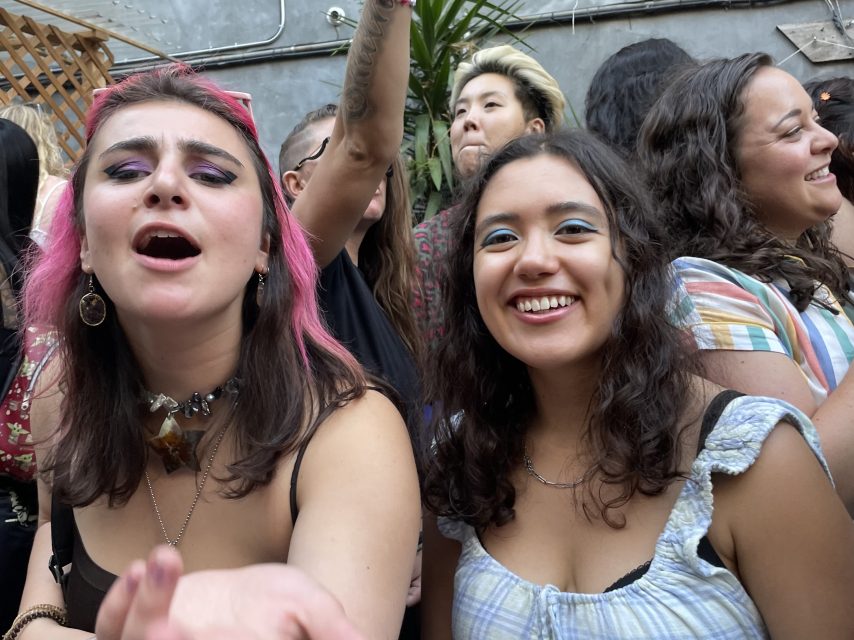
Because queer women and femmes have few opportunities to flirt, dance and otherwise seek out romance or sex in person, some feel intense pressure at Mango to meet someone.
Mango is “a gay debutante ball, judged by your appearance and ability to fit in niche social group aesthetics,” said Raleigh Williams, a graphic designer and occasional Mango attendee.
Williams said Mango puts “pressure” on attendees to make the most of the party, given that it’s one of the few such spaces in San Francisco. “If there were more events like Mango and they were more frequent, it would alleviate some of the social pressure and obligation.”
Hill is familiar with the social anxieties that Mango can provoke. “The fact that lots of women come means you’re bound to meet your ex, or have four of your exes in the same place,” she said. “We all want to go and be a part of that community and be a part of that love, and at the same time, sometimes that comes with a little bit of discomfort for some people around how many people they’re gonna see.”
“I don’t know anybody who doesn’t go through that at Mango,” she said.
Hill recalled that Salkey wanted a space welcoming to women of color, and created it for herself with Mango.
“She wanted to get the music for women of color. So, hip-hop, salsa, Latin groove, and make that a place where we all could come listen to our music, meet each other,” she said. “We could recreate the environment we had before, where we felt so seen and so heard and so loved when we were in D.C., and bring some of that to California and San Francisco.”
Mango was promoted by Salkey until her death in 2010. Hill then took over, and has managed the party ever since.
Over time, it has drawn a wider audience: “In the beginning, our tagline was, ‘A club for women of color and their friends,’” she said. “Now, we really have everybody. We even have men, we have a strong group of gay men that come every single Mango. The thing that hasn’t changed is our core: that we have this type of music, this type of food, this type of atmosphere together, where it’s love.”
Love — and a place for sexual and romantic exploration. “Mango was actually one of those places where I sort of realized that I might not want to be monogamous if I don’t get to dance with whoever I wanna dance with,” said Nahman, who is now in a polyamorous relationship. “There’s this, I don’t know if it’s even sexual, but there’s this strong energy of togetherness and strength and power.”
By early evening, couples are dancing close, heads bowed to whisper in each others’ ears, the only way to be heard over the pounding bass. Drinks from the bar have long been set aside in favor of waists and hips, as the atmosphere goes from backyard barbecue to drunken bacchanal.
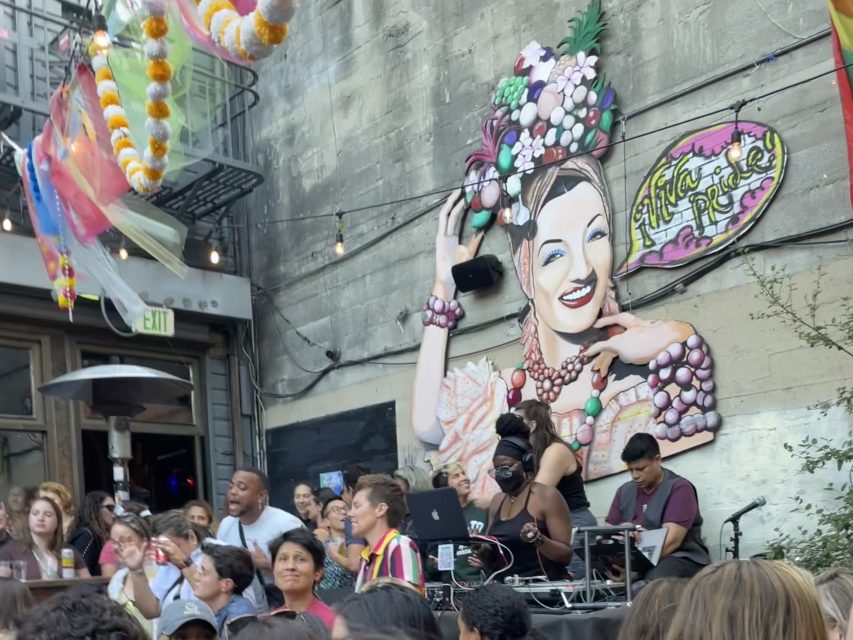
At Mango, queer women and nonbinary people can express physical affection more comfortably than at other nightclubs in the city, where such sapphic displays are novel and can attract unwanted attention.
“There is something about when everyone is dancing and feeling themselves and feeling each other and, especially as queers, we all feel safe,” said Nahman, a long time attendee. “There’s this moment of respite, and it’s really powerful.”
Maya Gorgas first realized an acquaintance of hers was queer at Mango. “We met at a dinner party in January, and I didn’t really think anything of it, just because she’s rather straight-appearing,” Gorgas said.
After seeing her at Mango in March, however, Gorgas realized that she was gay — and available: “I was so shooketh. I was not expecting that. So that’s where we hit it off, actually.” She added, dreamily, “I love Mango, because I don’t think I’d be dating Katie if it wasn’t for Mango, and I like Katie so, so much. So I feel really grateful for the space.”
For most, however, Mango remains what its founders envisioned: A fun, friend-filled party, where attendees return over and over to create a community.
At 8 p.m. on a recent Saturday night, Hill announces the last song of the evening with a cheerful, “We’ll see you next month!” Phones emerge and numbers are exchanged before the sweaty, disheveled crowd emerges into the crisp outdoors.
“At Mango, queer women and nonbinary people can express physical affection more comfortably than at other nightclubs in the city, where such sapphic displays are novel and can attract unwanted attention.”
It is 2023 in San Francisco for satan’s sake.
Contrast this centering of vulnerability with the DGAF queerness of the high queer era, where queers invaded het bars and did PDAs, during the depths of HIV/AIDS, to demystify homo affection.