

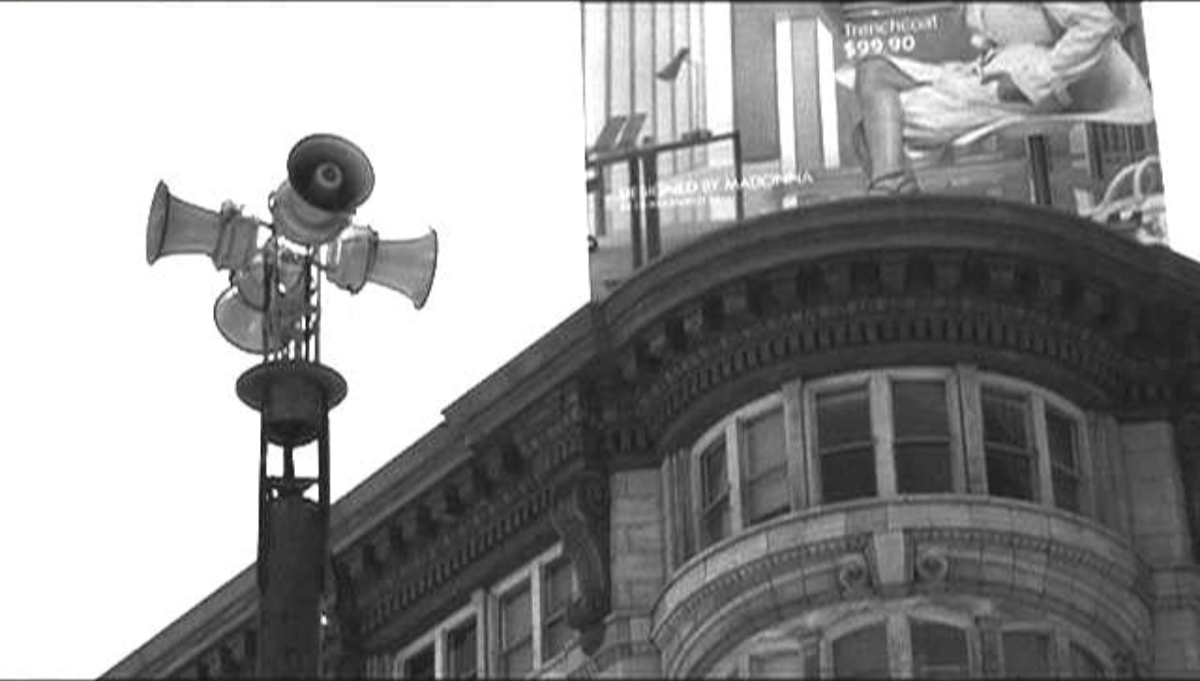

When a massive volcano erupted off the coast of Tonga on Jan. 15, 2022, it kicked off a tsunami that drenched parts of Tonga’s capital city and put locales around the Pacific Rim on alert. In San Francisco, fire and police crews drove along Ocean Beach and through the Presidio, using loudspeakers to warn people out of the water and up to higher ground.
Under normal circumstances, the city’s outdoor warning system — a fleet of more than 100 sirens stationed throughout the city — would have sounded during the tsunami advisory, followed by instructions on what locals should do.
But these aren’t normal circumstances. The city’s Department of Emergency Management took the sirens offline at the end of 2019 for security upgrades. The sirens were supposed to return within two years.
Almost four years later, their upgrades remain unfunded: In 2019, emergency officials estimated that it would cost $2 to $2.5 million to upgrade the entire system, which included software improvements, enhanced encryption and new hardware that could handle those changes.
But the Covid-19 pandemic struck three months later, and suddenly San Francisco’s emergency funding was needed elsewhere, Bechelli said.
Each year, DEM has asked the city’s Capital Planning Committee for funds to bring the sirens back to life, but the committee keeps putting the plan on ice. And, over time, cost estimates have ballooned; overhauling the whole system would now cost closer to $3 million, said Adrienne Bechelli, the deputy director of the emergency department’s Division of Emergency Services.
After that 2022 tsunami advisory, Supervisor Connie Chan, whose district includes many coastal areas of the city, challenged the Department of Emergency Management to find money for the sirens. “I said, “What are you guys going to do? This is not an acceptable situation.’”
So in February 2023, DEM proposed a $2 million plan to upgrade just 27 sirens in coastal, tsunami-prone areas, but was shot down again by the capital committee, which is made up of 11 city officials and department heads.
“These are obviously very critical projects that we would want to prioritize, in terms of emergency management,” Port of San Francisco director Elaine Forbes, and member of the committee, said at that meeting, referring to the siren upgrades as well as a new emergency operations center and improvements to the 911 call center. “I’m very supportive.”
And yet, “the committee decided not to move forward” with funding the outdoor warning system, said Angela Yip, a legislative analyst with the City Administrator’s office. “It funded other things.”
San Francisco’s current Capital Plan includes nearly $41 billion in infrastructure improvements over the next 10 years, $1.4 billion of which will go toward public safety needs. That will cover upgrades to fire and police stations, county jails, the 911 call center and the emergency firefighting water supply system, Yip said in a statement.
Yip noted that San Francisco has alternative ways of notifying residents in emergency situations, including AlertSF, which warns people of fires and police activity via email and text message, social media posts, and a wireless warning system similar to Amber Alerts.
When reminded that all of these rely on mobile-data technology, which might be knocked offline in a major emergency, Yip said, “That’s a valid point.”
From air raids to climate change
San Francisco’s emergency sirens went live in 1942, to warn residents about imminent air raids during World War II. They’re generally reserved for evacuation-level emergencies, such as tsunamis, although they were also used on Treasure Island in 2012 to warn residents to boil their drinking water after a water main break, according to Bechelli.
Even though the sirens were rarely used for emergencies, longtime San Francisco residents grew fond of them because of their weekly tests. Each Tuesday at noon, the sirens would blare from rooftops and posts across the city, followed by a brief recorded message from legendary KFOG host Dave Morey. Some repeat the message in Spanish and Cantonese.
The outdoor warning system is so popular that it has its own page on Yelp, where it has a rating of 4.1 stars and reviews like, “It’s loud and very punctual. Great Siren.” For many years, a Twitter user posted regularly, pretending to be the sirens. Just like the real system, those tweets went silent in December 2019.
Over the decades, the outdoor warning system has undergone a number of upgrades, including one in 2005 and another in 2018, the latter to enhance their security in an era of increasing cyberattacks. Even then, they were still vulnerable.
Some in the San Francisco tech community have raised questions about the system’s potential security flaws. After the sirens went off unexpectedly in August 2012 and November 2014, Mozilla cofounder (and DNA Lounge owner) Jamie Zawinski wondered if they were due to security exploits. After all, locals were hacking them for fun in the late 1990s, and a 2018 whitepaper exposed the sirens’ vulnerabilities.
DEM spokesperson Kristin Hogan denied that those misfires were the result of anything nefarious. Rather, they were “due to general technical system malfunctions,” she said. Even so, the outdoor warning system needed major system upgrades after the quick fix in 2018.
“In December 2019, we took the siren system offline [after] some security vulnerabilities were identified within the system. We did not want the sirens to be hacked, or anything of that nature, and set off unnecessary panic,” Bechelli said.

That shutdown has led to a four-year gap in San Francisco’s emergency notification system, leaving residents vulnerable in the event that cell phone service or internet access is knocked down.
Indeed, as flames swept through Maui last week, telecommunications and electrical systems failed, making it nearly impossible for residents to receive evacuation warnings. Lahaina has an emergency siren system similar to San Francisco’s, but Hawaii officials told the Associated Press that there’s no evidence the sirens were activated during the fire. At least 96 people died in the blaze.
And AlertSF, for its part, is an op-in system, where residents must sign up to receive notifications. To date, only about 174,000 of the city’s 815,201 people, or 21 percent, have opted in, according to DEM spokesperson Jackie Thornhill.
Bringing the sirens back to life would add critical redundancy to San Francisco’s emergency systems, Bechelli said. In a crisis, “we love to have five or six solutions for every problem,” she said.
When asked whether, as climate change brings more extreme weather, San Francisco’s sirens could be used in a wider range of emergencies, Bechelli was hesitant.
“The primary goal [of the sirens] is to invoke immediate actions. The extreme weather patterns we’ve seen … usually require more nuanced info,” she said. “In a purple air-quality day, we would tell you to do whatever you can do to get out of the smoke, and offer different information based on your vulnerabilities. With that, or in flooding due to major storms, an evacuation siren might not be the right tool.”
Supervisor Chan disagreed, saying, “The environment we face is increasingly unpredictable. We know the siren hasn’t been in use, with the exception of tsunami warnings, but we know we might see this type of use more frequently as we’re going through climate change.”
DEM plans to bring the siren upgrade back before the Capital Planning Committee early next year in the hopes of finally winning funding, Bechellli said.
“The Capital Planning Committee’s reasoning [for putting this on hold] is very sound, and there’s adequate support” for the sirens,” she said. “There’s just, frankly, never enough money to go around.”
This repair and on lining should be Top Priority Now!! Maybe it’s not so wise to not charge billion dollar businesses any payroll tax! San Francisco should be able to handle this cost without issue. Please get this done ASAP!! It’s hard to even believe the City would be so negligent on an emergency alert system
Our “world class city” confounds me. You can find $1 mil for a single public bathroom but can’t find $2 mil to upgrade the city-siren system.
In comparing alertsf to the sirens it is worth noting that alertsf is:
1: cumbersome to sign up for. I did it just now and it is quite the process.
2: extremely chatty. Looking through past notifications, I see 25 notifications in the most recent 30 days. I suspect I will quickly unsubscribe due to the volume of notifications
Learn from Maui! Get the system back on line!
And then there’s of course the back and forth and cutting and delaying of the extension to the Auxiliary Water Supply System.
Thank you. This was well written.
3 million is a drop in the 41 billion dollar budget. I don’t understand what the problem is.
I remember it cost a million dollars just to repair the vandalized slide and other playground equipment at Children’s Playground a few years ago. Surely we can spend 3 million on a city-wide disaster warning system.
I remember being at some event Newsom spoke at as Mayor, and he made a big deal about how he had expanded, improved and modernized the siren system and linked it all with the SFPD command center. I’m guessing, as with most things, he didn’t do that good a job…
We don’t have the funds for this. We need to continue spending every dime we have on destructive street people who don’t get better.
How many ways can London Breed’s San Francisco tell San Franciscans that they hold us in contempt?