

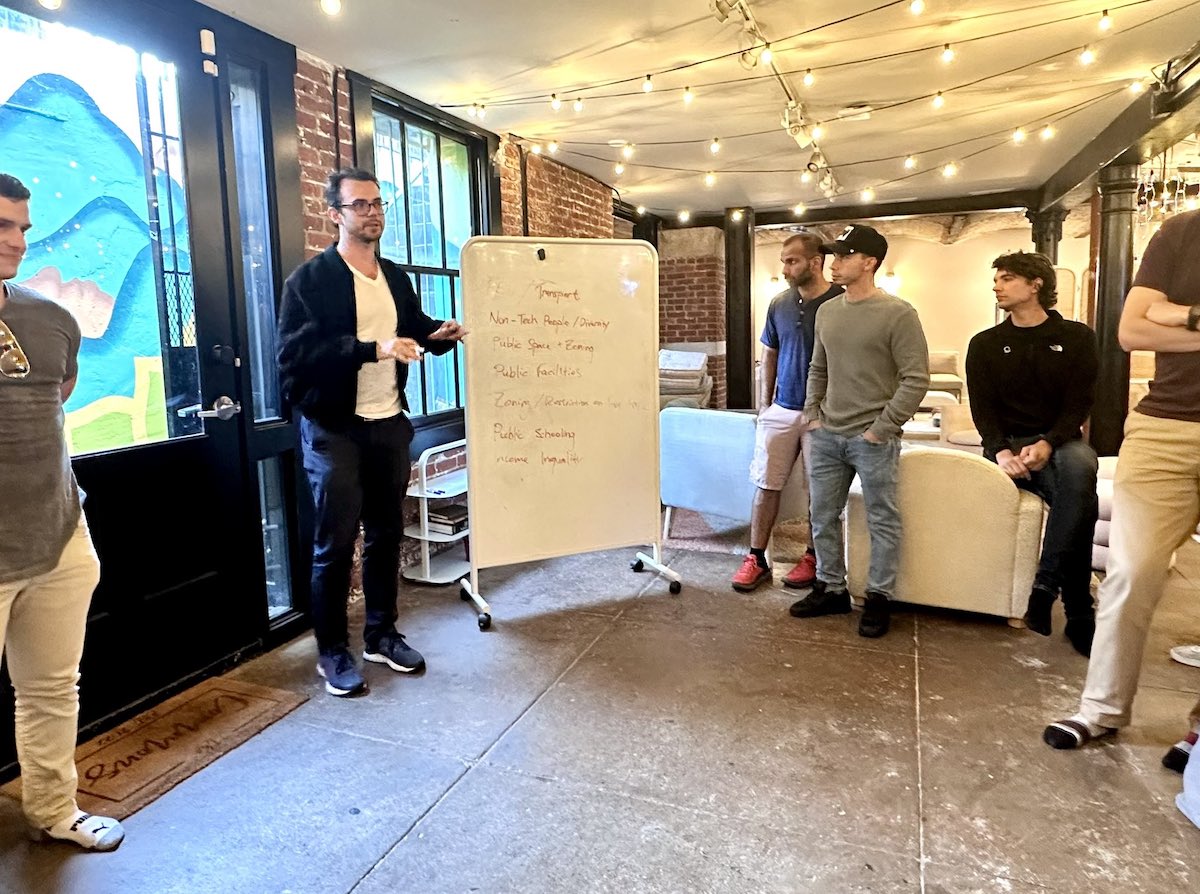

While artificial intelligence evangelists promise to save the world, two local AI enthusiasts have narrowed their focus: Save San Francisco.
That is the clarion call two twenty-something techies are making at social gatherings around the city, inviting fellow coders to a hackathon on Sept. 23 and 24. Instead of promising to solve homelessness, housing and the city’s approach to data in one fell swoop, they are looking for down-to-earth applications of AI — bites of the bigger problems.
Already, 200 engineers have signed up for their sessions.
“Many people complain about problems in San Francisco,” said Anthony Jancso, a former employee of Palantir, a data analytics company known for its intelligence, military, and immigration enforcement contracts. “We really wanted to give them an opportunity to actually submit project ideas to improve on San Francisco.”
Jansco and Jordan Wick, a former employee of autonomous vehicle company Waymo, founded Accelerate SF earlier this summer with the goal of building AI solutions for the city’s most pressing challenges.
This “hackathon” is a chance for attendees to work simultaneously. Each will decide their own project, and do their best to do something — anything — to help the city, in two days. This could include streamlining application processes, organizing data sets, and making financial information easier to access.
Especially successful projects may have the potential for “city-wide deployment,” the event says, though it is not clear what official backing those projects would have.
Wick said they see the hackathon as “redirecting some of this builder energy and engineer brainpower to just thinking [about], and hopefully acting on, some of these challenges.”
The two entrepreneurs said the vast majority of new AI startups have focused on the private sector, and shied away from government problems, because of the perception that “it’s really hard to interact with the government or to deploy solutions within the government,” said Jancso.
Accelerate SF wants to help with that. “Everyone we reached out to was very happy to get back and open the doors for us,” said Jancso.
As part of the hackathon, the two have a speaker series, and already on the list are California state Sen. Scott Wiener, who is expected to focus on housing issues, and District 4 Supervisor Joel Engardio.
They are also in conversation with the Mayor’s Office of Innovation, the San Francisco Police Department, the San Francisco Municipal Transportation Agency, and other organizations, like YIMBY Action, which has close ties with tech workers, and the Housing Action Coalition.
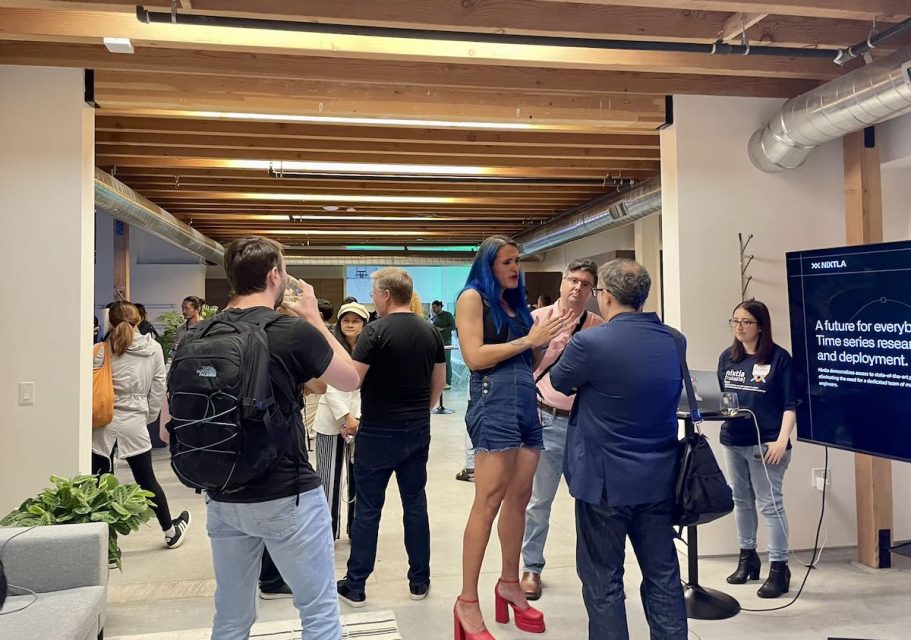
Through its discussions with the city and other tech workers, the team has identified 11 challenges in San Francisco’s public sector where software solutions could help the city. They shared a few.
One is housing. Using large language models, a type of AI, engineers may be able to find a way to help businesses fill out permit-application forms to expedite the construction process.
Filling out permits might be less exciting than more dramatic ideas espoused elsewhere, but Jancso believes these small changes are where the potential of the technology lies. “This is obviously not going to solve homelessness, for sure, but it can definitely have a positive impact on house prices,” said Jancso.
They’ve also suggested a chatbot that could parse through government datasets. Current interfaces, they said, are difficult to use, and they hope to streamline that process — a simple application of what ChatGPT is already doing.
Users, for example, wouldn’t have to download datasets in cumbersome programs such as Excel. Instead, government employees could just simply talk to their data sets and ask simple questions such as, “’how much did we spend on fixed income on mitigating homelessness in the Tenderloin’ or, ‘Which law talks about this thing?’”
They hope that by collaborating with local stakeholders, they can find a path to citywide deployment after the hackathon. “Technology is a way to do more with less resources, and large language models are a new technology to do more with less resources,” said Jancso, who called these applications “low-hanging fruit.”
As for the profit model of Accelerate SF, “what we really want to do is to just be useful,” said Jancso. “We’ll first start with this hackathon, and then we’ll see where it takes us.”
The Accelerate SF hackathon is tentatively scheduled for Sept. 23 and 24 and is still accepting new registrants. According to Jancso and Wick, investor Jeremiah Owyang, Peter Hirshberg, chairman of the Maker City Project, and “Steve Jobs’ former marketing director,” are also on the list of participants.






Wasn’t tech already addressing the issue of housing affordability through algorithm?
RealPage has been recommending that landlords artificially inflate their prices by taking units off the market, to sit fallow.
https://www.propublica.org/article/yieldstar-rent-increase-realpage-rent
https://www.propublica.org/article/yieldstar-realpage-rent-doj-investigation-antitrust
Yeah, the same folks who contributed to many of the problems are now going to fix it.
I think of ‘tech folks’ as just using software to monetize through informational enhancement. Not really concerned with the human condition, but making some money off that condition.
Palantir supported ICE agents with intelligence. WayMo is accused by EFF (electronic frontier foundation) of surveillance.
Perhaps the founders are looking for forgiveness? Tech won’t solve problems. Giving money to someone facing eviction would help more than AI. In SF Tech workers have $500-1000 spendable cash, easy, so please aid someone before they too become houseless
I’m both a renter and a land lord (I can’t afford to buy in SF, so I bought outside the city and rent it) so I can offer some perspective here.
1. If you put a unit up for rent that’s above the market rate for that type of unit in that area, you’ll still probably rent it, but the renter will most likely move as soon as another place that’s more competitive becomes available.
2. Someone who’s got a good deal on rent is simply going to hang onto that rental, even if the owner wants to sell. Renters, even good ones, are hard on a property. So if you have a property, and you want to sell it or if you want to redo the floors or if you want to upgrade the kitchen or if you simply want to give it to a friend or relative, you can’t do it with a renter in there and if they don’t want to leave, it’s a HUGE deal to try to evict them.
The result is that rent prices keep going up – and I don’t think it’s anyone in particular’s fault, it just naturally seems to do that as long as these factors are in place.
The only “good” plan seems to be making some inexpensive public housing that normal people could rent like any other unit .
I will be generous and assume that some of these hackathon participants genuinely want to help people and society. The way to do that is not completing forms for building permits, nor listening to YIMBY Action, nor “entrepreneurs.”
It is done by listening to people who actually work with people who face ridiculous problems in our society to figure out what exactly the problems are, brainstorming to develop plans to solve those problems, working with the various communities to get “buy in” for the proposed solutions to make sure they are workable and then the development and implementation those solutions.
In short, you all have to get out of your bubbles and get your hands dirty to bring about any meaningful change. You are not experts in identifying problems. Relying upon YIMBY whatever, Scott Wiener, SFMTA and other entities that are so removed from the real-world problems that too many among us face will accomplish nothing meaningful.
I wish you success.
I’m a Weiner & Engardio fan (minus some policies) but Small Property owners (mom & pop’s) face other problems, like onerous laws. Rights of owners have diminished every yr for past 20-40yrs. It would be great to see ChatGPT highlight which laws they need to strike to make the playing field level. These are things that come from human experience, a computer (I’m pretty sure) can’t model this, but if it can, great! Then that’s exactly what SF needs to be told. I know people don’t want to hear this, but SF does have an abundance supply of housing in SF, there are SO many units available for rent on the market, building more housing is probably not the answer, as much as politicians like to tout. It’s the affordability of those units that’s the issue. Construction costs are high due for many reasons (CA building codes), you’re not going to get a much cheaper product, it’s expensive to build.
For existing housing, rents would come down if there were laws that protect owners, you can’t have it both ways.
Thank you to the tech folk who are donating their time for this effort, I just hope they ask the right questions.
(Of course politicians like Preston, far far left, run on creating fear & division. These are the politicians ironically keeping the prices high).
Isten éltessen Zsombor!
Maybe the ai can solve the problem of housing commodification that’s at the center of our housing crisis.
Or better yet, maybe our politicians at all levels could finally enshrine housing as a right for all and we could get to work ensuring that everyone actually have a livable and sustainable place to live.
Tweaks at the edges are not solving and will not solve what is a structural problem in the first place.
Government, private enterprise, volunteerism, and non-profits incessantly blur to gift us with everything to live in our best of all possible worlds. And if they don’t, wasn’t it best to have lit a candle than to have cursed the darkness?
With some personal experience in this type of “do-goodism”, and a healthy distrust of experts whose expertise came from working for companies known for their “intelligence, military, and immigration enforcement contracts”— I intuit that profit and prestige are the chief goals here.
Even if we had a magic wand to solve all our problems, what will the solutions mean to us when they make us more dependent and walled off from participating in genuine democratic solutions?
Are we not witnessing the results of something similar in our city currently plagued by brainless autonomous vehicles?
We had long known that they were coming— but to what extent did we, and do we, have a say over them?
I stopped reading at Palantir.