

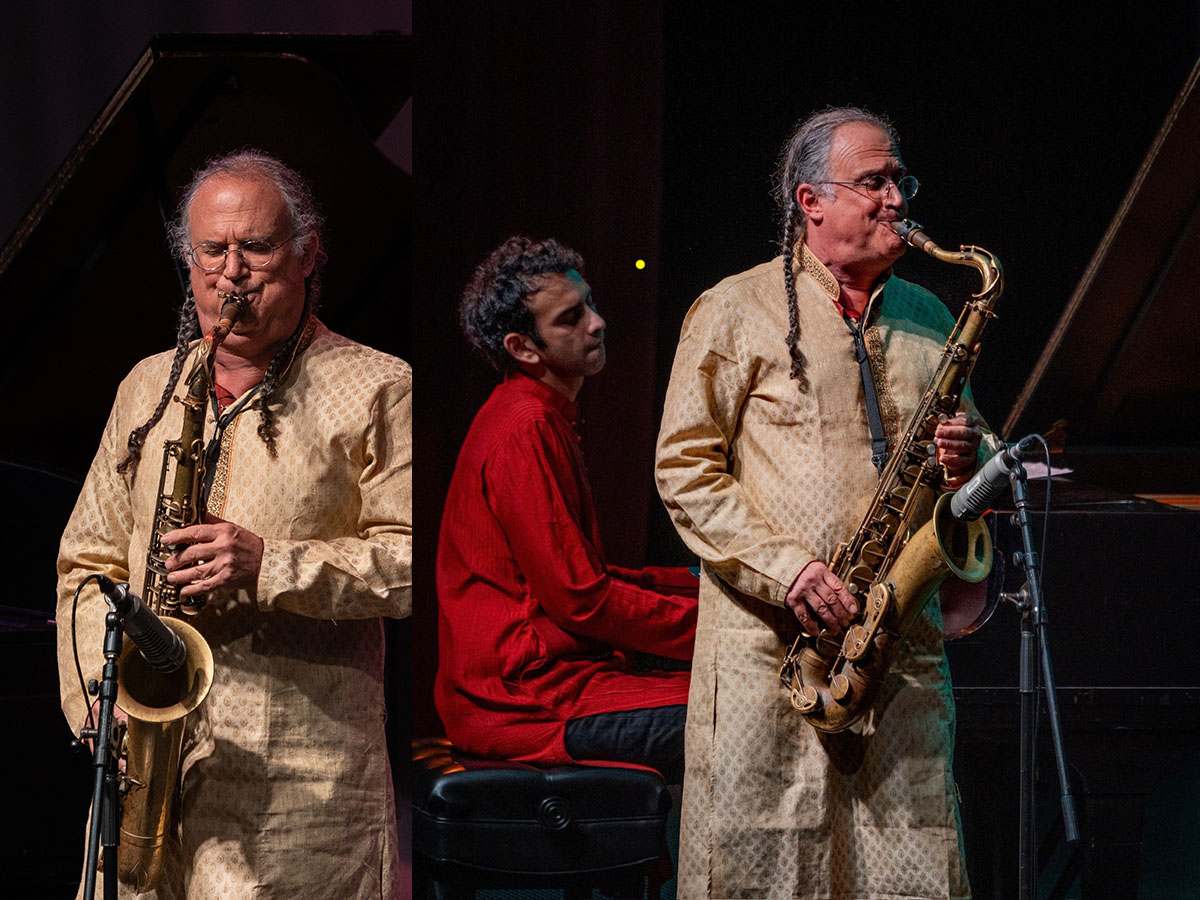

With his twin braids running down his shoulders, saxophonist George Brooks blends right into the Berkeley landscape. Offstage, there’s not much to indicate that he’s a transformative artist. On the bandstand, he’s a fulcrum for East-meets-West encounters in which American jazz players and North and South Indian classical musicians blaze new trails together.
Over the years, Brooks has been at the center of collaborations with some of the most celebrated improvisers in jazz, Hindustani and Carnatic music, and he’s bringing together another promising combination to celebrate his 67th birthday Sunday at the Red Poppy Art House. Featuring 30-year-old New York-based raga pianist Utsav Lal, veteran Oakland keyboardist Frank Martin, Berkeley drummer Scott Amendola and special guests, it’s a confab that got a partial test run last month at the Stanford Jazz Festival (when Lal and Amendola were part of Brooks’ annual Indian jazz summit concert at Stanford).
Sanjoy Roy, the producer of the Jaipur Literature Festival, connected Lal and Brooks via email in 2019, and the saxophonist “was pretty excited to find a pianist trained in Indian classical music, especially dhrupad, one of the oldest forms of Hindustani vocal music, who is also well-versed in Western classical and jazz,” Brooks said.
Like Brooks, Lal is a graduate of New England Conservatory and very familiar with the music of Terry Riley, with whom Brooks has collaborated extensively, “so, I was pretty certain there would likely be lots of points of connection,” he said. He first brought Lal out to California in February 2020 for a San Jose performance at the EnActe Arts gala. They stayed in touch throughout the pandemic, and have found opportunities to play together in half a dozen situations since then.
Lal happens to be in town this weekend for the San Francisco Silent Film Festival, performing solo accompaniment for three films at the Castro, including Friday’s re-premiere of “Flowing Gold” (1924) and the pioneering haunted-house thriller “The Cat and the Canary” (1927), and Saturday’s Japanese gangster homage by Yasujiro Ozu, “Walk Cheerfully” (1930).
Brooks has been looking for an opportunity to get Lal together with Martin, a longtime friend and collaborator who’s both a ubiquitous performer in the Bay Area and a first-call studio musician known for his work recording and producing sessions with luminaries in jazz, pop and Latin music. Like so many Bay Area musicians, he first gained widespread notice with saxophone great John Handy, who was riding high with his hit 1976 album for Impulse!, “Hard Work.”
Martin went on to perform with a stellar array of jazz stars, including Herbie Hancock, John McLaughlin, Dizzy Gillespie, Joe Farrell and Al Jarreau. But he filled out his pop, soul and R&B resume via his relationship with the hit-making producer Narada Michael Waldon, who contacted him in the mid-‘80s, shortly after settling in San Rafael and setting up Tarpan Studios. Their creative relationship blossomed as Martin participated on sessions with music stars, including Stevie Wonder, Diana Ross, Whitney Houston, Ray Charles, Elton John, Sheryl Crow, James Taylor and Madonna. His work with Sting has led to an ongoing gig as music director of Sting’s annual Carnegie Hall extravaganza.
“Utsav has all these experiences, but he didn’t grow up playing four-hour gigs every night like Frank, who has such an incredible breadth of experience,” Brooks said. “I wanted to the two of them to meet. Frank has done a lot of Indian projects with me but he didn’t grow up with raga. He’s such a good accompanist. Utsav developed certain techniques on the piano, evolving from the hammered dulcimer santur. They will really complement each other.”
The Red Poppy concert is just the latest manifestation of Brooks’ vast web of connections in jazz, Indian music and beyond. He started exploring the the North Indian classical tradition while attending New England Conservatory in the late 1970s. When his wife received a fellowship to study Indian vocal music in 1980, he developed a relationship with Pandit Pran Nath, the giant of North Indian vocal music who deeply influenced pioneering minimalist composers LaMonte Young and Terry Riley. Back in the Bay Area, Brooks and Riley’s mutual passion for Indian music brought them together in a widely traveled duo.
It wasn’t until 1996 that Brooks unveiled his own Indian jazz synthesis on his debut CD, “Lasting Impressions,” which tabla maestro Zakir Hussein released on his Moment Records. The project that introduced Brooks’ melodically charged compositions and command of extended rhythmic cycles. His relationship with Hussain deepened with 1998’s “Night Spinner.” Hussain co-produced the album and they honed their musical connection through a series of duo performances.
Over the past three decades, Brooks has also performed and recorded with North and South Indian masters such as bansuri legend Hariprasad Chaurasia, violinist/vocalist Kala Ramnath, guitarist Prasanna, and T.H. “Vikku” Vinayakram, the world’s foremost master of Carnatic music’s ghatam, a clay pot drum.
He performs in India almost as often as he plays in the Bay Area, and his next gig here takes place Oct. 15 at the Montalvo Arts Center in Saratoga when he joins forces with Afghan rubab master Homayoun Sakhi, Hindustani vocalist Apoorvaa Deshpande, ghatam expert Dr. Ravi Balasubramanian, and award-winning tabla player Rajvinder Singh.