

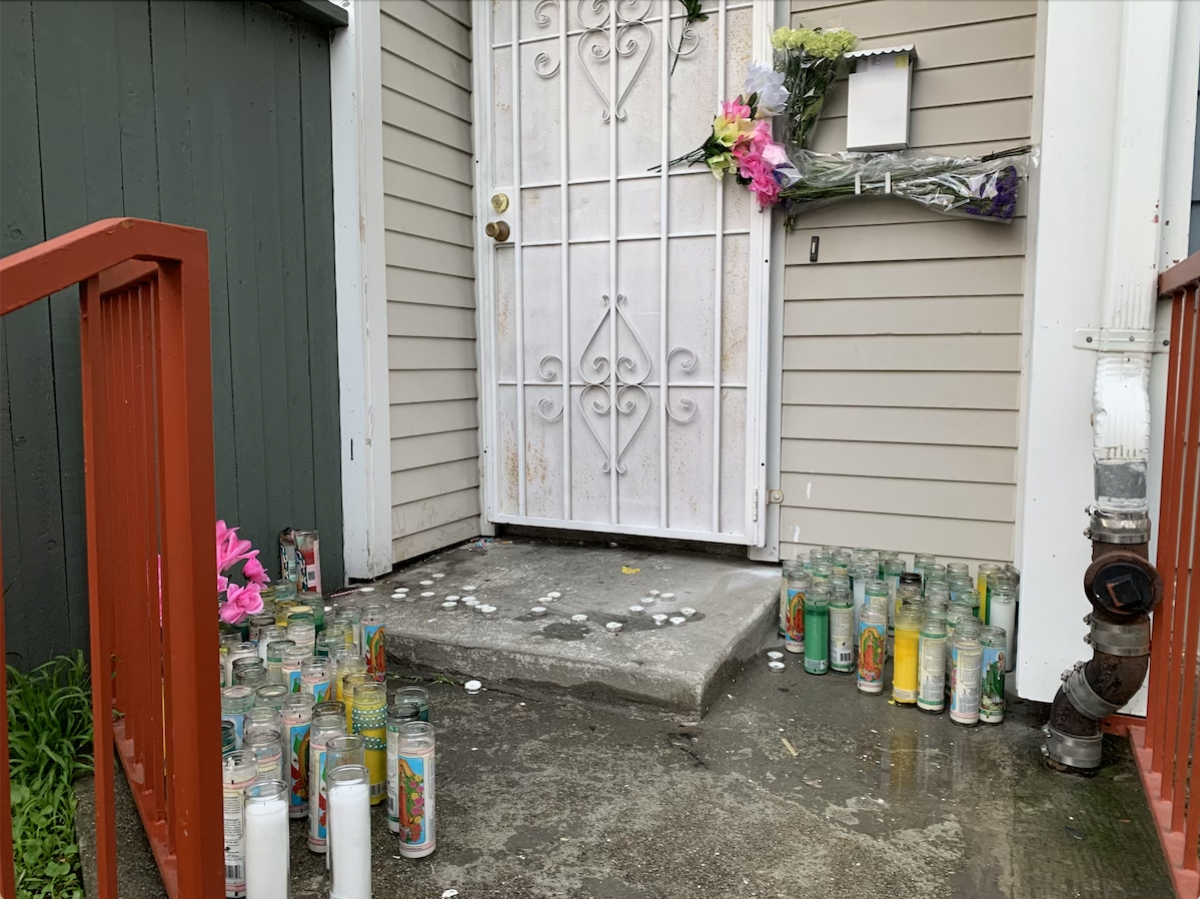

Following testimony from three witnesses, a judge today ruled that a mother accused of killing her two young children two days before Christmas will face murder charges at trial.
Paulesha Alma Green-Pulliam is charged with two counts of murder and a multiple murder charge for allegedly killing her daughters, Justice Alma, 5, and Paragon Maya, 1, and faces arraignment March 2 at the San Francisco Superior Court Hall of Justice. Green-Pulliam could be sentenced to life without parole if she is convicted of all charges.
On Thursday, Green-Pulliam attended her preliminary hearing, during which a judge decides whether to dismiss or proceed with a case based on evidence the attorneys present. Following the graphic details of the situation and Green-Pulliam’s alleged admission to a police officer, Judge Loretta M. Giorgi decided that there was sufficient evidence, or “probable cause,” to send the case to a trial before a jury.
Giorgi reasoned the daughters’ dead bodies found in Green-Pulliam’s closet, one of which had white foam coming out of her mouth and a cloth lodged in her throat, was enough evidence to move the case forward. The judge acknowledged that though the San Francisco Chief Medical Examiner had not yet listed the causes of death, it was not due to “some sort of natural causes.” Still, Giorgi added, “we do not have the exact picture yet.”
The judge also referred to a statement Green-Pulliam allegedly gave SFPD officer Rachel Leung on Dec. 23, the day of her arrest. Purportedly without prompting, Green-Pulliam told Leung that she feared her daughters would be sex-trafficked, and she “should have let that happen instead of take their life,” Leung testified on Thursday.
While Green-Pulliam did not explicitly say she killed Justice and Paragon, the “take their life” phrase “is pretty clear,” Giorgi said.
Giorgi’s ruling came after three police officers testified on behalf of the prosecution. Prosecutor Omar Talai from the San Francisco District Attorney’s office suggested that Green-Pulliam strangled her children when she was alone, and that she admitted to the murders.
The defense’s strategy, helmed by senior trial attorney Phoenix Streets for the San Francisco Public Defender’s Office, was to suggest Green-Pulliam’s statements could not be trusted based on her mental health, which was suffering at the time. Streets further implied something else could have occurred during the father’s three-day absence.
“What we have is that we have a grieving mother, who was at home with their two children who are deceased. We don’t know what happened to the children,” Streets said in his concluding statements. “A doctor from the Medical Examiner stated that she couldn’t determine the cause of death.”
Green-Pulliam’s boyfriend, who was the father of Justice and Paragon, told officers Green-Pulliam suffered from postpartum depression after grieving the death of their son in September, and had tried to kill herself.
He was present on Zoom on Thursday to listen, but not brought to testify. Mission Local is not naming him nor his daughter’s last name.
Though Giorgi appeared to agree with some of Street’s assertions that stronger evidence could be presented — “if this goes to trial, this will need a lot more evidence,” she told Talai — she sided with the prosecution’s arguments.
Only the prosecution called witnesses today. Talai summoned SFPD Officer Deandre Dudley, who responded when the girls’ father frantically called 911. Dudley said upon arriving at the apartment on Navy Road in Bayview Hunters Point, he saw a “male pacing back and forth and crying in the middle of the street,” and Green-Pulliam’s apartment door open.
“Did you see one of the residents? Can you identify them?” Talai asked.
“Yes,” Dudley replied, looking at the defendant. “Ms. Green-Pulliam. Sitting there.” Green-Pulliam, present for the hearing, was dressed in orange, and expressionless throughout.
“Were there any non-officers in the residence?” Talai asked.
“No,” Dudley said.
Dudley described walking into the closet of Green-Pulliam’s home, and finding the two girls’ bodies laid out. The bodies were covered in blankets, and there was a carton with pictures of “infant footprints” inside, he said.
Talai presented photos taken of the crime scene, which witnesses said corroborated their recollections.
Streets asked Dudley if he found any medication inside the closet. Dudley did not remember.
Officer Leung, who also responded to the scene Dec. 23, then took the stand. She corroborated Dudley’s account. Leung testified that she found Green-Pulliam on the couch, and then handcuffed her. She brought Green-Pulliam to the police car and stayed with her for approximately an hour, but was told not to interview her.
However, Green-Pulliam “spontaneously stated that she killed her children,” Leung said on Thursday, in response to Talai’s questioning.
“Did she say why?” Talai said.
“She claimed because [they] were being sex-trafficked,” Leung said. She recalled Green-Pulliam saying, “‘I should have let that happen instead of take their life.”
During cross-examination, the defense questioned this. “So, she never said the words, ‘I killed?’’” Streets asked Leung.
“Correct,” Leung responded.
Sgt. Francis Graves, an SFPD homicide investigator, was the final witness Thursday. She testified that she spoke with Dr. Ellen Moffatt from the Medical Examiner’s Office, who did not name a cause of death for the daughters but noted both had petechiae, round spots that form from bleeding under the skin. Graves said that during her prior experience working for the Special Victims Unit on domestic violence and child and sexual abuse cases, she learned that petechiae can be a sign of strangulation.
Moffatt also told Graves that a piece of cloth was found in the back of one of the girls’ throats.
Graves described arriving to the scene on Dec. 23, where the father of Paragon and Justice said he returned after celebrating his birthday elsewhere from Dec. 20 to Dec. 23. Upon arrival, he knocked on the door because he didn’t have his keys, and no one answered for 15 minutes.
When Green-Pulliam, his girlfriend, answered the door, he asked where their daughters were. She told him “they were gone” and “she apologized” to him, Graves said.

Graves entered the closet at the residence and found the bodies discolored and rigid. On the bodies were what appeared to be birth certificates and a sonogram, Graves said.
On cross-examination, Streets asked if Green-Pulliam told her boyfriend she had tried to kill herself before. Graves confirmed this.
Streets also asked whether Moffatt said if the piece of cloth was put in before or after the body was declared deceased. “She did not tell me that, and I don’t think it’s something she could determine,” Graves said. Streets moved to strike the last part based on speculation, which Giorgi agreed to do.
In cross-examination, Streets asked Graves if she could describe what a toxicology report is or a histology report is. Graves said she could not. “I am not a medical professional,” she said, shrugging.
Streets capitalized on this, arguing in his concluding statements that Graves twice admitted she was not a medical professional, and thus was ill-equipped to suggest the children died by strangulation. He argued that this, plus the lack of a Chief Medical Examiner’s Report and Green-Pulliam’s mental health, meant the prosecution had an insufficient case against his defendant and it should not move to trial.
“The prosecution is trying to rely solely on a statement by Ms. Green-Pulliam that is vague and meaningless at best,” Streets said. “Because they were trying to traffic her. I should’ve let them do that rather than take matters into my own hands. What does that mean? She feels bad because the kids died? Of course she does.”
Talai responded, “these kids are dead at the hands of Ms. Green-Pulliam, not because I said so, [but] because she said she took their lives. That is not a phrase that could have multiple meanings.”
The prosecutor added that he did not need a cause of death at a preliminary hearing, which only requires enough evidence to move to a jury trial.
“This is up to a jury,” Talai responded. “There is more than enough evidence at this stage.”
Ultimately, Giorgi agreed.
At the end, a family member supporting Green-Pulliam called something out to her before exiting with the rest of the group. Her brother, present, declined to comment, but described Green-Pulliam as “the life of the party.”