

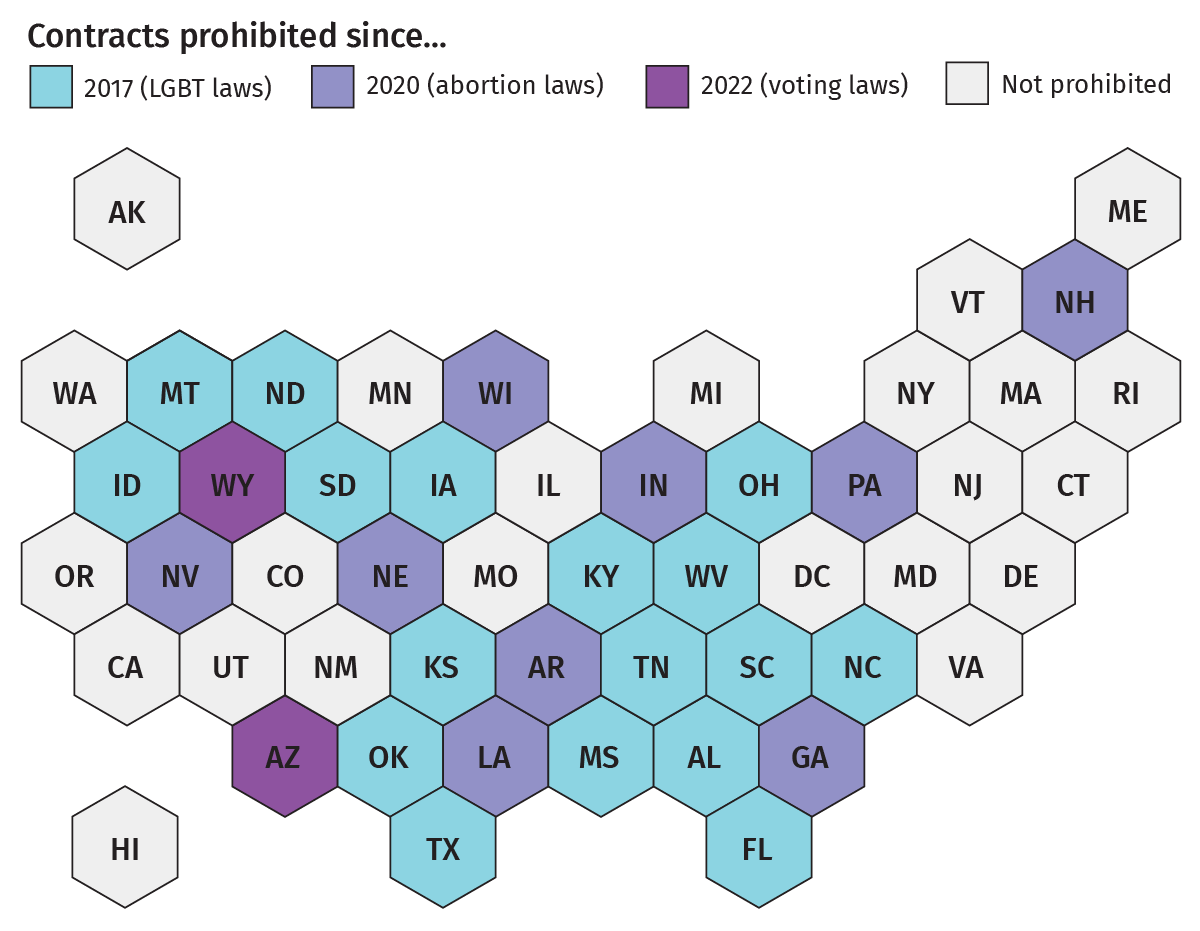

In March, Mission Local wrote that the city of San Francisco was boycotting the majority of the United States — 28 states that did not pass the city’s criterion regarding anti-LGBTQ laws, anti-abortion laws, or restrictive election laws disproportionately affecting people of color.
In the intervening seven months, that tally has grown: The city presently cannot contract with businesses headquartered in 30 states, nor can city employees visit those states on official business. But, in the relatively near future, San Francisco may greatly alter this increasingly unwieldy system, or junk it altogether.
The Board of Supervisors Budget and Legislative Analyst today released an analysis of this practice, following a request from Supervisor Rafael Mandelman. It is not a happy read: While the city, in 2016, initiated “Administrative Code 12X” with the best of intentions, San Francisco may have reaped the worst of results.
“While it is difficult to measure how the City’s contracting costs have been affected … researchers have found that full and open competition for contracts can result in savings up to 20 percent,” reads today’s report.
So, the city probably paid more, perhaps considerably more. But, while it was unaddressed in today’s report, it’s clear that the city’s boycott has not altered any objectionable practices in the targeted states. “There is no evidence this is effective at changing behaviors in any of these states we have a beef with,” Mandelman told us today.
Anti-LGBTQ legislation, reproductive health curtailments and voting restrictions have clearly mushroomed in the targeted states in recent years. But this was no surprise to city officials in charge of administering the boycott: In the six years since its enactment, no other cities have joined San Francisco’s boycott, meaning its power was diffuse — and bound to fail.
“No city has reached out to say they want to mirror our rules,” City Administrator Carmen Chu told Mission Local in March.
What’s more, the notion of irritating San Francisco is political manna from Heaven in much of the country.
Earlier coverage
San Francisco has, however, punished the individual businesses in those targeted states, even ones owned by LGBTQ people, minorities, women and others “attempting to pull their states into the 21st century,” in Mandelman’s words.
And San Francisco has borne a cost: By restricting the number of companies that can bid on San Francisco contracts, it has, intuitively, increased costs and potentially impeded quality.
“It limits our ability to procure products and receive services and contract services we need to run,” City Administrator Chu candidly admitted in March. “It limits competition for our work.”
Just how much more the city has paid to receive less will never be known. But today’s report makes an estimate. With the assumption that a full and open bidding process could save the city somewhere between 10 and 20 percent, the Budget Analyst compared 13 low-bid contracts enacted before the 2016 ban to the projected costs following the ban’s implementation. The report pegged increased costs of $23.5 million on the low end, and $47 million on the high end — just on these 13 contracts.
Mandelman today sent a letter to Chu, co-signed by fellow supes Catherine Stefani, Aaron Peskin, Hillary Ronen and Ahsha Safaí. It requests that she initiate the process of either amending the city’s boycott or doing away with it altogether. Chu’s analysis is expected to last until May of 2023.
Mandelman said he is not hoping to more tightly administer the boycott, which would necessitate “a giant bureaucracy dedicated to the granting of waivers.”
Rather, he’d prefer to see the city scale back its boycott, remove the contracting element, and align with the state of California’s measure of restricting official travel to states enacting discriminatory laws.
Unlike San Francisco’s stand-alone boycott, this would put San Francisco in step with the far greater buying power of the state of California.
“We need to try to speak together with places that share our values, insofar as these measures will be successful at all, because many places are doing them,” Mandelman said.
“This has been a hard thing to figure out how to tackle. Everyone’s intentions are good. And our level of frustration with the Red States is only growing.”
I know it is hard to see any results that were influenced by the 12X law. These things take time and quitting now will send the message that we approve of the laws we have opposed. I think it is not meant to turn a profit or to change the red states laws, it was created to voice to them that we do not approve and that they are wrong. The City’s website gives this reason:
“San Francisco is a leader when it comes to LGBT, women’s, and voting rights issues. We will not support states that discriminate against LGBT people, restrict the right to choose, or suppress voting rights. To voice our opposition, the City will not fund travel to certain states or conduct business with companies head quartered in those states. ”
It says nothing about influencing red state laws or turning a profit with the law. I think the City should not back down The report was biased, in my opinion. It shows that 3 contracts “may have” cost more. It doesn’t say how many of the contracts were awarded to City based business who had an increase.
Besides, the city has enough money anyway. There are plenty of rich people in the City who can give some of their billions to help the City pay for services. If it were so important, I am sure they would.
This is just my opinion, I have not read the entire report nor have I done research about it. I am making my comment based on the words on the City website which say nothing about the report, and doesn’t say the City was requesting it. We should keep up the fight for everyone to have the same rights. Even if it costs some money.
Might also consider it keeps economy local.
Or as the devil’s advocate a concise way to pay contractors of special interest for financial gain.
#followthemoney
Get rid of it all, forget “ restricting travel”, Gavin will still set the example and go to Montana or Florida to see family.
Being altruistic is great, and all. But there’s a reason the phrase “get woke, go broke” is popular. How many iPhones on Market St are used with slave labor. Yeah, try that one.
I didn’t come this summer from Atlanta to save money. I value human rights and fighting climate change. I’m sure SF could save a lot of money eliminating the best recycling system in the country and reduce energy bills will coal plants too but that would be stupid. Doing the right thing in a world of wrong costs money and I want SF buying power and sphere of influence to lead the defense of our future not capitulate to those destroying it..
well said
Looks like the typical bumbling san francisco virtue signaling. Rarely effective but always inefficient and rife with embezzlement and corruption
You’re looking at pass-throughs. Ideal for rent-seeking grifters. One can question the ethics of blanket cancelling places around the country. As mentioned by others, these boycotts are just hyper-expensive virtue-signalling.
it would appear that the commenters so far want to eliminiate the 12x provision before the analysis is complete. so much for the democratic process, eh?
fyi: the SFHA, in eliminating many local jobs, has farmed out the work to the highly unprogressive state of kentucky. apparently this administrative provision does not apply though it baffles me how that is possible.
Hey, ethics are expensive, but it’s worth it to sleep at night knowing you’ve upheld them: https://www.dnalounge.com/backstage/log/2018/03/10.html
Keep the boycotts and bring back the COVID mandates. 🇸🇻😷
This attention by Supervisor Mandelman is a great development and long, long overdue. I hope the City also takes this opportunity to sunset section 12B of the Administrative Code, which requires contractors to explicitly provide equal health and other employee benefits to domestic partners that they do to spouses. This was a landmark initiative back before gay marriage was legal and but now it just confuses new businesses trying to bid on City contracts and takes a huge amount of time to administer, all for minimal to zero social impact, since no one is forced to choose domestic partner status because they can’t get married anymore. It is really just a voluntary alternative but not one that requires major City effort to create special contracting rules around.
The “city family” of entrenched politicians has been running this town like the governmental equivalent of the Gettys since the first Internet boom.
Of course we’ll spend 20% more for everything to make a mumbling political statement that nobody can even hear, much less act on.
It’s gonna be ugly when the city goes into budget shortfall.