



Every morning, Connie Ngarangad walks down Lincoln Way toward Ninth Avenue. Walking to the green city news rack at the corner, she picks up the San Francisco Examiner and the occasional Sunset Beacon, which she reads at her favorite bench in the San Francisco Botanical Garden.
On July 25, to her surprise, the news rack was gone. “Taking any source of information away, especially free information, was sad for me,” said Ngarangad, who does not own a computer. “That is one fewer source of information that people can use to figure out what’s going on in their city. I had no idea where else to find it.”
Ngarangad wasn’t the only one whose neighborhood news rack disappeared overnight. In May, the Public Works Department approved the removal of all remaining ad-free news racks in the city, estimated at around 200. The 20-year contract with Clear Channel to operate up to 1,000 green, fixed-pedestal news racks was inked right as the print media business model imploded. The contract expired this year. Publications will now be responsible for furnishing their own news racks.
According to Public Works, Clear Channel started removing the distinctive green news racks in July. Clear Channel will continue to operate news racks with ads on the back of them, which are mostly located downtown. Clear Channel was responsible for providing, installing, and maintaining the news racks at no cost to the city, with the ability to put their ads on 485 of them.
Public Works spokeswoman Rachel Gordon says this change allows the removal of news racks that were underused and vandalized. “A lot of the news racks were abandoned. They’ve become magnets for trash, drugs being stashed in them, and vandalism. Some of them were becoming a nuisance.” She noted that Public Works met with the publishers of all the papers that were renting a box in the city news racks (for $50 per box per year) to give them a heads-up about the removals before Clear Channel started taking them down.
Community reaction to the removal of the news racks is mixed. Most of them weren’t highly used, as print readership declined and news racks became receptacles for graffiti and garbage. This also isn’t the first time that city-operated news racks have been removed; Clear Channel has consolidated and winnowed hundreds of racks over the last decade as newspaper distribution has reduced and print titles have folded.
Those impacted most directly are independent neighborhood papers that relied on the news racks for visibility and distribution, and regular print readers like Ngarngad. Yet some say that having news racks in a visible public place was important, even if they were underutilized.
“It’s a tragic loss for the general public,” said Juan Gonzales, founder of bilingual paper El Tecolote. “Removing the news racks eliminates the public and neighborhood knowing that these newspapers exist. It takes away visibility and access, which is critical for smaller and independent newspapers.”
Alexis Terrazas, editor of El Tecolote, said his paper was found at the city-operated news racks at both the 24th Street and 16th Street BART stations. Both racks are now gone. “I’ve gotten a few emails from readers saying, ‘Hey, where did your papers go?’ I do want the paper to be accessible in a central location.”
He already distributes 10,000 copies of El Tecolote biweekly to local businesses in San Francisco and the East Bay. And just moving online won’t address all the community’s needs. “Having a bilingual voter guide in print is valuable. People can physically take it to the polls with them,” said Terrazas.
“Fewer people being able to pick up the paper, it’s a First Amendment issue,” said Paul Kozakiewicz, founder of the Sunset Beacon and Richmond Review. “Nothing moves papers like racks on the streets. The city keeps whittling down our circulation.”
Michael Durand, publisher of the Beacon and Review, isn’t too worried about the news racks going away, however. His delivery team disseminates the two neighborhood papers to around 26,000 homes each month and used to place around 14,000 in city news racks.
“I’ve been around for a long time, and I don’t get too upset. I focus on solutions.” He’s on the lookout for local merchants who will carry the papers in their stores, to replace the city news racks as his additional distribution hubs. He already got the Tennessee Grill and Great Wall Hardware on board.
Glenn Gullmes, publisher of the West Portal Monthly, sees the removals as the latest continuation of a long-running trend. “The city has been consolidating and removing news racks for years. Some of the best locations have already been removed, where people could grab a paper on their way to work.” In 2016, Public Works stated that the consolidations were to “reduce sidewalk clutter and improve the appearance of San Francisco streetscapes.”
Before 2002, newspapers in San Francisco managed their own individual free-standing news racks, and the sidewalks were cluttered with them. “The sprawling, chaotic chattering of boxes was symbolic of a thriving press and media,” said Steven Moss, publisher of the Potrero View. “You’d walk past everything from national to local, neighborhood or regional media, all fighting for your attention. It was the physical civic engagement. When physicality is lost, it’s less a part of our lives in a civic way.”
In 1998, Mayor Willie Brown proposed to consolidate most of the free-standing news racks into fixed-pedestal ones, in an effort to declutter the streets. The proposal was met with a mixture of approval and consternation. Some local publishers prepared lawsuits saying the consolidation of news racks threatened their businesses and their first amendment rights of freedom of the press. The Board of Supervisors ultimately approved the Clear Channel contract.

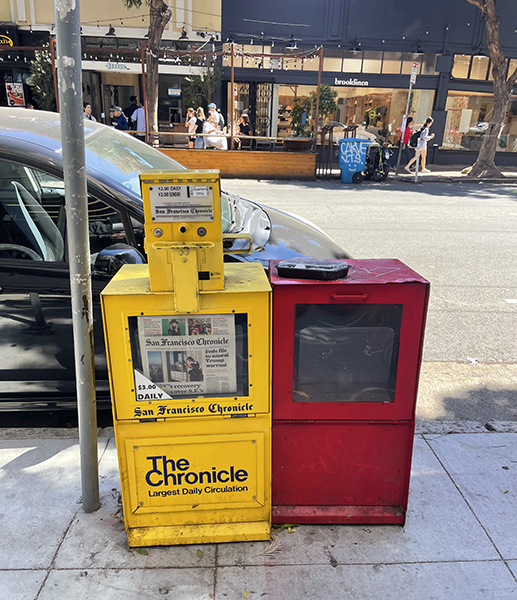
After how controversial and hard-fought the news rack consolidation was 20 years ago, the city is now undoing Brown’s efforts to clear up the sidewalks as we go back to the era of free-standing racks. A few days after her favorite city news rack disappeared, Ngarangad saw the Examiner’s bright red free-standing news rack pop up a couple of blocks away in her Inner Sunset neighborhood. And, a few days after that, the Chronicle’s bright yellow news rack, which demands $3 for a newspaper and only accepts quarters, appeared too. But it’s unlikely there will ever be enough free-standing news racks to cause a nuisance again.
The yellow and red news racks will remain the most visible across the city. Bill Nagel, publisher of the San Francisco Chronicle, says his paper is only placing 38 racks throughout town, with no plans to add more. “It’s convenient for the reader when there’s no retail location nearby, but the street racks are just a small fraction of our business. It’s more and more digital.”
Neighborhood papers will find it harder to get back into public spaces. “You need a million-dollar insurance policy to put a free-standing news rack on the sidewalk,” says Durand, which the Beacon and Review can’t easily afford.
Moss, who has a dozen free-standing Potrero View news racks around Potrero Hill, says “the problem is, they’re constantly graffitied. And we get ticketed regularly. We spend around $1,000 a year painting and repainting our boxes. Local businesses are a much friendlier place to put our newspaper, and it reinforces the whole merchant-community vibe.”
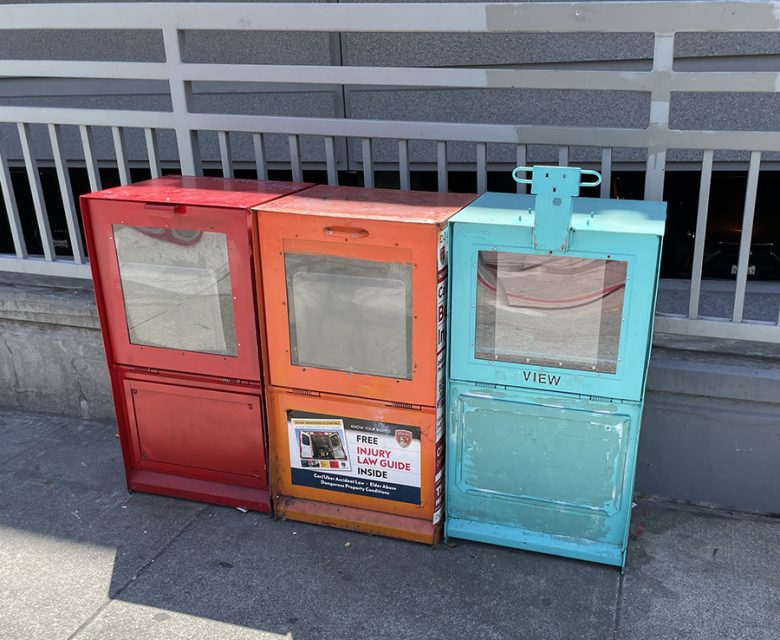
Kozakiewicz thinks the public should demand more answers about Clear Channel’s contract and how it profits from ads around the city. “As part of that deal in 2002, Clear Channel got ads on all the bus racks too. So now they get to keep all their bus ads, but without any responsibility for maintaining ad-free news racks around San Francisco for neighborhood papers.”
Clear Channel and the Department of Public Works did not respond to questions about the contract.
As for Ngarangad, she emailed the editor of the Sunset Beacon, and he responded with a list of local businesses where she can still find her neighborhood paper.
I had a very hard time finding an Examiner today. I passed several places where there were racks I had gotten it in the past and they weren’t there. These were single racks which were being used for the Examiner and not abandoned. Making it more difficult to get small newspapers is contrary to what we should be doing.
I think this is a net positive. Maybe only one in ten of these racks has held papers over the last few years. The other 9/10 times they’ve just been trash magnets. I’m not going to miss empty racks with ads for injury lawyers on them.
add free news racks, hopefully y the racks can be repurposed. Sustainable San Francisco
Metal bike loops same issue ….. city contracts and who got greased….
What was the contract and who benefited from their install clear channel… SFDPW? And kick backs Willie Brown era ?
Hand off the racks, keep the hand to yourself! Luv reading newspapers!
This is upsetting to me. I always read The Examiner and the local neighborhood papers, even the neighborhoods I don’t live in. These papers are an excellent way to find out about local SF news, and are an invaluable source of information. I will miss the racks, and now have to drive all around to find the papers I want to read. And I agree with the comments by Mike Zonta and DK below – this city is becoming a city of non-readers and that does not bode well for our society in general.
They may not be as vital as the also-disappearing public phones, but the loss of each is the loss of a crucial source of info for the public; particularly, those not well-off enough to have 24/7 internet access.
All of them are empty anyways. it is a loosing money business that is why they are taking it out. It is not worth it. People that dont know how to use the internet need to start learning because everything in this world is being digital.
expectations of profit to inform the public is the reason we have news orgs filling our minds with misinformation. to suggest that we must attach ourselves to the internet in order to be informed belies the truth of how technology has been weaponized against the populations of the world. our cellphones have become surveillance devices we carry with us to allow the government (in violation of the laws against unreasonable search and seizure), corporations and criminals to track our movements. camera networks use AI to racially profile the movement of populations. perhaps it’s not about learning to use the internet but a reasonable desire to be detached from the surveillance state.
p.s. it’s easy to see you allowed google to type your message.
I miss the racks ’cause now I have to hunt for the Examiner and other free local papers. On the other hand, most of the racks were empty and it seemed a blunt comment on the illiteracy of this city (and country). I know everybody is supposed to get their news online now, but news feeds are unreliable and narrow in perspective. In 2015 I visited Paris and was thrilled by the news/magazine racks throughout the city. And they have to read the news in French!
The racks are convenient but definitely hard to maintain and get trashed; I don’t mind the model of local business pickup (like Potrero View at the Good Life) if that’s the proposed replacement.
And as long as The Examiner follows the same format I am good with that. But I have never seen it available inside any business.