


Good Morning Mission and welcome to Virus Village, your (somewhat regular) Covid 19 data dump.
Covid is at once global and hyperlocal, with different numbers reflecting different local conditions and responses to the virus. Many thought the UK experience — high cases, low hospitalizaitons — would be replicated in the US, especially in pockets like SF with relatively high vaccintaions rates. For the first couple weeks of the Delta surge here, with high case numgers and high hospitalization numbers, it didn’t look good. But in the past week, even with cases advancing, there is been a pronounced slowing of local hospitalizations. Over the week ending August 8, hospitalizations rose from 93 to 105, before falling back to 97. With most of the population vaccinated, especially those most vulnerable, local officials and experts have remained relatively calm, and are not planning a new wave of lockdowns. For those interested, see here for current numbers from the UK.
Does that mean a full reopening of the City’s public schools will happen as planned? Though no one can predict the virus is thinking, or Board of Education, a recent study of infection and transmission among children in the UK can be taken as a positive sign.
During the Delta surge it’s become sport to blame Republicans and anti-Big Pharma dogmatists for stumbling vaccination rates. But who isn’t getting vaccinated? Are you surprised to learn it’s our essential(ly) screwed workers? Although businesses are mandating vaccination for customers, many don’t mandate the same for workers and make it difficult by refusing to give paid leave or time off to get the shot.
A new study has found that with the Delta variant, Covid misinformation is spreading twice as fast as original Covid misinformation. Unfortunately, the CDC has been part of the problem at least as much as part of the solution. In the wake of their new masking guidance based on an experience in Provincetown MA, the CDC generated a great deal of concern and anxiety regarding transmission from people who were vaccinated and asymptomatic. Intead of P-town, they should have looked at a study from Singapore where a study based on real contact tracing shows asymptomatic transmission to be very rare (the visualization in the study is quite good). Imagine what we might learn if we had a serious, functioning contact tracing program in SF.
Scroll down for today’s Covid numbers.
The CDC data used for the chart lags behind the data supplied from SFDPH. As of August 8, it does not appear that Delta has provoked a wave of new vaccinations in the City. According to DPH, over 77 percent of all San Francisco residents have received one dose, and over 70 percent are completely vaccinated. On August 8, the seven-day rolling average of shots per day to new recipients was 569. For information on where to get vaccinated in and around the Mission, visit our Vaccination Page.
Currently experiencing technical difficulties with this graph. On August 5, DPH reports there were 95 hospitalizations, 65 in Acute Care, 32 in ICU. According to the CDC, for the 7 days ending August 7, there were 69 new admissions to SF hospitals, a 1.43 percent decrease over the prior seven days. Covid patients account for 5.21 percent of hospital beds (up 1.39 percent) and 10.82 percent of ICU beds (up 2.91 percent).
The latest report from the federal Department of Health and Human Services shows SFGH with 15 Covid patients and 81 percent ICU occupancy, while across the Mission, CPMC had 8 Covid patients and 74 percent ICU occupancy. Of 71 reported Covid patients, 43 were at either SFGH or UCSF.
Between June 5 and August 4, DPH reported 435 new cases among Mission residents (or 74 new cases per 10,000 residents) and 496 newcases in Bayview Hunters Point (131 cases per 10,000 residents). Other than Bayview Hunters Point, 3 other neighborhoods had case rates in excess of 100 per 10,000 residents including the Castro (104), SOMA (102) and Western Addition (100).
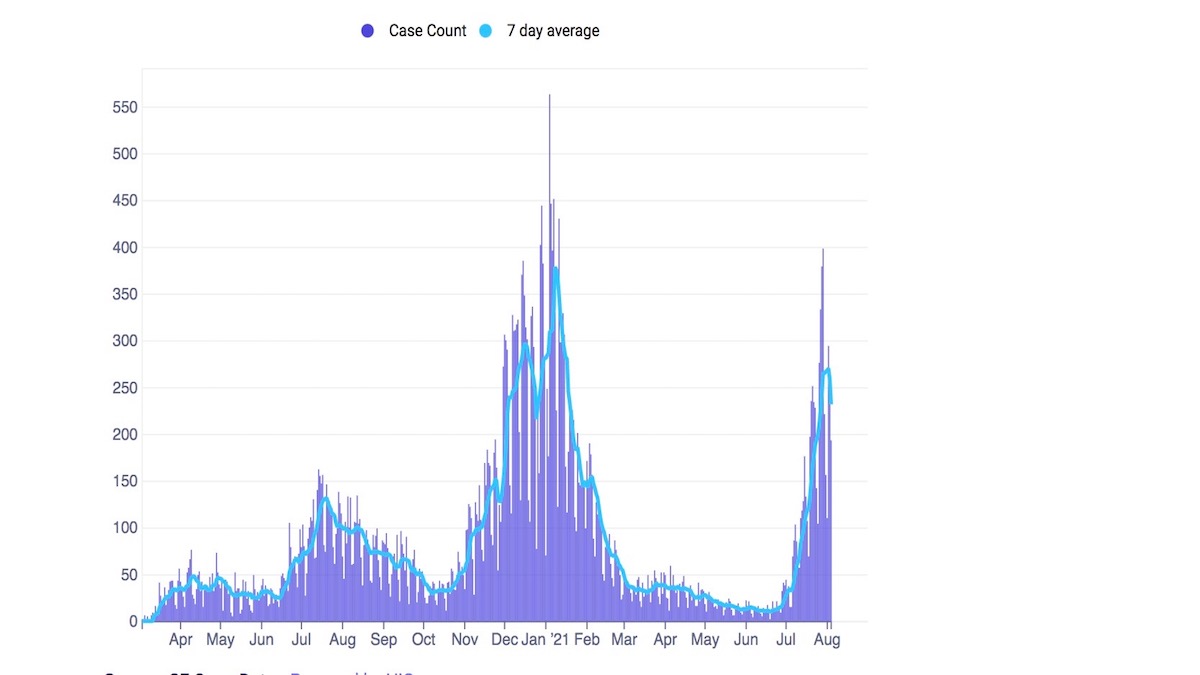
Early indications suggest we may be seeing a tapering of the rise in case numbers. For the week ending August 1, the seven-day rolling average of daily new cases in the City rose to 267 new cases, or approximately 30.3 new cases per day per 100,000 residents (based on 881,000).
As of August 8, DPH estimates 90 percent of the local Pacific Islander population has received at lease one dose of the vaccine, Native Americans 86 percent, Asians 79 percent, Latinx 75 percent, Whites 66 percent, and an estimated 63 percent of the local Black population has received at least one dose..
Between June 5 and August 4, DPH recorded 14,307 Covid tests collected in the Mission (or 243 tests per 1000 residents) the second highest number of neighborhood tests in the City. The highest number was 16,307 collected from Sunset/Parkside. Over these 60 days, FiDi/South Beach had the highest testing rate at 375 tests per 1000 residents.
The number of Covid deaths in July remains 9.
R Number models suggest the virus, though still prevalent, may be waning. The ensemble estimates the San Francisco R Number at 1.04 (the lowest its been since June 16) and the California R Number at 1.2. Don’t start celebrating just yet. Covid R Estimation continues to tell a more worrisome story estimating the current R Number for San Francisco at 1.44, and California at 1.36.
DPH reports 93 percent of San Franciscans 65 and older have received at least one dose of The Vaccine and 86 percent have been fully vaccinated.
If SF has one of the highest vaccination populations and if face masks work so well, why are there a surging number of cases, hospitalizations, and ICU admissions?
I know this may be difficult for people to come to grips with but _other_ people not being vaccinated does not impact the efficacy of the vaccine for _you_. Nor does it mean variants will increase. Nor will being vaccinated result in fewer infections. The _only_ thing vaccines do are reduce severity of illness and even that may not be forever. You will be infected with Covid at some point – time to come to terms with that.
Stop trying to be punitive. Worry about yourself and not other people for once in your life.
> Nor will being vaccinated result in fewer infections. The _only_ thing vaccines do are reduce severity of illness and even that may not be forever. You will be infected with Covid at some point – time to come to terms with that.
this is scientifically unfounded.
a vaccine that is 90% effective means far fewer people will get infected. and it’s clear that vaccinated people who get infected will be over it much more quickly than those who are unvaccinated thus limiting the amount of days they are infectious for.
the combination of both factors means that vaccinated people pose far less of an infection / contagion problem to a community than the unvaccinated.
Hmm, you, my friend, are mistaken. Bizarrely so. It’s odd that ML has allowed your post which is borderline disinformation. The OP is correct in that vaccines only reduce severity of illness – at least these vaccines. This is true also of influenza vaccines. This was never a question but the media chooses to ignore this repeatedly. In fact, what was understood by a great many people before vaccines were even widely available was that it was very likely that vaccines would allow the virus to spread even more rapidly precisely due to the fact that people would experience less severe illness and go about their daily lives more than they would if they had not been vaxxed.
It is absolutely scientifically “founded” in that you simply have to look at the spread of infections. You don’t need to have a PhD in biology – just look at widely published data from around the world by multiple sources. This is what’s referred to as empirical data and is the basis for robust science.
The human body may be primed to deal with Covid thru vaccination but that is a far different from being able to generate the necessary biological response (natural infection provides this through memory T cells after antibodies have disappeared) to keep the virus from replicating – hence infection and viral load and spread through respiration in those that have only been vaxxed but not infected.
What is so alarming is that individuals such as yourself claim to have some superior intellectual understanding of biology and yet are so ill informed, ignorant, and possibly even disingenuous. In an ideal world people like you would realize their ignorance and update their understanding of what’s going on.
“Public health” actually means worrying about other people because despite cynical propaganda that “we are all in this together” we do live in a community and are mutually interdependent to a much higher degree than many like to think, some more than others. And yes it does make a difference on a community level whether or not you are vaccinated. Vaccination has been shown to reduce the odds of infection and transmission as well as the odds of hospitalization and death. It reduces the overall speed of spread. And if you look at the most recent numbers, hospitalizations and ICU admittances are not surging along with cases. We have fewer overall hospitalizations now then we did at the peak of the July surge, even though there are more than twice the number of average daily cases. This article says it better than I do. https://www.sfchronicle.com/health/article/The-vaccination-advantage-How-San-Francisco-s-16370752.php. Do us all a favor: get vaccinated.
Dear Mark,
We have a serious, functioning contact tracing program in SF. I think it’s one of the reasons we’ve done as well as we have. We had an early and large contact tracing program up and running, and went on to train people in other CA counties and at the state level. It’s very challenging work, but morale and results were impressive, at least when I was volunteering and following the work closely, because of all the thoughtfulness, passion and effort that went into it. I’d be happy to put you in touch with them.
Thanks Rochelle. As I have followed the data daily provided by the SFDPH now for over a year, I have become increasingly dismayed and cynical toward the City’s contact tracing program (which does not come to news to anyone who’s followed Covid Tracker). I don’t want to list my complaints now except to note that no ongoing contact tracing information is now provided (before it was merely inadequate) and no information whatsoever has been provided with respect to what has been learned from the program since last October (and then it was so generalized as to be of little or no value). When the City shut down last fall, there were widespread pleas to show what data the City had to justify closing playgrounds and outdoor restaurants. No data was given. I do not at all fault the volunteers and the workers who have been hired to do a very difficult job;and do not question their passion or thoughtfulness. I do question the City for a complete lack of transparency in terms of how many workers, how many volunteers, how many hours worked, and most important, where outbreaks have occured and what they have learned. Even when businesses report outbreaks (as they are supposed to do under AB 685), the City does not report this data.
The Lancet study on school children in the UK is flawed. see: https://twitter.com/dgurdasani1/status/1422800835562647554
I have no idea what to do about vaccine mandates and essential workers, but I tend to think that if someone calls themselves an essential worker and does not have a damn good reason (medical) for not getting a vaccine, then I am disinclined to respect their belief that they are an essential worker or even that they are essential(ly) screwed.
Fact is, like our teachers, they screamed for early access over our older, sicker, more vulnerable population and we gave it to them. Now they have vaccine hesitancy I need to respect? I don’t think so.
I don’t think it’s a matter of what one calls oneself. Please read the linked article. We are talking about the people who could not work at home, who could not get assistance from the state, and who the rest of us depended on for daily functioning: healthcare workers, line cooks, agricultural workers, warehouse workers, meat packers, grocery store workers, and drivers/delivery people etc. etc. The same people who were most vulnerable last year are the most vulnerable this year. As the article points out, Walmart, Uber and Lyft have imposed vaccine mandates for their corporate offices, but not for their warehouse workers, store clerks or drivers, whom the companies have classified as contractors. Also see https://www.nytimes.com/2021/08/06/opinion/covid-delta-vaccines-unvaccinated.html
Mark, this paragraph seems in conflict with itself and with the other themes I read in your article
> During the Delta surge it’s become sport to blame Republicans and anti-Big Pharma dogmatists for stumbling vaccination rates. But who isn’t getting vaccinated? Are you surprised to learn it’s our essential(ly) screwed workers? Although businesses are mandating vaccination for customers, many don’t mandate the same for workers and make it difficult by refusing to give paid leave or time off to get the shot.
I am lead to believe that these “essential(ly) screwed workers” are unable to get vaccinated as they don’t have access to the vaccine, or are unable to take time off of work. But then your proposed solution is for employer mask mandates? How does that solve access to the vaccine or ability to take time off work? How does that solve vaccine hesitancy except by actually threatening their jobs?
I am all for David’s solution “However, business owners should make allowances for their employees to not only take time off to get vaccinated, but also allow for a few days off if needed for recovery in case of any strong side effects from the vaccine” but I am unwilling to give the vaccine hesitant cover by pretending the problem is a lack of employer mandates.
I am even okay with employer mandates!
I am not okay by calling the vaccine hesitant our “essential(ly) screwed workers”, the truth is, in San Francisco, we’ve given them plenty of access, accelerated access, line jumping access, neighborhood pop up access, as well as providing food and rent relief — all things I think were needed and are great.
I understand they are hesitant. I think there is some reason to be. I think we need to work to combat vaccine hesitancy.
I’m am just not going to agree we have somehow screwed these folks over or agree with their claims they are “essential workers” if after all of this time, they still refuse a vaccine.
I have similar ugly thoughts about our teachers, who also screamed for line jumping over actually vulnerable people, got their line jumping, didn’t re-open schools, and now still demand leeway to not be vaccinated, even in the face of Delta. Unless they have a medical reason, FIRE THEM.
I agree up to a point. However, business owners should make allowances for their employees to not only take time off to get vaccinated, but also allow for a few days off if needed for recovery in case of any strong side effects from the vaccine. My second dose wiped me out for a few days and I was lucky enough to schedule on a weekend day and have flexibility to take a day off to recover. Not every worker has that luxury.
Should essential workers be vaccinated? Absolutely. But there needs to be a supporting mechanism for those barely making ends meet in SF or the Bay Area and worried about losing wages if they need to skip a few days of work. Economic fear is motivating some vaccine hesitancy. Maybe not all, but more needs to be done to help close the gap.