


Good morning, Mission, and welcome to Virus Village, your (somewhat regular) Covid-19 data dump.
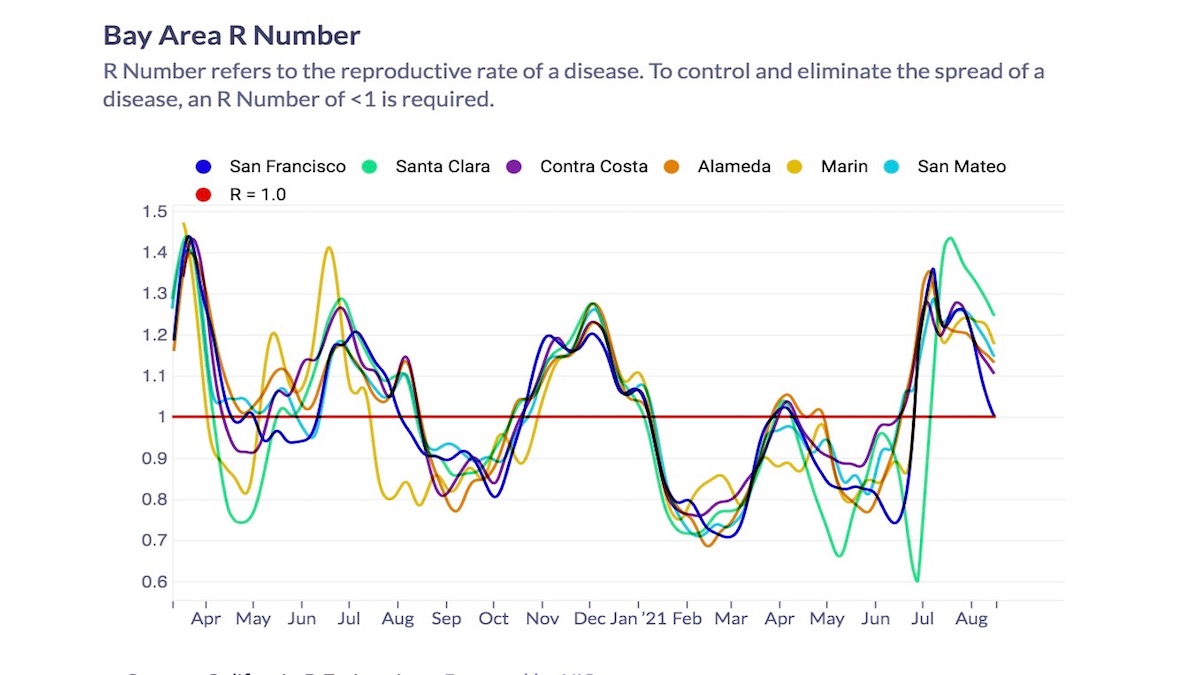
Local case numbers continue to fall as hospitalizations rise slowly, and R Number estimates fall to 1 or below for the first time in six weeks.
Average daily case numbers here have fallen 28 percent in 10 days. Is Delta retreating from highly vaccinated, heavily masked and very cool and foggy San Francisco? If so, will this lead the CDC to revise its latest revision to its revised guidelines?
Yes, I know, “science” should always be changing based on the data. But is it the data that has now led to the widespread introduction of boosters to vaccines?
It should come as no surprise that the decision to boost boosters is subject to widespread debate and mathematical modeling. Sometimes the numbers are not what they seem. Meet the Simpson Paradox.
Though scientists and doctors seem to be divided on the need for boosters (beyond the immunocompromised), Big Pharma has no doubt. Pfizer, which has not yet completed a Phase 3 trial of the booster, has been aggressively pushing it since June. They may not have data showing the efficacy of the booster to affect the virus, there seems little doubt that the booster will provide a great boost to their already swollen profits.
With boosters being flogged now, are booster mandates on the horizon?
Florida Gov. Ron DeSantis hates all mandates, but really likes the high-priced Regeneron treatment (the kind given to Trump and recently to Texas Gov. Greg Abbot). Is it a coincidence the makers of Regeneron (and their hedge fund investors) are DeSantis’ biggest donor?
Elsewhere in covid news, SF has opened, or reopened, a mass testing site at 7th and Brannan streets. Meanwhile, the lead scientist for the AstraZenca vaccine says widespread mass testing for covid is pointless (at least in the UK).
And some are summing up the Delta experience in three words: Live with It. Note that some doctors who take this position are under investigation for heresy.
Scroll down for today’s covid numbers.
The Centers for Disease Control data used for the chart lags behind the data supplied from the San Francisco Department of Public Health. Minimal change in the SF vaccination picture. As of Aug. 17, DPH reports more than 77 percent of all San Francisco residents have received one dose, and more than 71 percent are completely vaccinated. On Aug. 17, the seven-day rolling average of shots per day to new recipients was 590. For information on where to get vaccinated in and around the Mission, visit our Vaccination Page.
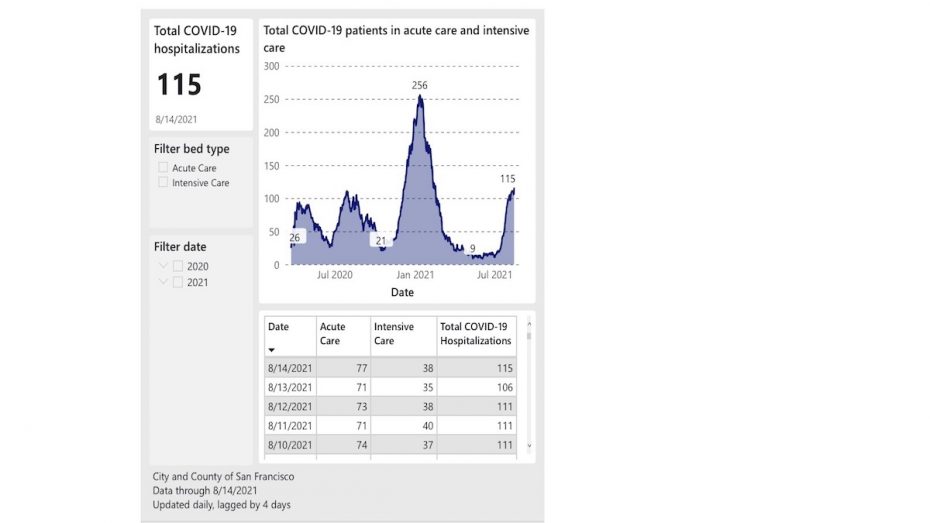
Due to a DPH reporting glitch, we don’t have our usual hospitalization graph. The visualization above is a screen shot from the sf.gov website . On Aug. 14, DPH reports there were 115 hospitalizations, 77 in acute care, 38 in ICU. Although the number of hospitalizations appear somewhat stable, according to the CDC, the number of new admissions has been sharply rising. For the seven days ending Aug. 16, there were 91 new admissions to SF hospitals, a 26.39 percent increase over the prior seven days. Again, relying on CDC data (as SFDPH no longer bothers), for the week ending Aug. 16, covid patients accounted for 5.93 percent of hospital beds (up .58 percent) and 13.6 percent of ICU beds (up 1.45 percent). Again, according to the CDC, as of Aug. 9, there were 166 million Americans vaccinated, of which 7,608 were hospitalized, and 1,587 died. But wait! Twenty-five percent of the hospitalizations and 21 percent of the deaths were either asymptomatic or not related to covid.
The latest report from the federal Department of Health and Human Services shows SFGH with 17 covid patients and 76 percent ICU occupancy, while across the Mission, CPMC had 14 covid patients and 71 percent ICU occupancy. Of 110 reported covid patients, 55 were at either SFGH or UCSF.
Between June 14 and August 13, DPH reported 593 new cases among Mission residents (or 101 new cases per 10,000 residents) and 638 new cases in Bayview Hunters Point (168 new cases per 10,000 residents). During this period there were 10 San Francisco neighborhoods with new case rates in excess of 100 per 10,000 residents, all in the east and southeast sectors of the city.
For the week ending Aug. 10, the seven-day rolling average of daily new cases in the city was 203 new cases, or approximately 22.7 new cases per day per 100,000 residents (based on 896,000 population).
August case numbers will not be available until Aug. 20. In July, White San Franciscans accounted for 35.1 percent of all new cases; Latinx, 21.2 percent; Asians, 15.7 percent; Blacks, 13.6 percent; Multi-racials, 1.5 percent; Pacific Islanders, 1.1 percent,
The citywide average positivity rate fell below 5 percent for the first time since July 22. In July, Blacks and Latinx each had 8.4 percent positivity, Pacific Islanders 5.8 percent, Whites 4.4 percent, Native Americans 4.3 percent, Asians 2.7 percent and Multi-racials 2 percent.
DPH reports 2 new Covid-related deaths in August, but July totals remained at 9. Nonetheless covid-related deaths, according to DPH now stand at 570 (and increase of 3 over recent days). Though not specified, it appears from other data (see below) the 2 August deaths were nursing home residents.
Is the virus spread decreasing in San Francisco? Organizations that estimate R Numbers seem to think so. Covid R Estimation has lowered its San Francisco R Number estimate to a 1.00 for the first time since late June, and places the California R number at 1.20. Most models in the ensemble estimate the San Francisco R Number at below 1 with a suprising average at .79, while the average California R Number is 1.04.
DPH no longer provides numbers on unhoused residents. As of Aug. 11, in nursing homes (“Skilled Nursing Facitlities”), there were 6 new cases and 2 new covid-related deaths. Single Resident Occupancy hotels (SROs) reported 53 new cases and 0 new deaths.
Some seemingly good news in a sea of bad news on Twitter regarding increased cases in Israel and comparing their situation to ours.
> Delta retreating from highly vaccinated, heavily masked and very cool and foggy San Francisco?
Do you believe the cool and foggy environment is making a dramatic difference? If so how? I have heard from ZDoggMD and other docs off the cuff theories that Delta is big in Southern States due to the heat driving everyone indoors where there is A/C.
Sigh, today’s vaguely orange air…