

‘Retired civil servant’ Mike Cheney’s plan is so not-crazy, it just might work
[dropcap]“D[/dropcap]ude, do you know how much those things cost me? Apiece?” This is a de facto rhetorical question from Mike Cheney. Most are. He immediately answers it. “Eleven bucks! Eleven!”
That’s a fair amount of money to spend for a retired Muni diesel mechanic with multiple grandchildren — but if it leads to one of this city’s most intractable problems being solved, it’ll be worth it.
So, that’s why Cheney prepared a comprehensive “2018 Proposal To Re-align Muni Goals & Operations,” printed up a handful of $11-a-pop copies, and hand-delivered a few of the svelte, 21-page booklets to the office of Mayor London Breed. That’s her quote right on the cover: “Muni has to work well for the people of San Francisco, so that it is their first option.”
Right now, Muni is hovering closer to the option of last resort. During the two-month closure of the Twin Peaks tunnel, the agency hapazardly plucked buses and drivers off core routes to patch the hole in its system, creating gaping service cuts on some of Muni’s busiest lines. And, compounding this fiasco, it did this without informing the riding public or even the office of the mayor.
Hand-delivering a transit manifesto to City Hall Room 200 — after copious emails dutifully signed “Michael B. Cheney, retired civil servant” — is behavior that could be taken as a bit, shall we say, eccentric. It’s the sort of thing befitting folks who rail at the Board of Supervisors during public comment about vast conspiracies being perpetrated by the administrators of the Recreation and Park Department. Or sing.
Cheney is not that kind of person. Over the course of three decades and change working in, on, or under San Francisco buses, he earned a reputation as a man not only obsessed with fixing Muni vehicles, but fixing Muni itself. As a serial whistleblower, he broke up overtime payment schemes, and exposed and helped curtail numerous instances in which the health and well-being of workers, riders, and the general public were being compromised. He’s complained to management. He’s complained to the press. He’s even complained to the FBI. And, sometimes, after years of effort, things even got fixed.
Mayors come and mayors go, but sclerotic Muni practices are forever. But now Cheney is hoping that this mayor will change all that. Many of the suggestions in his proposal are, in fact, recycled from proposals he made years or even decades ago — suggestions generated and/or ratified by experts and/or city number-crunchers many times over.
But hope, like Muni wait times of late, springs eternal.
“There is no statute of limitations,” Cheney says, “on good ideas.”

One of Cheney’s first suggestions on how to improve Muni performance is a populist’s dream: Muni managers will surrender their car keys: “All official Muni travels to be done using mass transit. Personnel will keep log books noting each trip, equipment numbers, routes & time, writing down any defects or needed changes.”
That’s the kind of suggestion that’ll be appreciated by barstool Muni critics everywhere. But Cheney’s 21-page missive goes far deeper than that. To wit: What if it turned out Muni could speed up buses and trains — and wouldn’t even need to buy new equipment, tear up the streets, or even eliminate stops?
Well, it can. It could install skip-stop route schedules.
This is a system in which Bus A picks up passengers at Stops 1, 3, 5, 7 and so on and Bus B picks up passengers at Stops 2, 4, 6, and 8. This has worked all around the world; it increases capacity and speeds up service. All the way back in 2005, Muni proposed using skip-stopping on Geary Boulevard for a Bus Rapid Transit line: “For the purposes of this analysis, Geary BRT service was designed as a skip-stop service, with ‘A’ and ‘B’ buses each stopping at every other stop, except at major transfer points.”
Thirteen years ago, Muni predicted that “given adequate funding and no community opposition,” the Geary BRT could be “designed and constructed in five to seven years.” It’s still years away, at best.
Well, that didn’t work out. But skip-stop could still work out. Would still work out, Cheney claims. He is its greatest evangelist. He explained it to the Hearst Examiner’s Rob Morse in 1998. He explained it to me in 2013. “You take the bumpers out of a pinball machine, the ball gets to the bottom faster, right? It’s just physics, dude,” is how he put it five years ago. “You see that bus?” he said, pointing at a packed No. 28. “There’s people hanging out the windows. Because they’re stopping at every stop. You don’t need to stop at every stop!”
Vastly improving transit service — and doing so on the cheap — would seem to be the end goal of every transit agency. But that’s not how things roll in the real world. Muni’s status quo isn’t working out for San Francisco or transit riders or San Francisco’s transit riders. But it is working out well for someone. There is, Cheney is wont to say, a lot of money to be made in running a transit system badly.
That’s why, when queried just what reason Muni has for avoiding skip-stop busing, Cheney replies, “because it’d work.”
By December or January, the Budget Analyst aims to complete an audit of Muni it was tasked to do earlier this year by Supervisor Jane Kim. It will focus on the agency’s decline in revenue over recent years and its epic, ongoing struggles with congestion management (Muni is the slowest transit service in North America. It doesn’t just feel that way, it really is).
That promises to be revelatory. But, then, so was this 1996 audit — and, Cheney quips, that 237-page tome has served as little more than an expensive doorstop for our transit agency; many of his present-day suggestions are culled right from it.
Maybe this time, he hopes, it won’t take 22 years for the city to not do the common-sense suggestions we paid experts hundreds of thousands of dollars to tell us to do. Cheney remains hopeful. He remains positive. Because, as he notes, there is no statute of limitations on good ideas.
Or, as Muni has amply proven, on bad ones either.
You can read Cheney’s “2018 Proposal To Re-align Muni Goals & Operations” here.
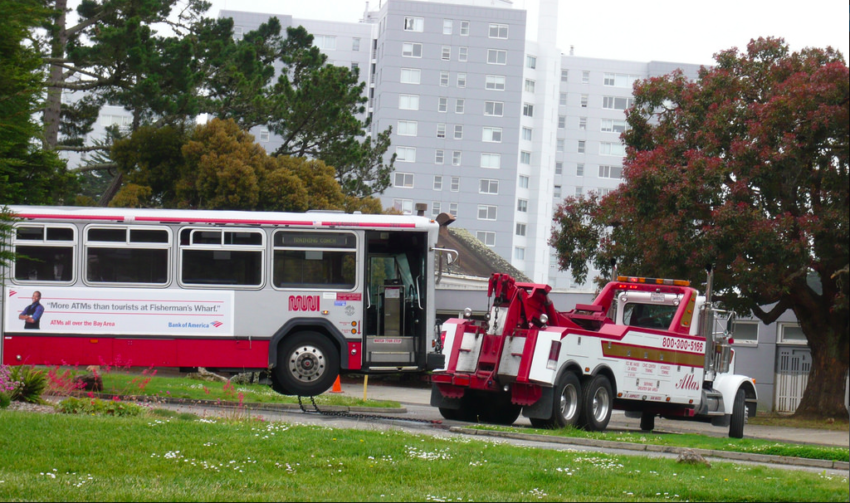
Photo of towed Muni bus by Aaron Kitashima
This guy is my new hero.
here’s a good one. the new buses hold less people and the bus fare now is ridiculous. if they really wanted to save money and keep fixing the old muni buses form the early 2000’s and keep fixing them with local sf mechanic shops. it will keep them in buissness and they are from the city working for the city in the city. unlike the tech shops bringing in people from every where who will eventually leave. i miss the old buses they ran till they didn’t and they were so much brighter on the inside. the price they are selling for are so cheap it’s basically like they are trashing them and don’t want to fix them. FIX OLD MUNI
There are a few interesting ideas in here, but fixing the system is going to require a much more ambitious approach.
If anything, it just shows how dysfunctional the organization is and how uninvested Muni’s leadership in making the system successful. They should be eager to use the bus system for all of their transportation, not avoiding it and driving personal cars. They after all run the system and are responsible for its condition.
Compensation of employees should be tied to system performance and overall mass transit adoption within the city. Any changes in labor contracts should also allow flexibility to explore new transit models including on-demand, app-based van services.
The report mentions that vested interests benefit from a sub-standard public transit system. Who do you think these interests are and how do they benefit? It’s been this way long before the arrival of Uber & Lyft, so I don’t think it’s them.
It has been a problem long before Lyft&Uber but they certainly contribute in their own way. I just don’t understand how the light rail gets so far behind “schedule” (as if there really is one,is there?) today at West Portal the K was in 17,23,58 mins, idk what frequency that is even, there is not car traffic underground , then like 5 1/4 full cars will come by, why not make those a line that’s running behind? Muni recently announced a 2 hour transfer to allow for people to “run errands” or “go to the Dr” bc the couldn’t really say (or own up to) the fact some trips take longer than 90mins to complete. I ran out of a transfer on one trip a handful of times. Other cities seem to work with older infrastructure & traffic but still manage to have decent public transportation systems.
Then it is expensive and fares keep going up.Someone scraping off the top?
They are bleeding $ somewhere.I always think those POP police, I mean there are always an excessive amount of them and how much $ do they spend on their salaries vs how much they make in no pay fines?
Then there is staffing. Drivers are late so it makes busses late. Do the drivers not get consequences when late?
It is a giant mess though.
Skip stop is a novel idea, but there’d need to be real data on it. The actual savings in travel time would be unclear, and the bus frequency could get much worse. It’d also be very confusing, especially for some of the more vulnerable riders.
I’d love to see Muni solve the bunching up problem. When two vehicles are next to each other, make the front one express. Eg, 38 outbound finds two buses at Fillmore? Then front vehicle expresses to Masonic and tells everyone who wants to get off before then to move to the second vehicle. We know keeping proper spacing reduces overcrowding and keeps a faster pace for everyone.
And unlike switchbacks, it doesn’t leave people stranded.
Mike’s ideas sound too good and lack the sexy street diets favored at the SFMTA Board. The question is, who are our elected officials going to serve, the public, or the corporations? Will our Mayor appoint a true visionary with a lifetime of Muni experience like Mike Cheney to the MTA Board our will she select a corporate shill intent on retaining the failed policies that are driving people off the public buses into their vehicles?
Other suggestions that are drawing a lot of public support for safer conditions on our streets:
Return consistency to the streets of San Francisco. Nobody can watch for pedestrians, scooters, bikes, cars, trucks and buses weaving in and out of lanes and read all the street signs and directions at the same time.
Lanes need to be straight and flow smoothly from one block to the next. Following lane changes is distracting.
Bring back the safer one-way streets with a single bus lane on each.
Extend the timing of yellow lights and give the red light a couple of seconds before turning it green.
The policy of Transit First goes back decades. The basic concept was that we’d both “Fix Muni” and de incentivize the use of cars by, mainly, almost random elimination of parking spaces. Since then the tech-based transportation startups have aggressively arrived without notice to the City and then forced negotiating with a fiat accomplish. It was “Google busses,” then Uber/Lyft, then scooters, orange bikes and rent-your-car-out and COMING SOONER THAN ANYONE EXPECTS DRIVERLESS CARS. In each of these cases the City leaders were taken unawares and had to play catch up.
The problem is that we’re busily building a 20th Century roadway infrastructure for a 21st Century traffic environment. The result, eventually, will be chaos. We may well have more cars than planned for competing for space with busses, undisciplined bikers, scooters and we really don’t know what else. The rational thing to do would be to pause all infrastructure work, INCLUDING THE BRT and do some serious planning for what the future will look like, in light of the tech/transportation boom. Given vested interests and ideologies, plus dysfunctional SF politics, this probably would require bolder leadership than we’ve seen in decades.