

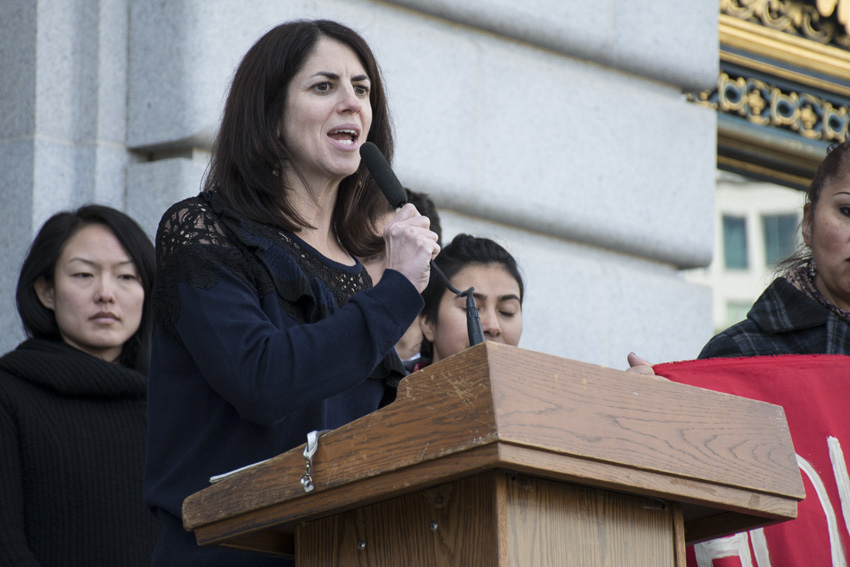

Mission Supervisor Hillary Ronen sat down with Mission Local to talk about issues relating to her district.
This is a monthly series – this interview has been edited and shortened for print.
ML: The new and temporary Navigation Center for the homeless at 1515 South Van Ness Ave. opened last week. Have you thought about a strategy for what happens when it closes?
Ronen: I am looking for a longer term Navigation Center. The whole reason I fought so hard to get this space and open this temporary center is because there is a health and safety crisis on our streets. It takes a long time to find land, find a building, obtain it, get the financing for it.
We couldn’t wait that long – so I got this temporary space for us to buy me the nine months that I need to find a more permanent site. Whether it’s a permanent site or just a long term site, we need to have a place to take people when this one closes down.
I have a few sites that I’m working with the city to located. I don’t want to name those sites – because when a landowner knows that the city is interested in purchasing the site, then the price ends up going up because we have a $10 billion budget.
But there will be a full community process when any site is considered.
There’s not that many sites in the Mission that are available. I’m definitely looking for sites in the more industrial areas of the Mission. We will see what works and what happens and then start a long term community process around getting neighbor’s buy-in, getting feedback. And what I expect is that we are going to show what an improvement Navigation Centers make and that the city is capable of running them in a responsible way that improves neighborhood conditions and doesn’t make them worse.
I hope that by the time that we start a community process around a longer term Navigation Center, that we have earned our credibility in that conversation.
ML: It seems that the continuation of services after the Navigation Center is crucial…
Ronen: It’s my understanding that no one will ever be released from the Navigation Center at 1515 and be released to the streets. The goal is to have people stay in that center no longer than 90 days, but to resolve the situation in 90 days.
The ways to do that is either getting someone into a longer term treatment program for mental health or substance abuse, or reuniting people with relatives through the homeward bound program. And in the worse case scenario transfer them to a different shelter or Navigation Center, which is the least desirable option. And then four is getting someone into long term, either supportive or subsidized affordable housing.
The good thing about this Navigation Center is that we got 50 housing subsidies that are linked only to the center. We will have access to the housing that’s available through the entire system, but we will have an additional 50 housing subsidies just for transitioning people off the streets through this Navigation Center.
The goal will be sending all the residents of the Navigation Center down one of those paths during the 90 days that they are there. It’s not a hard 90 days…if people need more time, it’s flexible.
My goal is to constantly fight for more resources, but very specifically tied to these solutions that we know work if we had enough of them.
ML: What’s happening with the eventual closing of the 16th Street Navigation Center?
Ronen: It will close around the same time as 1515 South Van Ness (January 2018). I don’t know the exact time and these are always influx.
That is my top priority right now – both making sure that this Navigation Center is run responsibly and successfully, and then finding the new one. Those are my top priorities right now.
A top priority for me in the future will be taking a look at our mental health system and substance abuse treatment system in order to build capacity there, which will also help.
ML: There is some funding coming in for both of those system in the next few years…
Ronen: I think we need to think bigger. There was some of that thinking happening when folks were fighting the jail replacement project. We don’t need another jail, what we need is a mental health treatment center. Because so many people on the streets but also in the jails are suffering from mental health or substance abuse disorder, and that is often contributing to the reason they were arrested and put in jail or are homeless on the street.
Fixing that, through creating some sort of treatment center, just seems like a logical use of funds and resources as opposed to building a new jail.
ML: What’s happening with your request for an additional aide and what would they oversee?
Ronen: Unfortunately I did not win the additional aide…What really bothers me often about the add back process in the budget is that all supervisorial districts are treated the same.
The way that the budget chair has done it this year (and it’s been similar in the past) is that each district gets about $1 million to prioritize. I don’t believe that this is fair or equitable. Other districts are just not facing what we are facing in districts 9, 6, 10 and even districts 3 and 5. Those are the five districts that when you look at any metric, whether its 311 calls, homeless encampments, homeless people on the streets, police shootings, crime, low performing schools, health disparities, uninsured people -take an metric that you want to look at, and these five districts are battling the toughest issues in our city.
The workload to do our job well is just not equivalent and it’s not the same. The fact that we have the same amount of aides doesn’t make any sense to me.
We have also in District 9 one of the biggest inequality levels, millionaires living next to homeless people. And that creates a lot of conflict in and of itself. We hear about every single conflict, and I very much believe it is my responsibility to respond and engage. And in order to do that effectively, to give my constituents the attention they deserve, i need more staff.
I made my case and I would wholeheartedly …support other district offices that face the challenges that we face in District 9, I would support them 100 percent to get additional staff. But I was the only one asking for it in this budget process, and my colleagues didn’t agree with me.
ML: In regard to your staff, who should Mission residents contact first if they want to get a message to you?
Ronen: I usually am like a week behind. I get literally hundreds of emails everyday and I try to respond to every one of them. I often do them at nights and weekends because I’m busy all day with meetings and committee hearings…and then my aides respond to a lot of them. Sometimes constituents already formed a relationship with an aide and they continue that. Sometimes they contact me and I bring in an aide to help us follow up with issues. Sometimes I send people directly to a department head. It depends on the situation.
But if you contact any of my aides or myself, we will get back to you.
ML: Other than homelessness and housing, what are you spending your time on?
Ronen: I’ve been doing some work around bail reform – I held a hearing on Wednesday at the Public Safety and Neighborhood Committee. I just learned about this incredibly unjust bail system that we have in San Francisco and have become passionate about it and realized that a lot of my constituents in District 9 who are the lowest income – mostly women, mothers, wives, daughters children – are the people who are paying up to $15 million a year in San Francisco in non refundable bail fees.
The way our bail system works, judges set the bail and it’s based on a schedule that judges create behind closed doors. San Francisco has the highest bail fees of any surrounding county in the Bay Area or Northern California period.
Once the judge sets that bail, lets say its $50,000, then the family of that individual can post bail directly to the courts and if they pay the full $50,000, if charges are dropped against that person, or the person is found innocent, or show up to all of their hearings, then the family gets the $50,000 back. But if you don’t have $50,000, and very few people do, and you have to go to a bail bondsman in order to post bail for your loved one, the bail bondsmen usually charges around 10 percent and you never see it back.
That 10 percent fee is taken from our lowest income, mostly women and they never get it back. Women are having to beg borrow barter work extra hours in order to come up with this money and sometimes come up with a payment plan over years. People go into bankruptcy, they have lost their homes, it’s incredible.
The treasurer released a fantastic report that explains the whole system showing neighborhood by neighborhood the impact. And there is a big impact on residents of District 9 and there is very little transparency in the industry.
We are hearing anecdotally from people who have posted bond and ex bail bond agents who are telling the stories of what’s happening and it’s terrifying. I’ve been working on reforms to that system with the treasurer, Jose Cisneros. I’m working on several pieces of legislation and resolutions to bring that bail amount down.
ML: What is a fair amount?
Ronen: It has to relate to the ability of someone to pay and to the severity of the crime. If someone is a threat to public then they shouldn’t get bail in the first place. They should stay in jail until they are no longer a threat to public safety. What we are finding is that the bail system isn’t actually making people safer. What we are doing is just making families and women more vulnerable.
There are larger reforms happening at the state level – SB 10 is one of those bills that’s pending that would do just that, create a bail system tied to actual public safety and the ability of someone to pay. I will be introducing legislation in the coming weeks.
ML: We’re taking a look at community policing and want to get your views on whether you sense it has become stronger or weaker in the Mission. The monthly meetings have been cut back and there is no Community Advisory Board as there is in every other district.
Ronen: I do think that regular meetings and advisory boards can be helpful but for me what is meaningful community policing is having regular beat officers that area assigned to regular areas that over years really get to know the community – the merchants, the residents, the people hanging out on the street, the homeless folks – by having these deep connections to community organizations, to the children that grow up in the neighborhood that grow up around them and develop respectful relationships with the police that will help them keep the neighborhood safe both by knowing deeply whats going on and by knowing when something is off.
That’s the type of community policing that I would like to see and that i think makes a big difference on safety in the neighborhood. Past supervisors have tried to mandate foot patrols…but that has never been able to pass the board of supervisors.
I haven’t seen a lot of consistently in any of the neighborhoods in the Portola, Bernal Heights or the Mission. In terms of foot beat officers that are engaged in this version of community policing that I believe is the most effective. That’s a change that I would like to see.
ML: Officers just successfully de-escalated a confrontation with a person armed with a knife at the station. What, if anything, does this tell us about reform efforts? Is this (impact weapons, bruising but no serious injuries) how you want policing done?
Ronen: I am so thrilled about this. The chief came, we have regular meetings on police reform at the Board of Supervisors and at the last one, the chief came and presented statistics showing that the use of force by officers has gone down dramatically and I absolutely believe that this is the result of reform efforts that we have been pushing as a city both inside and outside of City Hall.
And that its working. I just hope that we can continue to see that same type of process.
You recently secured additional funding for nonprofits working in the trans community. What is some of the work you think is important to support in that area in the Mission District? What are you hoping can be achieved by these groups?
Ronen: The trans community, there is a lot of work today. Specifically around mental health, homelessness, immigration…I’ve been very supportive over the years for El/La, which is for trans Latinas, an organization working with trans women who are often immigrants, monolingual Spanish speakers and the special needs they have.
There is still violence against the trans community in SF, something that we need to work on. Trans people are overrepresented in terms of percentage in the community in the jail system – the treatment and issues they face there are tremendous. We still have issues with unemployment.
I fought hard in the budget process to make sure that the trans community was getting the resources they need to do the work…we have some fantastic organization in San Francisco that are leading the charge not just in the city but statewide and nationally.
Agreed. All politics is local, and Ronen and her staff fail at it. One-termer.
Want to test that? Call her office with a problem. You’ll receive words but no action. Typical politician. Let’s get someone better in who actually deals with constituent problems in The Portola District.
Recall Ronen!!!
1. Good work on eliminating money bail in most appropriate circumstances.
2. The San Francisco Public Press reports that 2/3 of people who are accepted to the Navigation Centers end up back on the streets within 30 days. http://sfpublicpress.org/
3. With regard to the additional aide and equity across districts, supervisors have the power to move legislation to change the rules of the game such that public policy is bent such that there is less need for service provision and triage by aides. The focus on add backs and nonprofits instead of actually supervising the Mayor’s departmental priorities illustrates the problem. Labor, for its part, will resist any changes to departments that employ their members. If we check corruption in the big departments, DPW, SFPD, Rec and Park, etc., then we could beef up public sector social services to provide the services that would take constituent service load off of the supervisors. More aides means more people to play parallel whack-a-mole.
4. Community policing. District station captains rotate out every 3 years. By the time they have the district figured out, they’re onto the next district. The POA is not going to be doing any manner of regular foot patrols unless they are forced. Supervisors can intervene in the contract renewals if they sit in on the meets and confers and other negotiations before the contract makes it to the Board of Supervisors.
Ronen can’t even stop illegal activity on San Bruno Avenue at 2818 San Bruno Avenue at Red House Bakery. Gangs, tax evasion, human trafficking, you name it. Why won’t Ronen due something about businesses that are effectively fronts for criminal activity???