

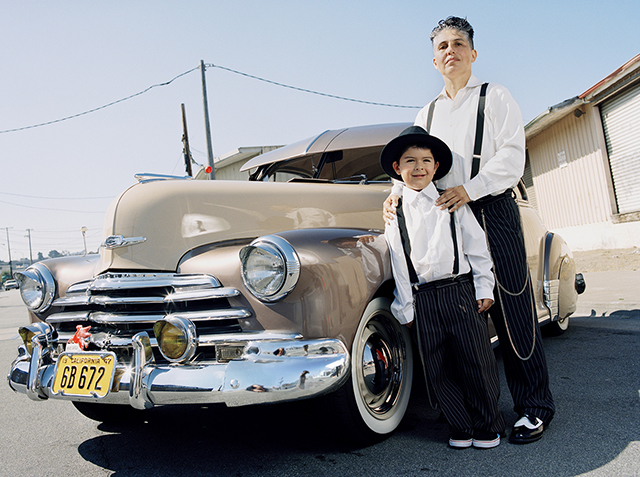

Artists at the closing ceremony Thursday evening for “Q-Sides,” an exhibit at Galería de la Raza that showcases the relationship between queer Latino culture and low riders, reflected on the recent vandalism of the gallery’s “Por Vida” mural as well as acceptance, inspirations and relationships that led the artists to collaborate.
“It feels so good to be here tonight, to be able to breathe and heal from what’s been happening,” said Ani Rivera, the gallery’s director, about the recent acts of targeted vandalism.
“We will rebuild. Once we decide to rebuild outside, we will need your support,” Rivera said to the crowd during the ceremony.

“Q-Sides” is a collaborative work between artists Vero Majano and DJ Brown Amy (Martinez), as well as photographer Kari Orvik and filmmaker Dino Dinco. The exhibit displays photographs of queer Latinos alongside low riders, as well as Dinco’s film, “Homeboy,”,which documents gay men in Los Angeles involved in gangs. The night began with a performance of oldies from The Singing Boys, and was followed by a three-hour long panel discussion.
The discussion went over themes of being queer in a Chicano culture, desire, and the relationships that the artists built while collaborating on the project.
“The music is really what brought us to the project and with Vero growing up on this street, it goes really deep,” said Orvik. “It’s really about the relationships.”
The exhibit was based on East Side Story, a collection of oldies, which depicted homies and their girls in front of their low-riders.
During the panel discussion, Amy remarked that when she was growing up listening to the old records, she would imagine herself in the place of the homies, alongside the homegirls.
“I thought ‘how incredible would it be to reshoot those photos and have some queer representation,’” she said during the discussion.
With that idea in mind, Amy ran into Majano on the street, and brought up the idea of reshooting the record covers. Majano remembered one chance meeting on the corner of 24th and Valencia Streets.
“We didn’t want to imitate anything,” said Majano.
“But originally we did though,” Amy interjected.

A common theme between the panelists was definitely the connection to the music. Other themes included substance and alcohol abuse.
Mickey Martinez, one of those photographed in “Q-Sides” as well as a life-long Mission resident, said that when she was growing up, queer kids would mask their true selves under substance and alcohol abuse. She also said that being high on drugs allowed her to truly act out her desires, without having to acknowledge it the following day. The drug of choice? PCP.
“Having that moment when you’re loaded and you can truly express yourself, and then you put it all away when you’re sober,” said Martinez.
Dinco said during the panel discussion that he never realized until recently how much drugs played a role in his documentary “Homeboy.” One of his subjects in the film had done so much PCP during his youth that he needed heart surgery at age 30.
“Q-Sides” not only represents a marginalized group of people, but queer Latino people who have had to straddle many different worlds. In the act of coming out some have been shunned by family, peers, and even lifelong friends.
“We’ve always been here, even when we weren’t out,” said Cathy Arellano, who was photographed alongside Martinez for “Q-Sides” and who was also born and raised in the Mission.
“Homophobia is clearly still here,” Arellano said regarding the recently torched mural displaying LGBT iconography. “It’s always been complicated. We have a long ways to go.”

From this exhibit Arellano hopes that more doors open for discussion, and acceptance about coming out in Chicano culture.
“I just want people to be more accepting, especially when it comes down to their own families,” said Arellano.
According to Rivera, “Q-Sides” and as well as the showing of the documentary “Homeboy” has recently been extended until July 18 due to popular demand.