

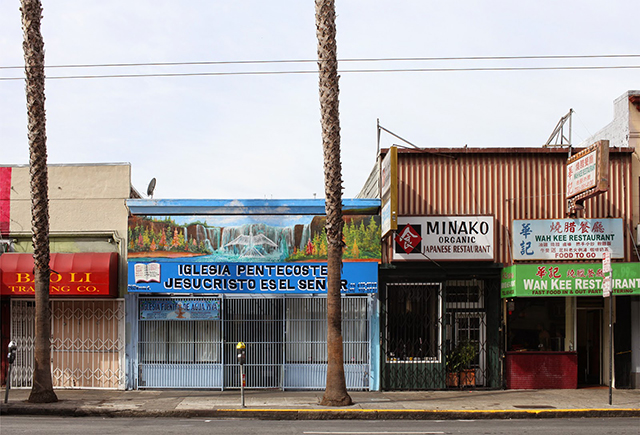
Massive Urban Change, the current show at the StoreFrontLab features three pieces that is part of City Making, a nine-month series of programs curated by Arianne Gelardin and Jacob Palmer.
The first installation is Eliza Gregory’s eponymous series of panoramic photographs along one side of Mission Street from 15th to 30th Streets. The photographs document Gregory’s route on the Mission 14 bus from her home to her studio, and the deliberately dry presentation is an obvious nod to Ed Ruscha’s (1966) Every Building on Sunset Strip. The second piece is Daniel Garcia’s Switch Bench, two inviting birch wood benches whose contours switch midway: if people sit side by side, they must face in opposite directions to talk.

The third installation is Nicole Lavelle’s takeaway postcards featuring original signage from Mission Street storefronts and buildings. Taped to the wall under the postcards, corresponding to each address, are visitors’ stories. I was intrigued to read about one of my old haunts, Hunt’s Donuts at 20th and Mission Street, which in the 1980’s was “ 25 hours” and a magnet for junkies, criminals, and bohemian artists. The stories will be posted on www.massiveurbanchange.com and also used in a book.
Some old-time working class Mission businesses like Whiz Burger, which has been open since 1955, Mexican bakeries, Latin nail and hair salons and Pete’s BBQ still survive, standing now alongside expensive new restaurants and condos. The rapidly changing Mission also features boutique businesses based on nostalgia. Walk down 17th Street and see the old garage that is now a posh bowling alley with gourmet food. Go to South Van Ness where the mortuary used to be and behold the dreamy miniature golf course (again with gourmet food).

Throughout the Mission you feel the economic apartheid: businesses for newly rich and those for the rest of San Francisco, these two classes meeting only when they rub elbows in the taco joints. I am not sure which direction Massive Urban Change and the City Making project are heading towards: Preserve the Mission’s past before it is destroyed? A call to action? Reminisce how times and places have changed, shake our heads, and wake up wondering if you are a renter if you will need to relocate to Oakland or another city to live in? (Disclaimer. I maintained an art studio around the corner from StoreFrontLab for about seven years at 17th and Folsom. In 2012, the new owner evicted all the artists on the bottom floor, and within 12 months the rents increased 40% for the remaining artists. Currently there is no protection for artists and small business people in commercial buildings. I have since relocated my art studio to the Bayview district.)
City Makers explores the physical, historical, mythic, and fecund place that was and is the Mission. Disentangling what is aesthetically affecting and what is therapeutic (or merely sentimental) from what is politically engaging is tricky. As the Mission is consumed one building at a time and becomes the playground of bobos (short for bourgeois and bohemian, two groups no one ever expected to find mixed up together), what is happening here can be summarized as a simple, if not inevitable, shift in demographics and economics.
Do artists and the working class have a place here? The idea that art holds superior social wisdom is an attractive one, but it falls apart when it bumps into anything that resembles political reality, says art critic Ben Davis. I hope this is not lost upon the otherwise thoughtful and optimistic organizers and participants of City Making.

The StoreFrontLab is an actual storefront in part of a small mixed-use compound on Shotwell Street, owned by couple architect David Baker and Yosh Asato. It hosts exhibits, lectures, readings, performances, pop-up stores, commercial projects lasting anywhere from one day to one month, and is a laboratory for ideas, makers and thinkers.
Using walking tours, discussions, and installations, City Making intentionally blurs the lines between sculpture, performance, and museum exhibit. For the next few months StoreFrontLab will also host Give by Juliana Raimondi and Bird Feliciano; The Society of Submerged Culture by Lauren Hartman; Big Sale by KIDmob; The Department of Cautionary Warning by Nicolaus Wright and Kathryn Doherty-Chapman; Office Work by Jon Gourley, Carrie Katz, and The Big Conversation Space.
Massive Urban Change , the current installations will be at the StoreFrontLab until December 14th and the next show Give, part of the City Making Series, will open January 9th. The Storefrontlab is open Saturday – Wednesday 12-5.
An earlier version of this article incorrectly listed Daniel Garcia’s name.
Further Resources:
www.storefrontlab.org
www.massiveurbanchange.com
Foundsf.org and shapingsf.org : Two ongoing projects by historian and social activist Chris Carlson.
yorkandfig.com : Marketplace’s series on gentrification in Los Angeles’ Highland Park
www.newyorker.com/tech/elements/dropbox-airbnb-fight-san-franciscos-public-spaces
Mission playground- https://www.youtube.com/watch?V=awpvy1dcup
The Poetics of Space. Gaston Bachelard.
Imperial San Francisco. Grey Breckin
Infinite City. Rebecca Solnit.
9.5 Theses on Art and Class. Ben Davis.