


It was around 7 a.m. on September 15, 2010. Steve Li was in his pajamas when he heard a loud knock on the door and woke up his mom to see if she was expecting anyone. No, she said. The knocking continued, and she got up to answer while Li went into the bathroom.
That’s when five officers dressed in black rushed into the small San Francisco apartment and, in a flurry, began searching — for passports, identification cards, wallets. They swung open the bathroom door and found Li brushing his teeth. Get dressed, they demanded.
“What are you doing here? Why are you in my house?” Li asked.
As Li’s mother dressed in her room, officers sat him down in the kitchen and informed him that he would be deported from the United States. They took him outside, searched and handcuffed him, and put him into a black van with dark-tinted windows. Li was on his way to a holding cell at the San Francisco headquarters of the federal Immigration and Customs Enforcement (ICE) agency. Half an hour earlier, he had been getting ready for school at San Francisco’s City College.
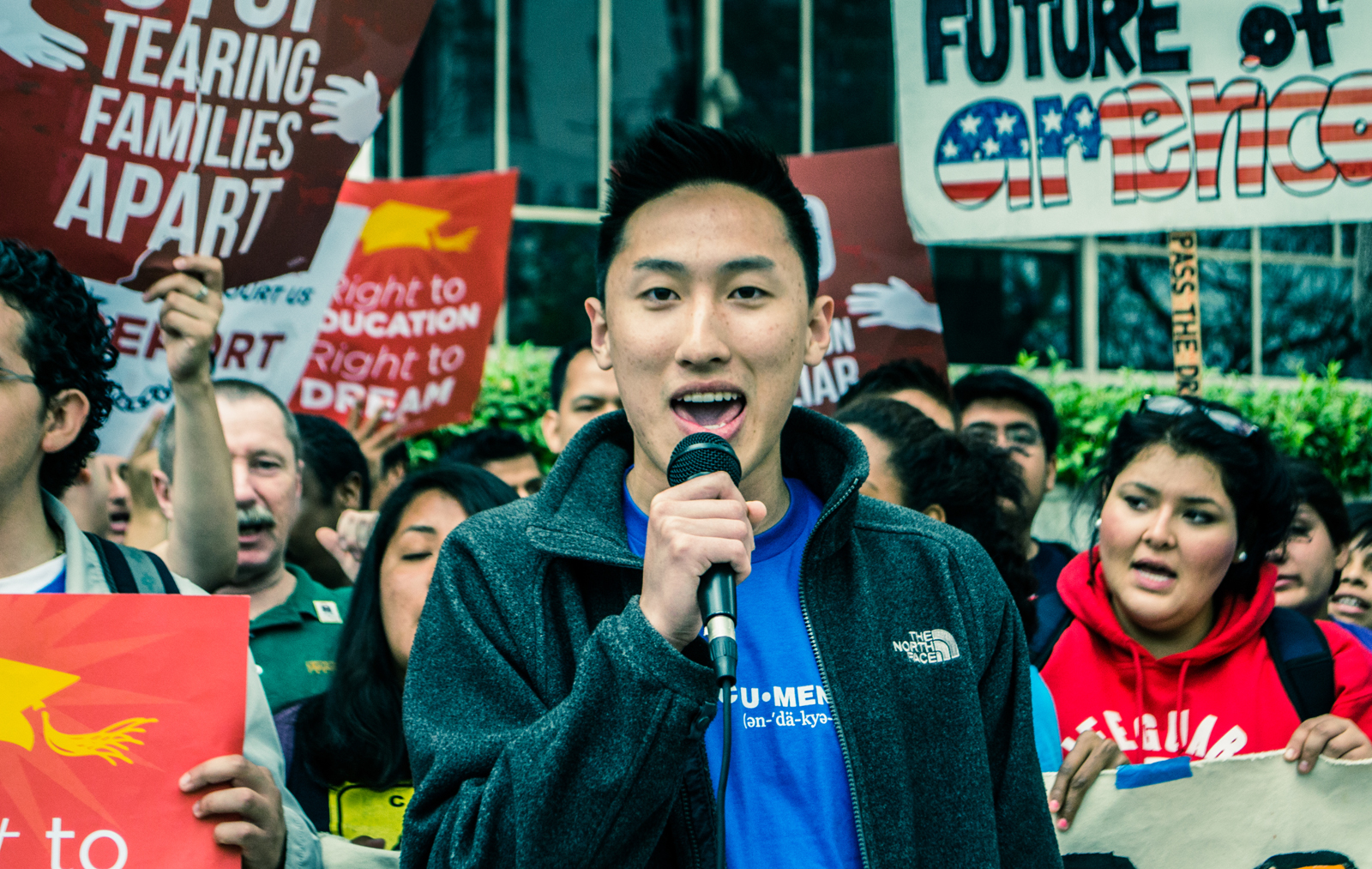
Today Li is one of the more than 1 million undocumented young adults in the country who could benefit from President Barack Obama’s new immigration policy, announced in June. Under the plan, some immigrants under the age of 30 will no longer face immediate deportation and can apply for a temporary work permit.
Li, who was allowed to stay in the United States after California Senator Dianne Feinstein introduced a private bill on his behalf, is happy but skeptical about the news.
“With Obama’s record number of deportations, the fact that we don’t know what will happen in the November election and my own personal experience with deportation, I’m cautious,” he says.
Also, the work permits granted under the president’s plan only provide a two-year deferral from deportation; they are renewable but are not a path to citizenship. “You’re still in limbo,” says Li, who — although he is set to transfer to UC Davis this fall — faces a life of uncertainty himself.
Li’s bill expires in January, and Feinstein must reintroduce it for approval. He lives alone because his parents were deported. He’s picking up tutoring jobs to pay for school.
How does someone go on with life knowing that things could change drastically within just a few short months? For Li, it’s a struggle between moving forward with his plans and saying goodbye to all that he knows here. He doesn’t like to talk about it, though, and it’s hard for him to relive that morning back in September.
The story behind the detainment, release and stay of 21-year-old Shing Ma “Steve” Li is complicated. Although Li’s parents are from China, they moved to Peru in the 1980s. That’s where Li was born and lived until 2002, when the family came to the United States, first settling in New York when he was 12.
Between that time and the day ICE officers searched their home, Li’s parents never told him he was undocumented. Sure, he had flickers of doubt about being an American citizen, like the time he questioned why he couldn’t get a driver’s license as a teenager, but he was always told that his family’s application for political asylum was being resolved.
That’s why Li sat in bewilderment that morning as immigration officials questioned him about his legal status.
“What do you do?” they asked. “Go to school as a nursing student,” he answered. “Well, you are undocumented and you’re being deported to Peru,” they said.
Li knows no one in Peru. Although he spent the first 12 years of his life there, all he remembers is going to school; he feels unfamiliar with the country’s customs. His slight accent, which is neither Chinese nor Spanish, is the only tangible sign that he’s not a U.S. native.
He’s tall at 5 feet 10 inches; his smiles are big, and at 21, he’s still building his confidence. His kind nature can be mistaken for innocence. He wouldn’t yet be able to handle the saga of being deported to Peru.
Immigration officials were determined to get him there, though. After the home raid they took Li to a holding cell at San Francisco’s ICE office.
Later that night he was transported to the Sacramento County jail, his home for the following three and a half weeks, alongside gang members and drug dealers.
“I was scared. I kept asking myself why I was here,” Li recalls. “I was just a student and I have never done anything wrong, and I was here in county jail.”
He heard that his parents had also been taken to the Sacramento County jail for a brief time before being released, so when he was transported back to immigration facilities in San Francisco, Li thought he too was going home.
He was wrong.
After 12 hours of waiting, officers gave him a paper to sign. He was going to Arizona, it said, and if he didn’t sign, he’d face up to five years’ jail time.
His pleas to call home were refused. No one will know where I’m going, he thought.
For a while, no one did. “It was totally weird because I had texted him a few days after he had been taken by ICE officials, and I had no idea,” says Li’s good friend Alan Herrera. “I went maybe even a month not knowing what happened to Steve.”
As friends struggled to get in touch with Li, he was put onto an ICE bus with 100 others. The seats were metal and the air was filled with the clickety-clack of the shackles that bound their wrists and ankles.
Once off the bus, a plane at a private airport in Oakland awaited. It flew to Los Angeles to pick up more passengers, then to San Diego, where those from Mexico were deported.
Twenty-four hours after Li had left ICE’s San Francisco headquarters, the plane, its occupancy now swelled to 200, touched down in Arizona. Li had not eaten once.
As soon as he saw the military-like compound with its high razor-wire fences, it hit him.
“I see the wires and I’m thinking, you hear horror stories from people who’ve been in Arizona and then stuck in county jail, who’ve been back and forth,” Li recalls. “They told me it was a horrible place to be and everyone there was going to be deported.”
For three days, Li and the other immigrants waited in a room the size of a high school cafeteria, sleeping on the floor until they were appointed to an official cell. Among the group were 18-year-old students who had been pulled over for traffic citations, as well as those caught crossing the border, still covered in mud and dirt. He could smell their sweat.
After two days of detainment in Florence, Arizona, he was able to call home and explain his situation. Soon after, word of his incarceration spread.
“I had heard about immigration taking away people, but in my mind it was them taking away criminals. When I heard it was my friend, who was doing something positive, I thought it was some cruel, practical joke,” says Herrera.
Lisa Chen, a community advocate with the Asian Law Caucus, a legal and civil rights organization that took on Li’s case, recalls how quickly the community rallied behind Li. A group of his friends wrote letters to Feinstein, started petitions and orchestrated press conferences and community rallies.
Over the phone, Sang Chi, Li’s former Asian American Studies professor, read him the comments people had left on his Facebook page.
“That was what really kept me going for a while, was to learn that,” Li says.
But that could only do so much. After two weeks had dragged on, the reality of his situation sunk in. “Then I just kind of gave up,” he recalls. “I felt helpless being in a detention center. There was nothing I could do.”
And for a while, there was not much anyone could do. Sin Yen Ling, his lawyer, had exhausted all options, including petitioning for deferred action, a last-ditch appeal that would let Li stay in the United States for a certain period of time. When it was denied by ICE, local media ran stories titled “Only a Miracle Can Save Steve Li Now.”
Check back tomorrow for part two of the story.
Dear Lisetta,
There are families with far more traumatic losses and separations by violence, domestic violence and deadly traffic accidents. These families will never see their loved ones again.
Congratulations on glorifying an illegal immigrant law breaker, and projecting cheap pity for his temporary loss.
How about focusing on domestic violence in the Mission District and empower battered women and children to report the abuse?
Mr Li should have left with his parents. They broke federal law, being illegals they took a chance not get caught, they lost & were deported, end of story.
Illegal immigration is a crime, end of story.
A very simple question… what part of illegal doesn’t everybody understand? He was 12 when he was brought here by his parents; he is now 21 and before the raid thought he was in this country legally! College isn’t going to help him gain common sense!
Mr Li is an illegal and should have been sent with his parents, not made a ward of the State of California!
No one is illegal anywhere, he is undocumented in this country.
If you cross a countries borders without proper authority or documentation then you have entered this country illegally. From this statement that makes Mr. Li an illegal! Simple statement of fact… you may disagree; but until such time as the law is changed my opinion stands.
Taca… I would truly love to see you enter into Iran, Iraq, or even Mexico to keep it simple, without proper documentation and try and get work, education or medical assistance!
The law disagrees with that statement.
Without documentation, someone has no legal right to live and work in this country, so your statement would seem to be incorrect.
Looking forward to Part 2.