

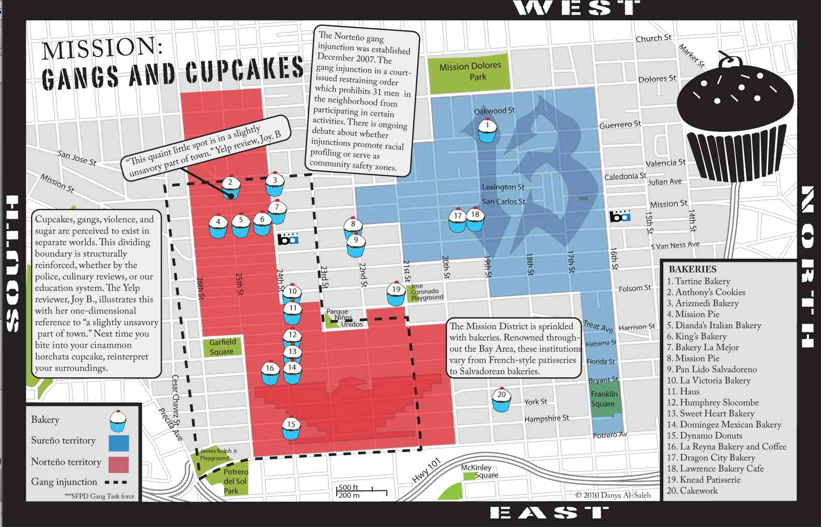

This Halloween was soberly upstaged by the veladoras and remembrances decorating the corners of 23rd from Harrison to Florida streets, honoring 26-year-old Reynaldo (“Rey Rey”) Cordova, who was fatally shot five times the previous Friday. In stark contrast, just a few yards from the shooting, lines of foodies enjoy a range of artisan ice cream flavors at Humphry Slocombe, and pay $3.75 for a small blood orange sorbet.
This growing disparity among Mission District “locals” poses questions about collective responsibility: How can the growth of local and sustainable business translate into community partnerships and shared resources?
At the close of 2006, City Attorney Dennis Herrera initiated a civil gang injunction, creating safety zones against five of San Francisco’s street gangs. In the Mission, the “Norteño Safety Zone” encompasses not only the site of Cordova’s shooting and of Humphry’s, but also several public schools and parks.
I grew up on the same block as Rey Rey, and my children attend a neighborhood school in the Zone. Since the end of August, a series of fatal shootings in the Mission has shaken the Norteño and Sureño gang territories. According to the Office of the City Attorney, the injunction has resulted in a reported “cooling off” effect, with a drop from 41 percent to 14 percent of identified gang members arrested for non-injunction offenses since 2007. Nevertheless, a recent report from the Office of Juvenile Justice and Delinquency Prevention suggests that over the last decade, gang-related violence has remained at significantly disturbing levels, particularly in urban centers and despite decreases in violent crime rates across the country.
Nationally, San Francisco County had the second-highest rate of gang-related homicides among gang members between 2002 and 2009. These figures and the recent rash of shootings tell us that not only are our neighborhood youth killing each other, but also that we need to be doing a better job as a community, seeing and serving our youth.
When you can order seared ginger tofu with quinoa at 18th and Mission, a block from where a gang-related shooting left a 22-year-old man with a bullet through his head this fall, it is time to be proactive about ways to share your table. While many may view these new establishments as a sign of community improvement, in a neighborhood historically characterized by poverty, violence and low-performing schools, the hard questions about community potential remain.
Both public health and civil liberties powerhouses offer evidence and alternative suggestions for addressing youth violence. Like heart disease and the flu, violence is recognized as an epidemic. In a recent bulletin, the Centers for Disease Control (CDC) found that an average of 16 youth are murdered each day, most by a firearm. For Latino youth, homicide is the second leading cause of death. All of these deaths can be prevented.
While criminal justice and police-based gang task forces may be part of the comprehensive solution, the American Civil Liberties Union (ACLU) opposes the gang injunction in the Mission on the premise that it fails to address root causes of gang violence and permits police to harass Latino (and African-American) youth. The ACLU points to the need for community policing and more job and education programs. Similarly, the CDC highlights the importance of school connectedness and involvement in positive social activities as a means to buffer youth violence.
Bi-Rite and Nextcourse have expanded their definitions of local and sustainable. At Mission High School, Bi-Rite has supplied sandwiches for student groups. Nextcourse collaborates with schools and community agencies to offer a comprehensive culinary education program to address food insecurity and educate youth about sustainable and local eating.
There is much the Mission can gain by holding all of the Norteño Safety Zone residents and patrons accountable. The police, local businesses, schools and families cannot exist side by side, each in a silo. Diners flock from near and far to Flour and Water for funghi pizza with sunchokes and chanterelles at Harrison and 20th, but the view across the street is of a public high school with a strict dress code to avert gang rivalry, a school striving to raise test scores to proficient levels in math and language arts. To more fully practice local and sustainable business, new and highly successful food establishments can seek opportunities to partner with local schools and community agencies and lend a hand in supporting Mission youth.
Evan van Dommelen-Gonzalez coordinates a community-based research program with Mission youth and is a first-year doctoral student at the School of Public Health, University of California, Berkeley.
I notice this post didn’t mention any Hispanic restaurants. Is Mission Local’s refrain that “gourmet food + crime = irony” a proxy for racial tension? Are we actually talking about white people “from near and far” finding joy in the Mission while Latino families with children face a greater challenge?
great article.
“To more fully practice local and sustainable business, new and highly successful food establishments can seek opportunities to partner with local schools and community agencies and lend a hand in supporting Mission youth”.
This community practice has been around for a long time. Many of the older established restaurants in the neighborhood have been donating and supporting our local schools and community groups for years. Some of the ones I have had personal experience with are Palacio Latino, Casa Sanchez, Sunrise Restaurant, Puerto Alegre, Reaction, Little Baobab… And some of the newest include Arizmendi and Mission Pie. We shouldn’t view this as charity per se but rather mutual support. Word spreads and parents at schools will more likely support a local business that supports their children (as long as the prices are affordable!)
Yes, thank you Oscar, for pointing out the level of support and community involvement that already exists among many established businesses in the Mission. I often wish MissionLocal included this aspect more often in their stories. The question, it seems, is how to encourage the newer, younger, “hip” or whatever businesses to participate as responsible members of their community. I’d like to see more on this in ML.
I’ve been thinking about this piece all morning and I think I missed the point the first time around. This story makes me think beyond the question of what “new & highly successful” restaurants can do to lend a hand. It makes me think about as this neighborhood continues changing in population we are going to continue experiencing deep disparities in income and access to opportunities. The whole notion of getting ahead means that someone is left behind, and this is being played out right in front of our eyes in the Mission District.
This article makes me think how we can build a culture and practice of mutual aid (not charity), where all community members can equitably exchange and build off (without exploitation) one another’s social, cultural and economic assets. It’s time for new community tradition that goes beyond our class, race, school, non-profit, issue, etc. silos.
Latino parents need to take responsibility too.