

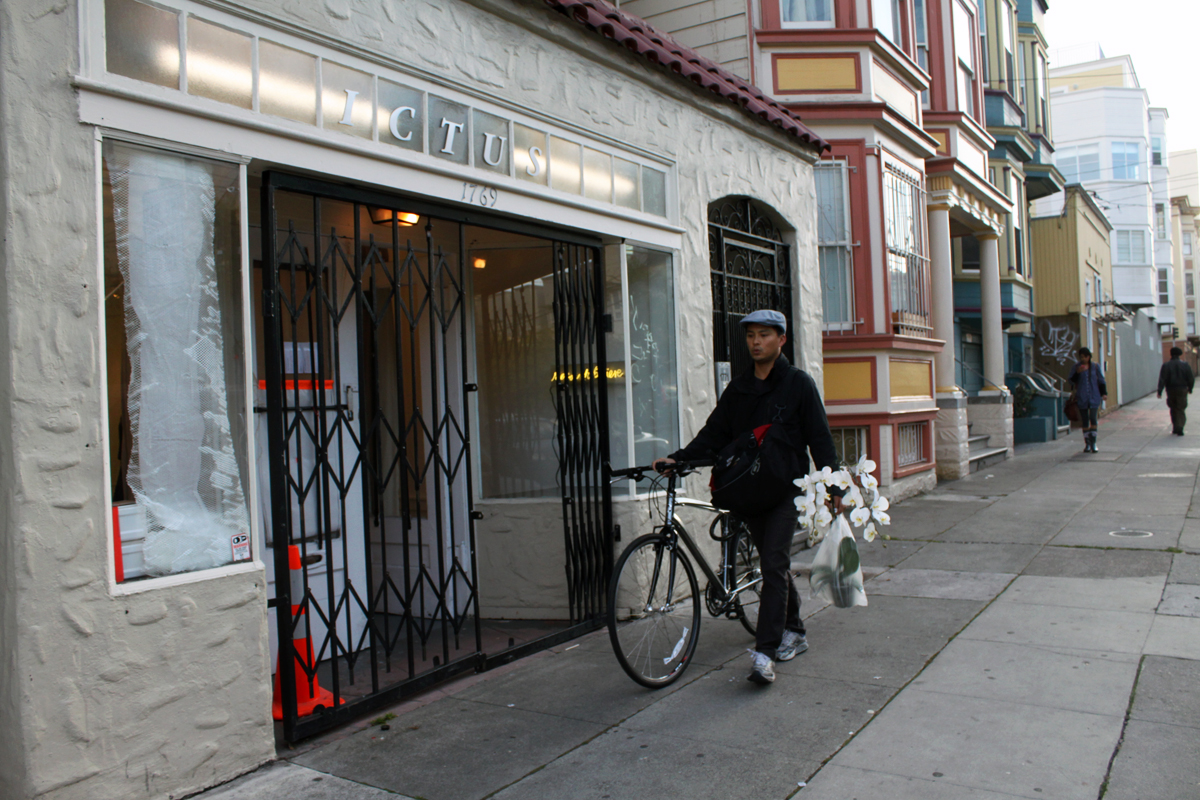

It’s the moment the heart stops. It’s the instant one becomes impassioned and completely inspired. And it’s the essence of the “ictus” in Ictus Gallery.
That’s what the curators say, as they close their eyes in a gesture that looks like they might be trying to find peace within. Suddenly, their eyes open. “Is it Latin or Greek?” asks Katya Min, curator of visual arts. “Hmm, let me double-check,” laughing at herself.
In this case, it really doesn’t matter. A cultural intersection of visual art, music, performance, screenings and literature, Ictus doesn’t want to skip a (heart)beat. After closing in November 2010 because of family issues, Ictus reopened in March 2011 as a hybrid between a commercial gallery and an artists’ assembly space.
“We came together really wanting to provide a community space for people to gather and share open arts,” says Min about working with Jose Rosales, curator of music. “And at the risk of sounding cliché, open hearts, too.”
The duo worked together on occasional exhibits even before the reopening. Now they’re preparing for a series of shows slated through next September, with musical acts in between.
With the opening of Ictus’ new show, Immaterial, on Thursday evening, the curators will celebrate the work of Mary Conrad in 1,400 square feet of vacuum-sealed bags, neon signage and orange safety cones, along with a performance by a Japanese Butoh dancer Deborah Butler. Butler will be covered in white powder from head to toe, with red makeup under the eyes and over the lips.
Mmm, a dose of urban materials accompanied by a dash of eerie-looking human. At Ictus, it’s all about making something uncomfortable feel comfortable. Certainly there’s an underlying respect for art. But it’s also supposed to be “campy, coco fun,” says Min, dressed in denim cutoff bermudas and a loose gray top.
Slow and meditative movements from the dance will reflect the theme of Conrad’s work, or at least that’s what the curators say. Conrad’s color palette is bright and neutral, her textures thin and shiny. Plastic and foil emerge in her art — byproducts of mass production and mass consumption. “It’s really about how at the end of capitalism, there’s really trash,” says Min.
“I want to be able to talk about [the art] with an analysis and not have it necessarily just be presented and vacuumed,” says Min, carefully executing each word.
She’ll do just that on the exhibit’s opening night, starting the discussion and ensuring that messages are conveyed correctly. After all, presenting plastic and powder together could be taken in many directions. It’s risk-taking, to say the least.
Stepping inside the freshly painted beige gallery and onto the splatter-painted gray floor, you feel a slight chill in the room. Yet the space is warm and inviting, especially when the curators are passing out water and hugs. It’s also ideal for visual art, with ample walking space.
The reopening signifies a shift from a primarily Latino focus to a more international direction, visually and musically.
“We’ll bring artists from all over the world,” says Min, referring to past exhibits with artists from Korea, El Salvador and Lebanon. And all over the map aesthetically, too. Only at Ictus will a viewer find a performance of boys wearing tinfoil crowns and shooting plastic laser guns at one another.
The same applies to Ictus’ music scene. Replete with alternative, punk, folk, hip-hop, flamenco and traditional music, Ictus doesn’t shy away from much. “Somehow it all kind of works,” says Min. Indeed, somehow an evening with mothers of punk-rock children and grandmothers of samba performers blends surprisingly well.
Recently the gallery held a course in Son Jarocho, traditional Veracruz music. People ages seven to 70 performed until midnight. That’s hard to find anywhere else.
“We have a really good space where you can be very close with the musician and artist,” says Rosales. “It’s an intimate place to experience live shows.”
When it comes to planning, however, much is still in the air.
“There’s a lot of prototype things that happen here,” says Min. “A lot of times people put on funky shows and they’re like, ‘Oh that was good, maybe we’ll try it again differently the next time.’”
Adding to the flexibility: no red tape and no need to fill out papers. “It’s kind of liberating because it’s really free,” says Chelsea Baumberger, a gallery associate. “Like, ‘Oh, that’s gonna happen this Friday, OK,’” adds Min, with the enthusiasm of a 16-year-old. It’s become a way for bands to garner community exposure and support.
Sales also support artists. Bands receive 75 percent of the ticket sales, while Ictus receives 15 percent. Artists receive 60 percent of art sales, while Ictus receives 40 percent. The gallery’s funding comes primarily from art sales.
The location couldn’t be any more in tune with the diversity in art and patrons they promote. “It’s right in between Mission and Valencia,” says Baumberger. “It’s like bringing people together because they’re both so different.”
Nestled in between an auto shop and a salmon-trimmed Victorian, Ictus is a mixed-use building, with the gallery on the first floor and two apartments above. Rosales and his wife, a photographer, own the building. The mortgage covers the gallery.
Rosales opened Ictus because of his passion for the arts. He acknowledges the shortcomings of making a profit, but is currently trying to bring in better talent with each exhibit or performance. “We love to do this, so that’s why we are trying to do a good job,” he says. The gallery certainly has the potential to gain a larger following.
For now, Rosales’ day job as a sous chef keeps him stable. Min’s day job as an art consultant for Lumina Arts, and as the senior project manager at the Yerba Buena Center for the Arts, does the same. It sure makes working at Ictus relaxed and really experimental. And maybe a little weird, but in a good way, of course.
Ictus Gallery hours are Tuesday through Saturday, noon to 5 p.m., and by appointment