

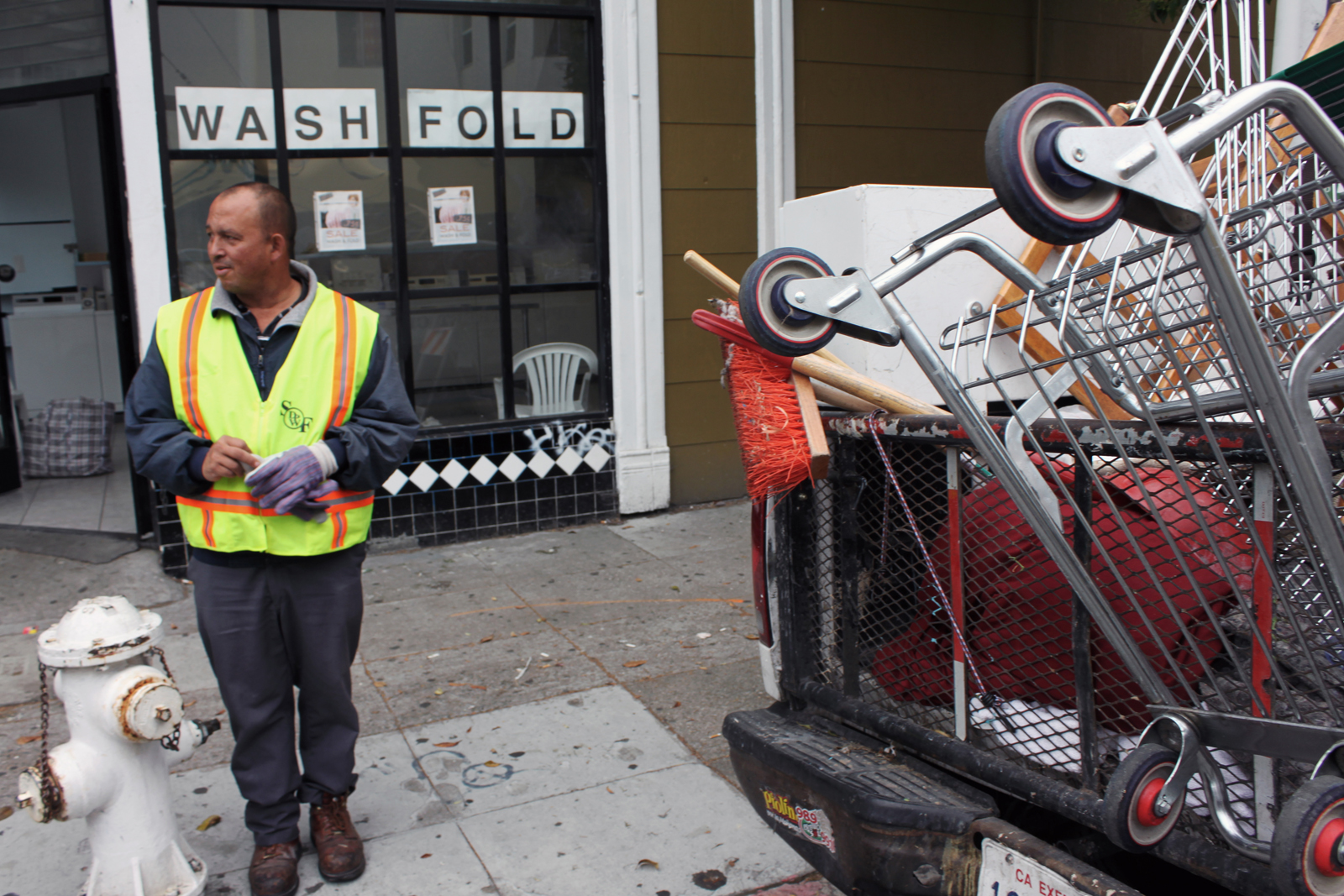

His least favorite thing to clean up is human waste. Every two years he has to go to San Francisco General Hospital for another round of shots. His truck has a white lockbox mounted on the back, stuffed full of rubber gloves and disinfectant and first aid supplies. He gets teased about this sometimes.
But Isais Vidal is not easily fazed. A kind-faced man in a gray jumpsuit, he is currently stomping a salmon-pink entertainment center to bits. The jagged particleboard fragments go on to the back of the truck, along with the shopping cart, multiple IKEA chairs, battered suitcases, broken lamps, children’s toys, dirty blankets and a plastic statue of a pug wearing a red collar. The pug stays — found on the sidewalk a few weeks ago, it has acquired mascot status and now rides wired to a perch on the back of the truck.
Last year, Vidal and the other people who share his job at the city’s Department of Public Works picked up 10,000 tons of debris off the streets of San Francisco. That’s above and beyond normal trash collection — DPW is responsible only for clearing away objects left in public rights of way. It’s work that costs the city an estimated $4 million. In the struggle between stuff and the humans hired to move that stuff elsewhere, stuff is winning. Last year, DPW received 17,000 trash collection requests. At the rate they’re going, it will be 19,000 calls before this year is out.
It may come as a surprise to those who live here, but the Mission is not the neighborhood with the most debris. The Mission is also not the neighborhood with the second most debris. The Bayview has the most (only one in four residents of the Bayview actually has trash pickup, says DPW spokesperson Greg Crump). Next is the Tenderloin.
“Look at that!” says Crump. On the next street over, a sofa rests, upside down, on the corner. Smaller objects — kids’ toys, a rumpled Safeway bag, a lampshade — are piled around it. “Someone leaves one thing, and everyone starts piling things on it.”
“Feel free to remind everyone that they’re entitled to two free pickups a year,” Crump says. There is such a thing as a garbage bust, he says. If DPW can find three pieces of mail or other identification belonging to the same person in an illegal trash pile, they’ll issue a fine. Right now, they issue about five a week.
There seems to be very little about street trash that Vidal isn’t aware of. “That trash can,” he says, pointing to one of the large green receptacles at 24th and York. It’s filled to the brim, and surrounded on all sides by shopping bags stuffed with trash. “If I take that away, it’ll be back in an hour.”
It’s a sign, he says, of illegal dumping, he suspects from the apartments nearby. Less scrupulous landlords are known to hide trash bins from tenants, hoping to minimize trash collection fees.
Ever since Vidal left El Salvador in 1979, the Mission has been his neighborhood. When he first arrived, he worked as a cook and a house cleaner. He got this job this way: He went to 44 Gough Street and filled out an application. Two years later, he got a call. Did he want a job? He did. He likes the work. “You’re not in one place the whole time. And sometimes the Mission is not that bad.”
Up ahead, an enormous white truck is waiting at the intersection of Alabama and 21st. It’s a compactor truck, waiting to crush the sofa across the street.
Vidal and a co-worker pick up the sofa, which has the dark color and curved arms of the late-’90s modernist roccoco revival, and push it into the square maw of the truck. With a satisfying crunch, it bites down and breaks the sofa in half.
The two stand on the corner, gathering up the last of the items and throwing them into the truck: a kid’s plastic storage bin, a few throw pillows. But part of the pile — a blanket — won’t budge. A Volkswagen Jetta is parked on top of one corner.
Vidal leans over, pulls out a knife and saws around the edge. When they leave, the only thing remaining is a scrap of blue fabric under one tire.