

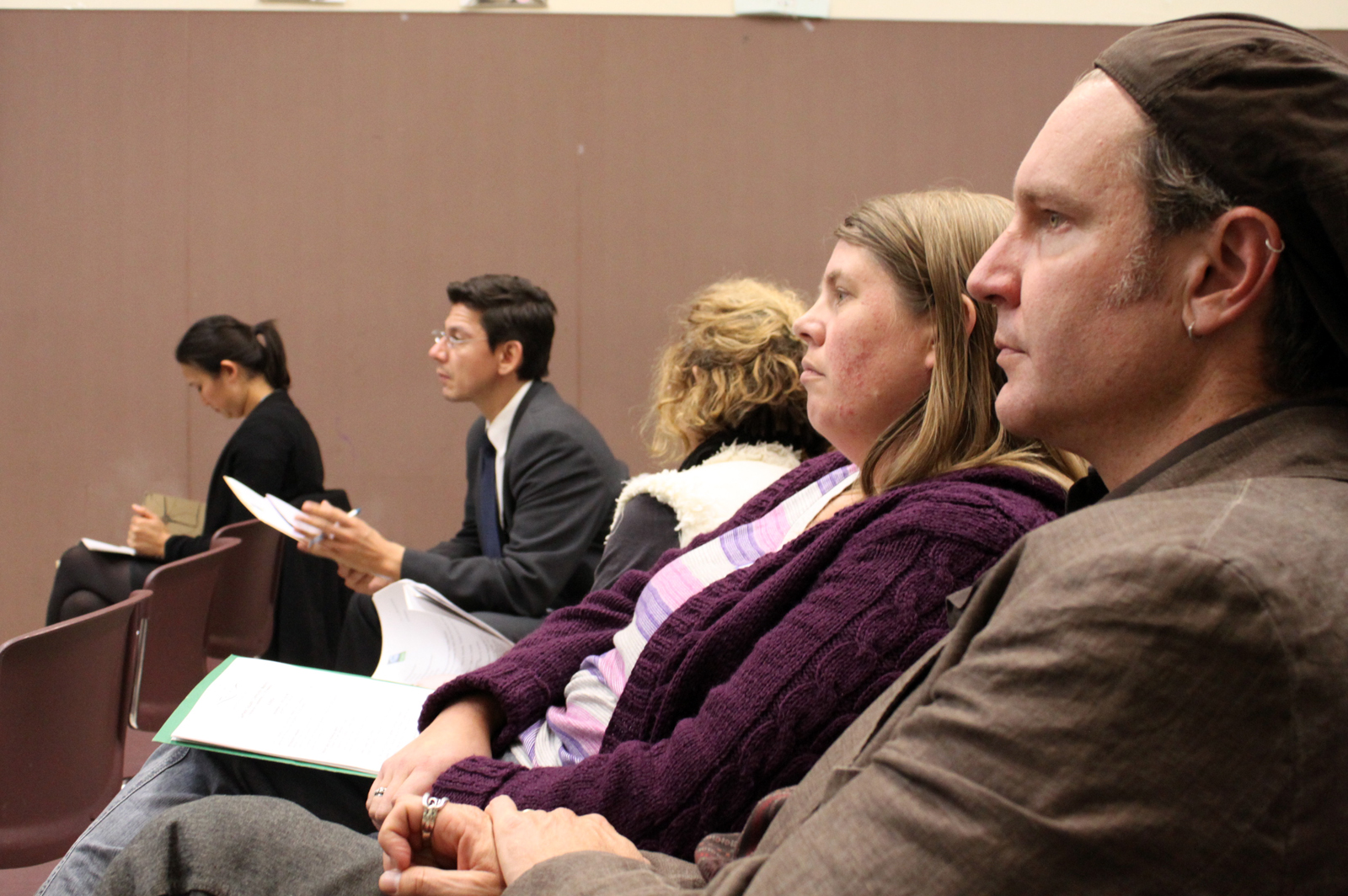

It is mostly the few and the proud who gather Wednesday night in the Garfield Park clubhouse, a far cry from the standing-room-only scene a month ago, when more than 40 people crammed in to air grievances about safety, recreation cuts and public drinking and gambling.
Intended to be an update on the progress officials are making in these areas, the meeting instead becomes a brainstorming session for a dozen residents and a handful of officials on potential events to get more people to use the park.
The first update: The park now has a Friends of Garfield Square Park group, says Meredith Thomas of the Neighborhood Parks Council, a nonprofit organization that advocates for parks and is serving as the meeting’s host.
The neighbors who joined want to kick it off with a holiday event.
Frank Brooks interrupts. He wants, again, to advocate for extended hours at Garfield Pool. It’s “inconceivable,” he says, that the pool is closed on Sundays. He also reminds the 20 people in attendance that there are ongoing problems with derelicts, the homeless and drunks.
Thomas steers the group back to the kick-off.
Ideas begin to flow. A hot cider party with Santa, a swimming relay, a dog show and a pumpkin patch on the soccer field are all tossed around.
Eric Andersen from the city’s Recreation and Park Department interrupts to say he’ll have to check on permitting rules for events on the new soccer turf.
They press on.
Salsa dance parties, sidewalk murals, movie nights with an outdoor projector and popcorn machine — the neighbors are on a roll, and the possibilities seem endless.
“This is what it means to be a “friends of” group, to have these conversations with one another and the folks who can help us make it happen,” Thomas says.
Officer Steven Keith takes the floor, armed with an excess of handouts for the sparsely attended meeting. He’s here to talk about the liquor store on the corner, the subject of many complaints regarding alcohol sales to minors.
“It can be a little confusing, because it’s a state agency that handles it,” he says, amid a couple of knowing laughs.
The Mission police have attempted unsuccessfully to send decoys in, he explains. “We weren’t able to make a case, because they were tipped off.” That’s where the neighbors come in.
Keith arms the attendees with a flowchart of the agency’s complaint protocol, a citizen’s log to record disruptive activity, and a complaint form for the Department of Alcoholic Beverage control. He’ll collect everything and forward it to the agency.
Mission Station Police Captain Greg Corrales steps in to underscore his commitment to parks. “Every district station has a park officer, a couple districts have two. At Mission Station, we have six,” he says, adding that Garfield Park is one of the top three priority parks, based on the volume of calls for service.
“I’m going to use my resources where people have let me know they have concerns, that’s why it’s important that you all come out here to let us know so we can address them.”
So they do, and the drunks, the derelicts and the gamblers are back on the agenda.
Someone suggests park signage using the faces of children to guilt-trip others into better behavior. Thomas suggests routine neighbor walk-throughs of the park, with calls to police or 311 to report any problems. It’s worked elsewhere, she says.
Mark Scandrette, a founding member of Friends of Garfield Square Park, agrees. He wants Garfield Square to be a place where children and older people can feel safe. But there are challenges. “The soccer field is working because it’s enclosed, but right outside the fence there are 20 to 30 people, passed out, or gambling.”
Scandrette’s wife, Lisa, also an organizer of the friends group, agrees. “If the guys who are down there just wanted to hang out, that’s not a problem. What’s a problem is when my 17-year-old daughter can’t walk down the street without being harassed or catcalled.”
Corrales encourages the Scandrettes and others to be the “eyes and ears” for Mission Station. “Don’t get discouraged, don’t think you’re being a pest. You’re not,” he insists.
“I have a question,” says a young girl in the front, raising her hand timidly. She and her little brother are the only attendees under 30, and everyone listens in anticipation. “Are you Hayley’s mom?” she asks Lisa.
“Yes, I am,” Mrs. Scandrette says with a smile. The comic relief is welcome.
Last on the agenda is the clubhouse, which, like nearly half the clubhouses citywide, remains shuttered because of budget cuts.
Eric Andersen, parks manager for the Mission District, hands out flyers detailing open hours for the remaining park features — the soccer field, bathrooms and pool.
Brooks’ ears perk up, but Supervisor Campos beats him to it. “With respect to the pool on Sundays, is that just a resources and staffing issue?”
Andersen explains that budget cuts have made the closure necessary, and reminds them that two pools nearby remain open on Sundays. Frank persists. Health reasons prevent his swimming outdoors. Judy Brady, another pool patron, nods in agreement.
Ron Chisholm, manager at Garfield Pool, explains that the Sunday closure was decided based on an evaluation of usage statistics. To open, they would need more funding.
Meredith suggests renting the space out for birthday parties on Sundays. That and other fundraising could help extend hours. For now, they just don’t have the money.
Eric Andersen says the parks department is committed to finding an organization to lease the building and provide community programs soon.
How soon is hard to say, however. The formal request for proposal process can take months. Andersen says their strategy is to initiate a pilot lease to open the center’s doors as soon as possible while the full RFP process takes place.
But the department doesn’t have much else to report. They have no organizations lined up, and things are moving slowly. “Nothing has really come through for Garfield yet, that’s where I think the friends group could really help,” says Andersen.
Other options include finding outside grants to fund the hiring of a clubhouse staffer, or putting together a proposal for a collective of neighbors to run the center themselves. “That’s a fairly ambitious thing,” adds Andersen, as at least one person would have to sign on as a leaseholder and pay rent.
With the long list of tasks laid out, people are growing visibly weary. And so the meeting winds down.
Judy Brady, the swimmer, hangs around for a bit. When asked how she feels about the meeting, she says, “Not very inspired. People don’t show up.” Looking around the emptying room, she adds, “But I think people are really burned out.”
But some park activists say Garfield neighbors have every reason to be hopeful. “We’ve been through this road before,” said Pat Delgado, an active participant in the Parque Ninos Unidos community and one of three park group mentors assisting the fledgling Garfield Square group.
Delgado says that when her park opened, the department had no funding for maintenance, a gardener or a clubhouse director. They gave her the keys to the clubhouse and she kept it open when she could, even stocking toilet paper when it ran out. Within a year, they’d received all of those things from the city.
“You need to tell the department exactly what you need and how they can help,” she said, adding that she thinks the Garfield group is off to a strong start.
“The energy is really strong,” she said, glancing over at the Scandrettes, who have lived in the neighborhood for 13 years. “That’s what you need — park users who want to see changes.”