


BY JENNIFER MENDOZA
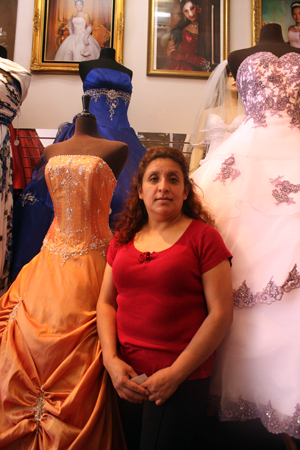
Gloria Martinez, a woman with short, curly hair, busily fills tuxedo rental forms, piling one on top of the other, in a store filled with gowns, purpose and possibilities. Nearby, a tall woman with black hair looks through the wedding magazines.
“Your friend needs to come in, even if she wears a size eight in jeans, dresses are different,” Martinez, an employee of 20 years, insists.
The customer disagrees: her friend is a size eight. She turns on her heels and walks out. Martinez runs after her. She returns.
“We cannot let her leave with the magazine, it’s the only one we have,” Martinez explains as she walks back in with the magazine. “Last time someone did take the magazine and we lost lots of money since it was the most popular magazine and we couldn’t get another copy.”
The bright colored Quinceañera dresses in the front of the store— purple, turquoise, lime-green, burgundy and hot pink— stand out as a full moon does on a dark night. The accessories are there too: Quince crowns, artificial bouquets, party favors, bibles, and crystal rosaries fill the stores the glass cases.

The busy season begins in March and ends in May when the high school proms start. For some reason, it’s also a period of many baptisms, Martinez says
The phone rings. “Latin Bridal” Martinez answers with a strong Spanish accent. “In two weeks” she says when a customer asks her when her dress will arrive for a fitting.
Martinez is a veteran and knows the prices of all the dresses from the $369 bargain to the $1798 gown. She also knows whether the dress can get there the next day or will have to be rushed to arrive in two weeks.
Martinez says “it’s a tough economy,” but there isn’t as much competition as when she arrived 20 years ago from Mexico City.
Back then, she only knew one person who lived in the United States– a brother-in-law in San Francisco and that’s how she landed here.
She began from the start working at a clothing store at the same location, but two years later it reopened as the Latin Bridal and she stayed on.
Martinez still remembers how it felt in the Mission District and how similar and different it was from her hometown. Everyone spoke Spanish, but she could no longer walk from her house to the tortillería.
Like many of her new neighbors, she too immigrated to find work. Martinez, her husband, and her eldest daughter—the only child they had at that time—crossed the border together. “It was a good choice,” she says even though she had to leave behind some of the most important people in her life including her mother, father and only sister.

“I felt lonely,” she remembers. After her father passed away she brought her mother and sister to live in San Francisco. “I wanted to take care of her,” she says referring to her mother.
Aside from her mother, she also has two daughters and one son and all of her children have grown up in the Mission. From her point of view, it’s a community that is only getting better. “
There’s less violence, less gangs and more vigilance by the police,” Martinez says. “I see less teenagers wandering around in the streets.”
Martinez no longer worries about her daughter walking through the Mission after school. Her daughter is going off to college. With sadness she asks Adriana “Mija, what school are you going to again?” It’s in the south and too far for Martinez.
“I want her to go to college but I wished she would have gone to UC Davis since it’s far, but not too far” says Martinez, but adds, “I have to support her in her decision because this is for her education.”
Martinez gets up to help a customer and a man walks into the store, “Does someone want flan?” he asks in Spanish. “Yes, can I get two?” She pulls out a $20 bill; each flan is ten-dollars. She carefully sets them down on the side and finishes pilling the tuxedo rental forms.
Rigoberto Hernandez contributed to this story.