

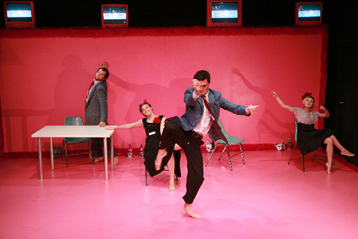

7 p.m. Dandelion Dance Theater
Red velvet cloth = blood. Black mask= terrorist. Dandelion Dance Theater took the obvious approach when looking at the presence of mass media in our homes in a piece titled “We Love You to the End of the World.” And, although the ironic connections between violent war images and commercials for penal enlargements were accessible, the performance was far from risk taking. With not much more than literal movements dancers portrayed the anxiety and restlessness that come from watching the nightly news.

Less obvious was the piece directed by Eric Kupers called “Mutt 49 Crosses the Line.” The dance centered on a fictional indie band that uses song and text to examine their insecurities and sexual desires. With almost no dancing and an excess of nudity, the performance seemed more suited for a showcase at the Power Exchange. Performers groped each other, themselves, and even their instruments while singing songs about suicide and thoughts of insanity. Lyrics such as, “I am going insane come and die with me,” mixed with performers gargling water in harmony and naked head stands left me feeling like I would rather die than stay for the rest of the show. The mix of dancers, musicians and actors in the ensemble seemed forced and the interdisciplinary performance failed to allow any of the elements to shine. By AMANDA MARTINEZ
8 p.m. Vicious Dogs on Premises By Witness Relocation

One, two, three, four, five, six, seven eight, DING.
What’s the worst way I can think of to die?
Four characters: A, B, C, D. Each offers the audience one or more versions of horrible ends involving hemorrhoids, shit brains, rape, former vice presidents improved seating fans DING.
One, two, three, four….And so it goes.
The program assures the viewer that “their work has been described as, “magnificent” (The New Yorker) and, “like going to your first punk rock show in the 1980’s…” I don’t think so. But the actors are physical, dexterous, and more talented than many—especially C or Heather Christian.
Too bad they’ve given up on play writing, which becomes clear when three-quarters of the way through the 60 minutes, D has to explain what Vicious Dogs is about: Shamelessness, humiliation, (there’s a lot of baring of teeth and photos of dogs baring teeth in case the viewer doesn’t get it) torture. ”I think it’s about life,” D says.
Oh dear. By VIOLA
Repeats June 12, June 13th. 8 p.m.
9 p.m. Bond Street Theater and Exile Theatre of Afghanistan

As the Hindu-Kush mountains rise darkly in behind the scrim of our collective consciousness and “Af-Pak” becomes the next “Iraq,” it is fitting that the headliner for this year’s Fury Factory Festival comes to the Mission from the refugee zones of northern Pakistan. Performing for Afghan refugee children in 2002, members of the Bond Street Theater (U.S.) met Afghan Exile Theater collective and the two began a collaboration resulting in Beyond the Mirror. Before coming to the Mission, the play had been performed in New York, Baltimore, Tokyo and Kabul, where it won first prize in Kabul’s first International Theater Festival.
Beyond the Mirror tells the story of Afghanistan from the Soviet Invasion in 1979 to the attacks on the World Trade Center and Pentagon in 2001. To overcome the natural obstacles of presenting a two-decade history in 70 minutes, the play utilizes mime, music, dance, personal stories, archival film and puppetry to present images of Afghan rural life during this time. The images, visual and aural, tell the story. There is no plot or narrative, no character development, no arc, little exposition and the climax is . . . more a revelation (of sorts) than a resolution. It seems to derive from folk theater combined with a strong dose of agitprop reminiscent of works developed by Chinese peasants and soldiers during the Cultural Revolution. We have villains (Soviet Army and Taliban), and the victims (peasants and women). What’s missing is the hero. But then, Major General Stanley McChrystal had not yet arrived on the scene.
Beyond the Mirror invites Mission audiences to learn about the struggles of the people of Afghanistan, but through stock, almost hackneyed, portrayals of Afghan peasant life and the war. Repetitively juxtaposing images of placid daily rituals with the shock of bombs, beatings and beheadings tells us little new about Afghani life or culture. Hey, we’ve seen that on TV. And the baby getting maimed by the cluster bomb? We’ve seen that too, and expected it immediately, draining all the suspense, surprise and emotion from what was clearly intended to be a highly-charged scene.
Dolores Park is home base for the San Francisco Mime Troupe. Tony Kushner’s “Angels in America” got its start here, and the Mission has been a center for the development and production of left-wing agitprop since the 1930’s. Call us snobs, but we do have standards. Political theater at its best combines a fresh viewpoint and sharp ideas with the emotional power to move an audience to action. Though Beyond the Mirror may be pitched perfectly for an Afghan audience in a refugee camp outside of Peshawar, the play misses its mark in the Mission. A great human drama is unfolding in the Hindu Kush, but the play flattens it and keeps the audience on the outside looking in. Although the brilliantly haunting music performed by Quraishi on the Afghan rubab gives hope at the outset of the play’s journey, the last line “we are merely reflecting each other” could not be more disappointing. Wasn’t this play going to take us beyond the mirror? Unfortunately, it doesn’t. By MARK RABINE
I gotta agree with you for the most part, nicely put.