

Tucked inside a nondescript room at the Community Music Center on Capp Street, a 70-something piano teacher flexed her muscles.
It was only one muscle, actually—the adductor pollicis, which bulged below the index finger on the back of Shirley Marshall’s left hand.
She was flexing to show pre-teen student Isabella Spicer what results from decades of pounding and finessing piano keys, treating that tiny hand muscle like a sprinter treats his quads.
“It’s strong, isn’t it?” Marshall asked.

Spicer nodded. She’s more than 60 years away from the brawn of a veteran pianist.
Sixty years is how long Marshall has spent teaching piano at the center, a nonprofit music school founded on the belief that music lessons should be accessible to everyone. Marshall won’t divulge her age to a reporter, but she said she started teaching at the center when she was a teenager.
On this Monday, she bounded about the room with the excitement of a first-day student. She wore a light blue blouse on top of navy blue pants—the color of her hair lying somewhere in between—as she became a wave of energy sweeping through the room.
In the next room, a saxophone slid sharp as another student worked through scales. Down the hall, there were drums and oboes and trumpets and singers—none of which Marshall could hear, she admitted. Whether through her own focus, a bias, or as a casualty of age, she hears the piano and the piano alone.
The lesson was a master class in technical precision delivered with the feistiness of someone who, quite simply, was having too much fun to stop. She drilled home the fundamentals—”Loosen up your wrist; don’t be so stiff”—but took moments to laugh and squeal and even to sing, her diaphragm’s vibrato-laced notes falling just flat of the piano’s.
She’s given thousands of lessons to hundreds of students at the school, founded in 1921, and has no plans to stop.
“She’s so experienced; she could do the whole thing blindfolded,” said Beryl Landau, who began taking lessons from Marshall when her son left for college four and a half years ago.
A native San Franciscan who grew up in Noe Valley, Marshall began playing as a 7-year-old. She paid for her own lessons using the money she made counting ration stamps at a local grocery store, and quickly graduated from student to teacher. She began by teaching children, intimidated by the thought of teaching adults, but over time settled into her niche: children and beginning (or re-beginning) adults.
She said the difference between students who succeed and students who quickly drop out is a simple matter of passion and discipline. You have to love it, she said. And you have to do it every single day.
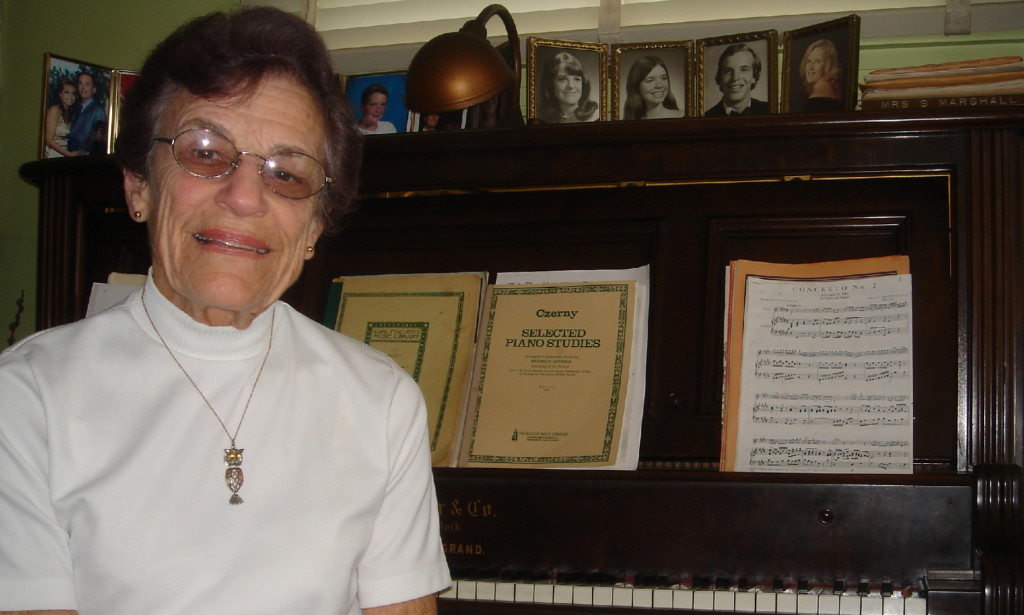
So every night, around 11:30, she sits down at the brown Sohmer & Co. New York Cabinet Grand that serves as the centerpiece of her living room, and she does the same thing she’s been doing nearly every day since she was seven.
First, she practices technique. Then she goes over the scales. It all starts with the technique and the scales, she said. “You can try all that jazz and pop stuff that you want, but without the techniques and the scales you’ll be lost.”
Then she practices for an upcoming performance—always in an ensemble or as an accompanist, never a solo—before pulling the cover over the keys and heading for bed.
“If I’ve been doing it every night since I was seven, then my students definitely have to do it every night,” she said. “If I miss two nights, I feel like I have someone else’s fingers.”
Lester Jones has been listening.
“Some people have a way of saying things that just makes you want to do whatever they say,” said Jones, who is in his third year learning from Shirley. “I practice every night, and I think about her. I want to please my piano teacher instead of her pleasing me.”
Marshall graduated from San Francisco State with degrees in music and education, and decided to make a career out of the job she already had. Now she’s one of the center’s most popular teachers—no small feat at a school with a faculty of more than 120.
“Shirley understands the fundamental value of this place,” says the center’s executive director, Stephen Shapiro, who has worked with Marshall for 31 years. “There is a warmth about her that is very special, and students respond to that.”
For Marshall’s part, she says the key to her success is simple: “Start young. Stay in one place. And then get old.”
But despite her success, Marshall isn’t without complaint.
“Here’s what I think,” she says, bolting upright in her chair. “Number one, there aren’t enough hours in the day. Number two, there aren’t enough days in the week. Number three, there aren’t enough weeks in the year. And number four, there aren’t enough years in life.”
This article about Shirley Marshall is very inspiring for me because I just started learning the piano and sometimes it feels like the pieces of the puzzle are never going to fall into place!
I feel like I’ve been taking lessons from Shirley Marshall! Thanks for putting me in her shoes and highlighting the work of someone who must be a local hero to many. Music transcends culture and sociological boudaries. Surely this woman’s passion has provided many with the desire to reach beyond their personal circumstances to accomplish more than they dreamed. At the very least, her influence has surely provided a life-long gift to those she has touched that will always bring them joy. That is what’s really important anyway; right? To give our giftedness to others; what is better than that?
Thanks again!!