

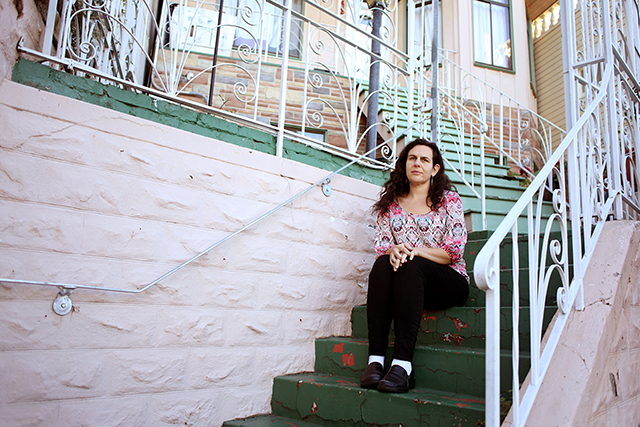

Sanchez Elementary teacher Tara Ramos won the lottery in March to buy a below-market-rate housing unit – one of four affordable units at 35 Dolores Street, a four-story building completed in late 2014. Instead of paying the market rate of $1.38 million for a two-bedroom at that site, she could buy the unit for $270,000.
“It wasn’t even a year before my number came up,” marveled the mother of a two-year-old, who has been teaching in the city’s public school system for 11 years.
While the market-rate tenants have moved in, however, Ramos and another of the affordable-unit buyers remain in limbo, unsure of when they will be able to move in as they find themselves caught in a number of conflicts. The developer blames the city process, while the city says it is doing what it can to move things along. Meanwhile, only one of the four buyers of the below-market-rate units has settled in, while the last has backed out of the deal entirely.
“I’ve never had a BMR buyer kind of sit with these delays for months and months,” said Matt Fuller, a realtor who worked with the one below-market-rate buyer at 35 Dolores, who did eventually close on her home.
While he said that it was typical for the below-market-rate units, commonly referred to as BMRs, to close last, it has been five months since the last of the market-rate units were sold. Many of those were sold as early as January of this year.
Bill Lightner, head of the Lightner Property Group, which developed the project where Ramos is hoping to move, blamed what he called the city’s convoluted, lengthy process.
“The city has a distorted vision,” Lightner wrote in an email, referring to the Mayor’s Office of Housing’s requirement that a BMR unit be marketed for at least 45 days. “The process for selling the BMR units can be very cumbersome and time-consuming. As a consequence, these units were the last to sell.”
They may have been the last to sell, but the affordable units were spoken for quickly. It’s moving in that’s proving difficult. Ramos even changed the school she teaches at and planned to sell her car to make back some money, anticipating a shortened commute, but that didn’t pan out.
“I’ve been having this feeling, oh, next weekend I’m gonna move,” Ramos said. “I’ve been rallying all the resources and I’m always like, oh… never mind. It’s a high-stress situation for me.”

The Planning Department says the below-market-rate units should have been the first to sell, and has opened an enforcement case against the developer.
The delays appear to be a mixture of construction deficits, procedural snags, and legal disputes between the builder and a subcontractor.
Ramos was told by her realtor she would be closing by May. She had paid the first half of her down payment and entered into contract in March. By June, she hadn’t closed, and was being told testing needed to be done due to water intrusion related to issues arising before the building was sealed during construction. Lightner said these were due to construction deficiencies that were never fixed by the building contractor.
Fuller was unimpressed.
“This developer was such a mess, it was just so ridiculous. We’re in the middle of a four-year drought and you’ve got a brand-new building where it’s never rained that you have a concern about water intrusion. How do you manage that?” he wanted to know. “And if this was a building-wide issue, was there a reason you didn’t catch it earlier? It puts the BMR buyer in a really no-win situation.”
Meanwhile, in June, Ramos was walking by her highly anticipated future home when she noticed that a street-facing porch door, made of glass, had been smashed and taped over with a sign: “Danger, Do Not Enter.” A few weeks after she noticed the sign, a final walk-through inspection was delayed because a realtor for the developer finally noticed the broken glass.
“They acted as if they had no idea it had happened,” Ramos said. “I was like, how did you not know about it? There’s a sign that says ‘Danger, Do Not Enter’!”
Lightner said his company had planned to put sturdy fences in place to protect the ground-level units from unwanted attention and security threats from the street. But, he said, the Planning Department nixed that idea.
“They told us that fencing does not create as attractive a street scene, and was contrary to neighborhood norms,” Lightner wrote in an email.
He said his firm is working on getting approval for some kind of fence to prevent similar issues in the future, and that safety demands that couldn’t be met convinced one BMR buyer to back out of the deal.
After further delays due to the discovery and remediation of mold growth, Ramos was told she could deliver the second half of her down payment and sign the final papers in October. She’d have the keys in hand. But it wasn’t to be. After paying the rest of her down payment, she was informed while getting ready to sign the last of her papers that a legal conflict had arisen between the builders and the developer of 35 Dolores.
The builder, Build Group, blamed a subcontractor for the problems with construction. Build Group withheld payment, the developer alleged in a lawsuit, to which the subcontractor responded by placing a lien on the building.
That lien meant that the building couldn’t be sold. Ramos, again, could not move in.
“I felt like the developer should have known about the liens,” Ramos said.
“Frustrated with Build Group, we have hired a new contractor to deal with the remaining construction defect issues. The new firm is on the job,” Lightner said. “We are pursuing Build Group vigorously. They are bad actors,” he later added.
That hasn’t translated to any tangible progress for Ramos, however. She is starting to worry that the delays will go on forever. She has tried to enlist the help of tenant advocates and lawyers, but in this situation, she is a buyer rather than a tenant and didn’t qualify for assistance. A lawyer with experience in the field offered her his help, she said, but for a deposit she couldn’t afford.
“My perception is that the mayor’s office has no teeth to make them sell me this unit,” Ramos said.
She’s right. Maria Benjamin, Director of Homeownership & Below Market Rate Programs at the Mayor’s Office of Housing and Community Development, which selects candidates for the BMR program, said her agency does not have any enforcement capacity if parties in a housing deal are not acting in good faith.
“MOHCD only ensures that the unit is being sold to an income-qualified household under the Inclusionary Affordable Housing Program enforced by the Planning Department,” Benjamin wrote.
Fuller, the realtor, agreed.
“When there’s delays they can certainly say, ‘Hey, stop delaying’ but they have no power,” he said. “All they can really do is kind of be squeaky wheels.”
The Planning Department, on the other hand, may have some ability to move things forward. Having a BMR sale escalated to planning enforcement is rare – Kate Connor at Planning said that in the five years of her role at the department, she hadn’t seen it happen. Another planner said she has a handful of other cases at the moment, but none in the Mission.
The department has opened an enforcement case and sent a notification (which Lightner said he was unaware of). If planning receives no response, fines of up to $250 per day can be levied. But it’s unclear how those fines would move along a legal battle between the developer, a builder, and a subcontractor – a legal process that is already under way, but with a mediation conference scheduled for March 2016. Lightner’s group has agreed to pay
Meanwhile, Ramos and the other BMR buyer are still waiting.
She worked really hard for her downpayment. She should give these greedy developers the finger and back out of the deal. They will probably beg her to stay in contract. Probably earning 10% interest on a short term CD with her down payment money. Hurt them where it hurts….. the wallet. Do not vote Trump. No idea what’s going on… no facts