

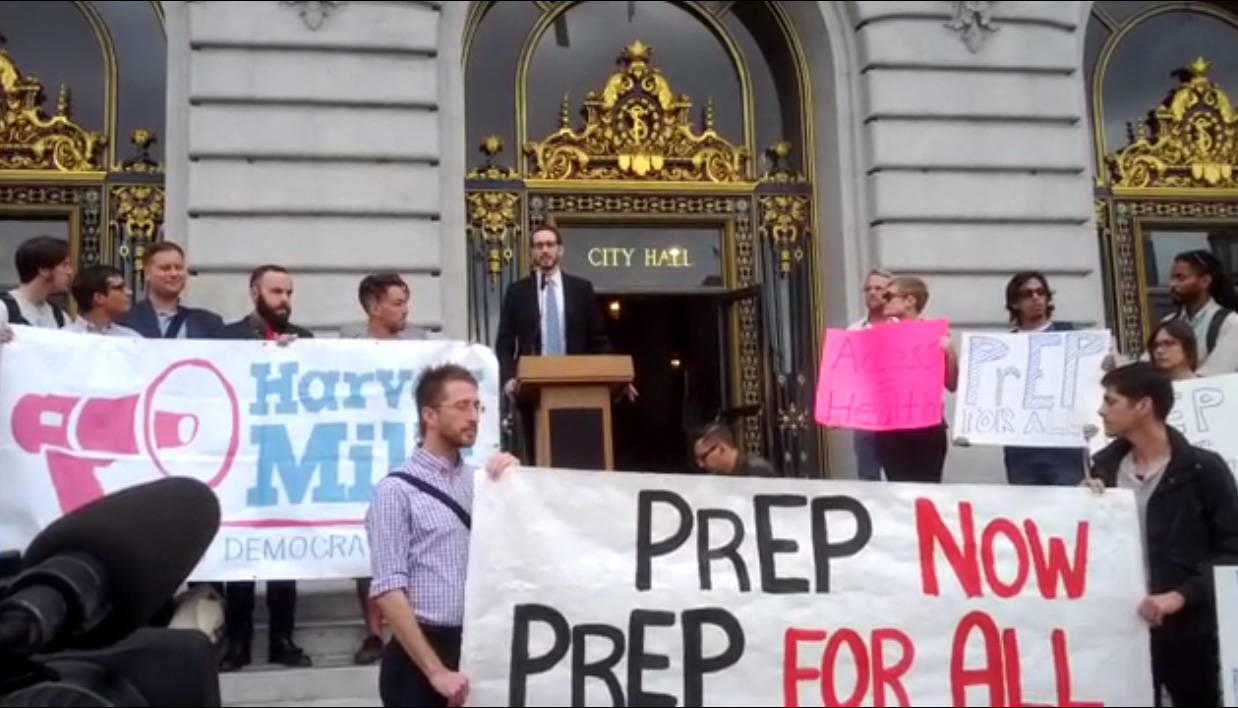

Truvada, the daily pill gaining use for preventing HIV in people at highest risk, recently won some high-profile proponents in San Francisco political circles. But that hasn’t quelled the social and moral debate with those who fear it may undo decades of safer sex messages.
One of its most outspoken critics, Michael Weinstein, president of the AIDS Healthcare Foundation, has called Truvada “a party drug.” Weinstein “believes that few people will take the pill daily as indicated and many will engage in riskier, condom-free sex because they think they are protected,” the foundation said in an article on its website. The foundation declined requests for comment.
Such criticism hasn’t stopped San Francisco Supervisor David Campos from pushing forward with September legislation that would appropriate $801,600 to help make the drug more accessible to those who need to take a daily pill to block possible infection – a practice known as “pre-exposure prophylaxis,” or PrEP.
Nor did it inhibit Supervisor Scott Wiener, who represents San Francisco’s 8th District, from becoming the first elected official to disclose his use of Truvada in late September. He said it felt that it was his responsibility to speak out. Negative views about drugs that help people take control over their sexual health isn’t new, he said.
“We’ve seen it around birth control; we see it with the HPV vaccine,” Wiener said in a phone interview
Sexual risk-taking feared by critics of the prevention pill would include not using condoms during sex or failure to ensure that one’s partner is HIV and STD-free.
But, studies of increased risky sexual behavior related to Truvada so far failed to prove the link. Research published in 2013 looked at the question of whether using the prevention pill could result in the behavioral phenomenon called “risk compensation.”
Risk compensation is the theory that “individuals adjust their behavior in response to changes in their perceived level of risk,” according to a study published online in PLOS ONE in December 2013. In the case of taking an HIV prevention drug, the theory would imply that people on treatment might take more sexual risks because they felt they were protected.
The study was part of a multi-year research project following 2500 men and transgender women in Latin America, South Africa, Asia and the United States. Researchers looked at the incidence of some sexually-transmitted diseases as “biological markers of sexual risk behavior.” Incidence of these markers actually went down, according to the lead authors of the study, Julia Marcus and Robert Grant of the University of California at San Francisco.
Despite the research findings, squeamishness may surround the drug for awhile because of the public perception of drugs like Truvada.
All aspects of sexual health ends up being controversial, said the study’s senior author Dr. Grant.
“I think that sex is a hot topic,” he said in a phone interview. “It just leads people to being judgmental.”
Many agree that condom use is still an effective tool against spreading HIV, whether or not Truvada is a part of that prevention toolkit.
However, the Centers for Disease Control and Prevention reported on their website that Truvada can reduce the risk of HIV infection by 92 percent if taken once a day as prescribed.
Supervisor Campos’ legislation, which has been sponsored by fellow supervisors Eric Mar, Jane Kim, and John Avalos, is still going through the legislative process.
Wiener says that while the legislation is a positive step forward, it’s not a “structural solution.” He says more work needs to be done to make the drug more financially accessible.
There is a stigma against the drug and its use, Wiener acknowledged. But, he says that the public feedback that he received on his coming out as a Truvada user so far has been overwhelmingly positive. Those who stigmatize the use of PrEP are “not the majority of people.”
Thank you!