

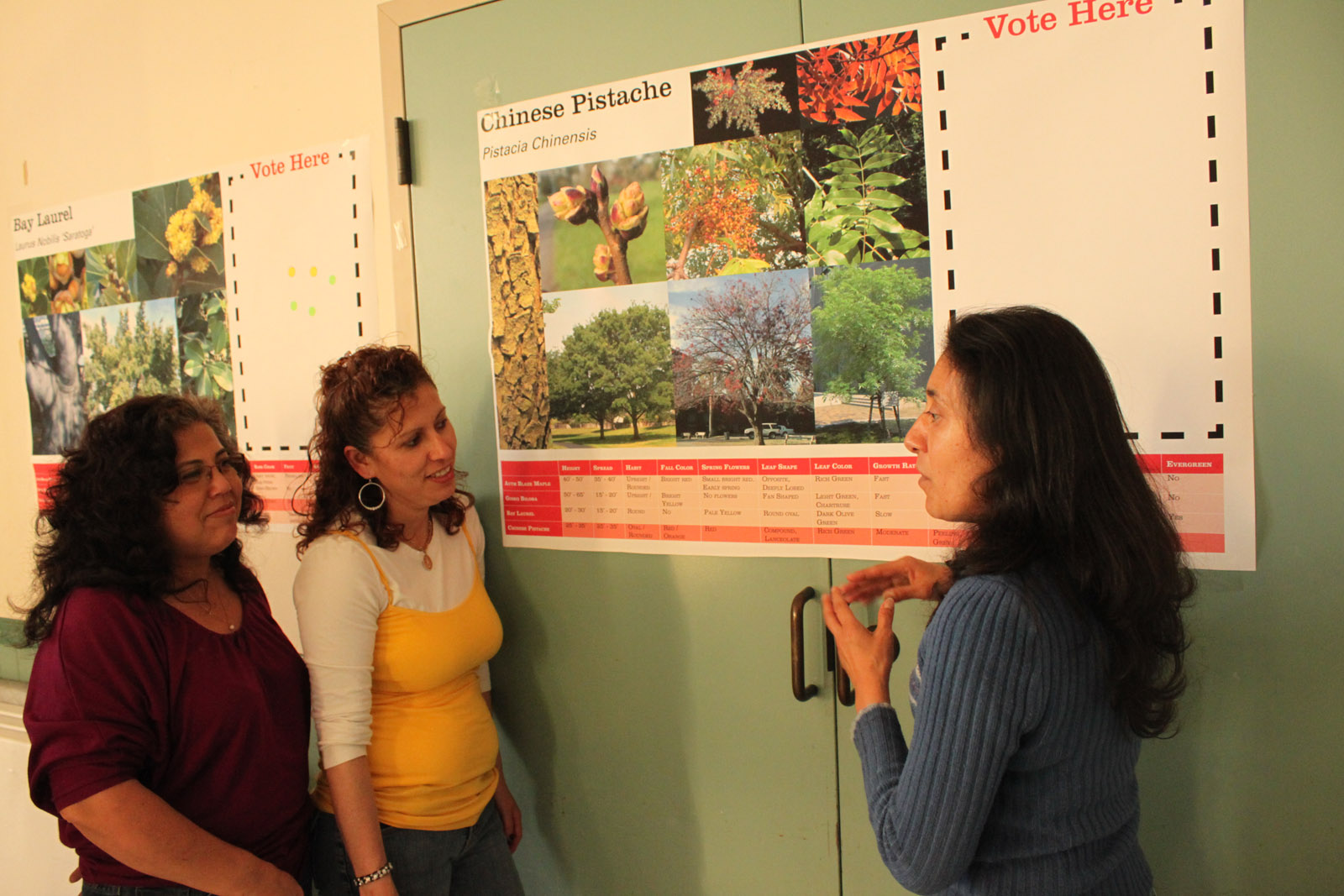

The trees scheduled to be planted along 24th Street between Mission and Potrero (also known as the Lower 24th Street Corridor) will be delayed until mid-July in order to give the community more time to decide which type of tree it would like to see planted.
A decision regarding the approximate six to 10 new trees to be planted along the busy thoroughfare will wait until the next hearing, sometime in early July.
It was a long meeting for such a short conclusion. The night, hosted by the Lower 24th Street Neighbors and Merchants Association in association the office of Supervisor David Campos, the Office of Economic and Workforce Development and the Bay Area Local Initiatives Support Corporation, began with introductions from Eric Arguello, president of the merchants association, and Jordan Klein, a manager at the Office of Neighborhood Economic Development. The two explained the tree selection process, which looked at a tree’s height, density and sun protection.
Among the trees presented by the Office of Economic and Workforce Development were the autumn blaze maple, the ginkgo, the bay laurel and the Chinese pistache.
Paul Chasan, urban designer for the San Francisco Planning Department, followed with a discussion of why trees are important to the urban fabric.
“Trees are great for the urban environment,” he told the crowd inside St. Peter’s Parish Hall. “They help break down the scale of buildings, and help beautify neighborhoods.”
For years, city officials have tried to find a replacement for the ficus trees that line busy 24th Street, said Klein.
Although the ficus is well-liked by pedestrians for its healthy glossy-green appearance, it causes a lot sidewalk damage, said Chris Buck, urban forestry inspector for the Department of Public Works, which is responsible for tree removal and the permitting of new trees. “The denseness of the canopy obliterates light to the residents and the stores.”
Also, the ficuses are dying slowly from a disease called canker. Throughout the meeting, residents were assured that DPW will not remove disease-stricken trees on 24th Street until they have become severely damaged by the disease.
This delighted Judy Berkowitz, a delegate from the East Mission Improvement Association, who came to the meeting wanting to hear more about the tree selection process.
“I was worried with how this was going,” she told the audience.
“The history of the trees on 24th Street is that people have been trying to get rid of them for years. Most of the trees are probably healthy.”
After the hour of introductions and tree presentations was finished, Berkowitz cast her vote for the bay laurel. “It fits with all the others,” she said. It is “the least messy.”
It was also one of the most popular. The ginkgo and the bay laurel received the most votes.
But it was to no avail. Only a few dozen people, merchants and city officials were there to discuss the matter, compared to the 60 or so who showed up at a previous meeting.
The low turnout prompted the Lower 24th Street Neighbors and Merchants Association to postpone the final vote until more community feedback can be gathered. The night’s votes would be recorded, but “We are going to have another gathering to see what the people want,” Arguello said. “Hopefully more people will come.”
Like Berkowitz, some community members voiced their concerns with issues beyond the delay and the tree choices.
Why not just make the sidewalks of rubber, so that tree roots can’t crack them? Why were none of the trees native to San Francisco? And why plant just one species down the entire block? Why not more diversity?
Major commercial corridors, said Chasan, tend to be planted with one species because “it creates an identity and a sense of place.”
Other citizens felt the city should concentrate its resources on fixing the infrastructure, adding streetlights and repaving cracked sidewalks.
“These streets are too dark to walk in,” said a concerned resident. “We should be putting in more street lamps.”
But some residents, like Rosa Gonzales and her family, had positive remarks. “I think they all look beautiful,” she said. Her choice? The bay laurel.
Those interested in participating in this and other issues along 24th can sign up for email alerts from the Lower 24th Street Merchants and Neighbors Association or become a fan of the association on Facebook.
The trees on 24th are completely out of scale for that street. They block all the sun, rip up the side walks, and cancel out the best feature of the neighborhood which is the sun/climate.
No more discussion! Just do it! The ficus trees were a terrible choice and they’ve made a mess of everything. But this is not news. Their replacement has been “not far off” for years, but nothing happens. No need for more “community involvement.” It’s not that kind of issue, and it’s largely a professional judgement anyway. This is like having a community meeting to decide the diameter of the sewer pipes, or the thickness of the pavement. It’s a technical decision, and additional “community involvement” is a waste of everyone’s time.