

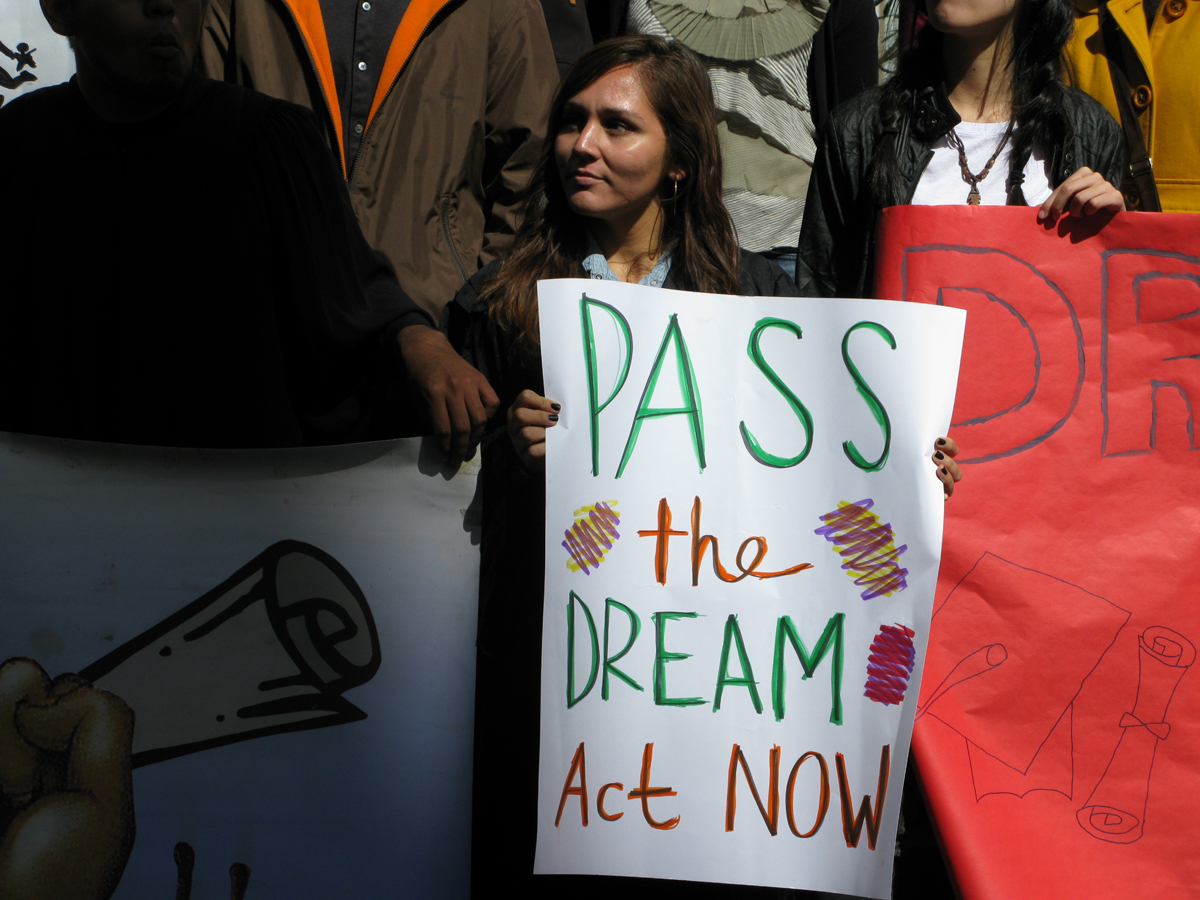

The path to legalization for thousands of undocumented students has once again become less clear, as the Senate voted 56-43 on Tuesday against a motion to proceed with a defense appropriations bill that would have been used to move the DREAM Act through.
Some 65,000 undocumented students graduate from U.S. high schools every year. The DREAM Act, which Senator Harry Reid planned to attach to the defense bill, would provide an opportunity for those graduates to gain permanent resident status.
“They are valedictorians, honor students, and all they want to do is go to college and contribute back to society, but because of current laws, they can’t do that,” said Lisa Chen, a community advocate with the Asian Law Center in San Francisco.
The DREAM Act had bipartisan support when it was first introduced in Congress, in 2001. This is the most attention the legislation has received in the Senate since it was voted down, 52-44, in 2007. Because of yesterday’s vote, action on the bill will be delayed at least until after the elections.
“This is not a defeat,” Chen said minutes after the vote was announced at a rally outside of Senator Feinstein’s San Francisco office. “We are still going to have a chance after the November elections. This is something we are going to continue to fight for.”
Charly, an undocumented student who is a senior in finance at Santa Clara University, anxiously watched the lead-up to the vote on his television at home. His parents brought him from Mexico to live in the Mission when he was 9 years old. He remembered struggling with English. “I couldn’t communicate with the teachers. I just hung out with other immigrant kids,” he said.
But the young man worked hard. “I got As and Bs. I felt motivated to do something more than just hang out.”
He excelled through honors and AP classes at Mission High School, but because of his status, he couldn’t apply for federal financial aid, limiting his options for college. He received a scholarship for undocumented students to attend Santa Clara University. Still, his options are limited.
“I’m petrified that once I graduate I can’t make use of anything I’ve learned in the past four years. To know that I can’t work not only scares me but makes me sad.”
Leticia Silva, a counselor at City College of San Francisco, meets a lot of students who find out they are undocumented when they finish high school.
“Once they get to City College, they realize they can’t work, so it’s really hard for them to pay for college. They can’t get financial aid,” she said, adding that she often hears them saying, “‘Well, hopefully the DREAM Act, hopefully the DREAM Act.’”
The California state legislature has approved a state version of the DREAM Act that would allow undocumented students to apply for financial aid for public colleges and universities. Governor Schwarzenegger has vetoed the legislation three times in the past five years. The bill is now back on the governor’s desk, awaiting a decision.
Eric Quezada, a member of the San Francisco Bay Area Coalition for Immigration Reform, said the next strategic push on the national level will probably be during a lame-duck session after the November elections.
Quezada attributes much of recent momentum to the mobilization of undocumented students throughout the country.
“This was the first time that our movement, in terms of calls, faxes, e-mails, letters to our congresspeople, that we were on scale with our opposition. In 2007, it was 20 to 1,” Quezada said to a group of disheartened students gathered outside of Feinstein’s office yesterday.
“In this particular situation, I think we win even though we didn’t win the vote today.”
*reply to J* Hostory? That was my favorite class in school.
People like “David” fail to know their own american hostory (meaning it is a land made up of immigrants)…. It is unfair to penalize a young person (a minor) for something their parents did especially when that said person is an honorable student and would make an honorable citizen…
At first the DREAM Act sounded reasonable, but after reading it’s context; it’s amnesty. Once the child gets residency, he/she will petition their illegal father, mother, brother, and sister. It’s the same thing their doing with the anchor babies, have their kids petition them once they turn 21 years of age. They need to be given a ticket number and return back to their native country, and re-enter the legal way. Only the people who are currently in line deserved to be given residency, the violators of the law. Their not special.
In response to Gason’s request, here is the breakdown of yesterday’s vote:
http://www.senate.gov/legislative/LIS/roll_call_lists/roll_call_vote_cfm.cfm?congress=111&session=2&vote=00238
I am glad the senate did not pass the vote. Undocumented immigrants are illegal immigrants; therefore, they are not citizens of this country and they are here unlawfully. There are higher educational opportunities in the nation where they came from. In addition, education in this country and others is possible through international student exchange programs. It is not the responsibility of the US Tax payer to give a free ride to a person who entered the country unlawfully at any age. Unlawful immigrants need to follow the same citizenship process that applies to everyone in the world. Why should they get special treatment for breaking the law? Most importantly, why should unlawful immigrants be granted in state tuition. They need to be charged out of state fees since they are not legal residents of any state in the union. Thank you US Senators for not bending to the mass of unlawful immigrants.
Will be possible to obtain and make public the names of the Senators who vote against the motion (abstainers too)?. Maybe this way they can shown a blush on their faces (at least) and don’t request votes with false promises.
It’s not over yet, the DREAM is going as a stand alone bill now. the defense authorization act didn’t pass, but the DREAM act was only attached to it, it wasn’t part of the bill.