
It’s called the Spring Studio Stroll, but I’m exhausted and frustrated. It was no stroll, but a marathon.
I started out a half-hour after the doors opened at 11 a.m. Sunday, and by 5:50 p.m. I had finished visiting the last four venues missed on Friday night. But, I was racing and unhappy knowing a lot of worthwhile work was getting too little time. Plus, I wanted to just enjoy. Argh.
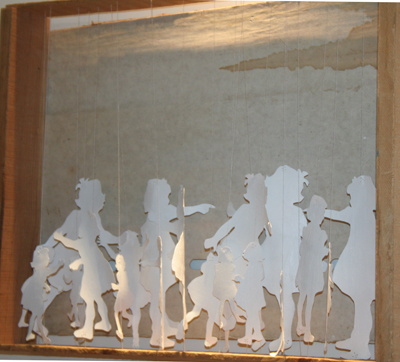
The morning started at Art Explosion’s 744 Alabama St. location. Ah, wait a minute—just looking back at my notes and calling up an image of Ehren Elizabeth Reed’s “21 Moments of Indecision” puts me in a better mood. It’s a 22-by-16-by-2.5-inch collage of cutout paper-doll figures.

It’s as delightful as her thread paintings, an “investigation of interpersonal relationships and how they are affected by technology.”
There was a lot of young energy in the building including Elizabeth Deters’s “Femme Maison Houses” and Andrea Slattery’s video installation. The latter show women performing simple tasks—making butterball cookies, crocheting, cross stitching—to produce what Slattery calls a kinetic meditative sculpture. See, this takes time.

Louise Bourgeois’ late-1940s series “Femme Maison” inspired Deter’s work. In Bourgeois’ time, women were trapped by their homes and Deter said she wanted to revisit that relationship.
Down the hall was Christopher Gonzalez-Crane’s “Macondo Will Never Leave Me.” The acrylic, ink and pen painting has a Chagall playfulness; one fit for the town where the magical realism of Gabriel García Marquez took hold.

Anthony Augustin Papini works in oil to paint animals, packed highways, and, from his days in Santa Cruz, a local bar at 1:30 a.m. The paintings are dark, intense, effective.
Also worth mentioning—and there were most likely many others, so send in your favorites—Charles Kruger, who teaches high school in Richmond; Tony Maridakis, who has a series that started with a wire sculpture and from there moved to lines; and Colleen Stockman, who does “anatomical landscapes” considering where our bodies “meet the landscape.” There was also Karen Slovak’s “Barbershop” oil and some cool jewelry that I had no time to look at seriously.
But let’s leave Art Explosion with the same playful sense I had on entering—with Steven Weinberg and Casey Scieszka’s Telephone and Soup ongoing projects. Missionites might know their “Shitty Kitty” series, but there’s more to like: Scieszka’s collages, Weinberg’s illustrations and more.

On to Project Artaud at 499 Alabama St. and its recently refurbished, spectacularly lit Theater Gallery. The live/work cooperative that’s been around since 1971 was full of photography, riffs on photos, printing and painting.
Ricky Weisbroth’s monotypes, linocuts and photo etchings were all lovely. I especially liked a 32-by-18-inch monotype, “The Lightness of Being,” and a photo etching of an old woman in Peru.
Upstairs, Laurie Anderson’s series of ink, oil and gouache pieces were mixed with the found objects that inspired them. The book designer considers different uses for an object. Shapes, textures and ideas repeat through the pieces. I wanted more time with them.

Again, more photography—notably some conceptual work by Luis Delgado—and much more, including a series of gouache-on-paper works by Kenneth Cooper.
At 1890 Bryant Street Studios, there was Chris Leib’s oil and canvas “Breakfast.” I wanted to take it home. Nowadays he’s working on a new narrative figure series that considers aesthetics.
On to Michelle King’s finely executed paint-and-ink-on-aluminum nature studies, and her nearly transparent acrylics suggesting trees or other landscapes.
Jennifer Bloomer’s mixed-media portraits of children or women against newspapers also stood out. I wanted to go back and see them again, but there wasn’t time. Her oil-and-graphite series, “Roads,” has also stayed with me. They made me remember car trips with the kids and especially one in which we drove too late through the impossibly dark and forested roads of North Carolina.
My last stop was to see the big, bold works by Catherine Mackey–the “Loading Bays at Hunter’s Point” featured on her card, but also her “Salon” and others.

We took a quick break at the Coffee Bar—excellent steak sandwiches, according to my husband and daughter. Ditto on the tomato soup. BTW, I forgot to mention the Universal Café in Friday’s post. It’s one of my longstanding favorite places.
Revived, we went to the final venue—Art Explosion at 2425 17th St. near Potrero Avenure. Immediately I noticed Georgianne Fastaia’s large, evocative oils, part of a series celebrating the Orishas. Ah, an immigrant’s point of view, I thought. Yes, from Brooklyn, she said. What an eye.
I also loved Kirsten Tradowsky’s watercolors and oils, some looking like illustrations from 1950s elementary school textbooks; Carmen de la Mano’s “Tocame” series of landscapes in which she paints with plaster, covers it with wax, and yes, you can touch it; and Angie Renfro’s “Bees” and Gabrielle Gambos’ “Feral Children.”
I ended with Megan Brady’s delightful collages that pay homage to the late Ray Johnson and his development of mail art—work sent to friends that can be sent on and on. Brady’s work inspires as well, and she asked those who dropped by to put their addresses on a piece of her work for later mailing. It was impossible to resist the chance to be part of her project.

Brady hadn’t heard of Michael Kimmelman’s book The Accidental Masterpiece, in which he writes about Johnson and other unlikely masters. It’s perfect, however, for anyone who wants to extend the pleasure of seeing Mission District artists in their studios.
Thanks so much for writing about this event and for all your local news coverage.
Enjoyed meeting and talking with you last Sunday.
Do come back in October for Fall Open Studios at Project Artaud.
Gracias–la