
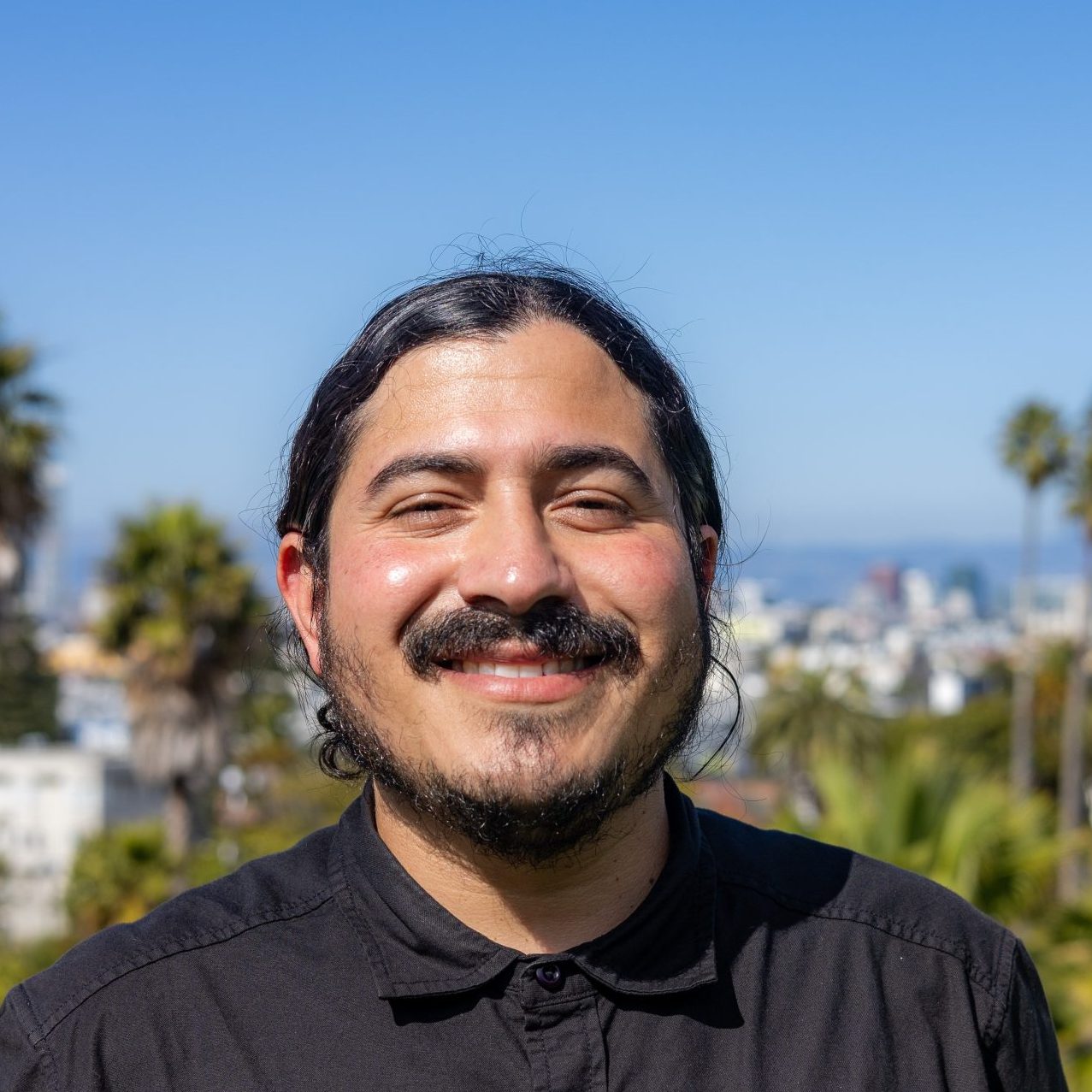

Josiah Luis Alderete, 56, has been a poet for decades.
For the last four years, he’s also been a bookseller, as a co-owner of Medicine for Nightmares Bookstore & Gallery at 3036 24th St., near Treat Street.
Alderete calls himself a “Pocho,” a person of Mexican descent who grew up in the United States. He incorporates Spanglish — a mix of English and Spanish — in his writings, which pay homage to the Mission District and his identity as a Chicano poet. He’s written four books, and has been invited to perform in Argentina and Mexico.
He doesn’t live in the Mission any longer. Alderete said he was pushed out after the dot-com boom of the late 90s/early 2000s more than doubled his rent.
But the neighborhood hasn’t left him. As Alderete put it: “There’s Mission folks now in Oakland, Vallejo, Berkeley and Marin. We’re like a diaspora of Mission cultura because everywhere you go, you take the Mission with you.”
This interview has been edited for clarity and length.
ML: Where are you from?
JLA: A lot of people don’t know this, but there used to be a Mexican barrio in North Beach, a Little Mexico. That neighborhood back then had a bunch of Latin jazz and flamenco clubs. It was a whole vibe there. My mom and dad met working at a club called El Sinaloa on Vallejo Street.
We lived in the Mission, but it was never in one place for very long. Eventually, my mom got sick of the relationship and moved us out to Marin.
So, that freaked me out because I was young (10 years old) and I got moved to one of the whitest parts of the Bay area. I toughed it out there until I was 18 or 19 and I ran back to San Pancho (in the early 1990s).
ML: The Mission?
JLA: Yeah, I came back home.
ML: How do you remember the Mission back then?
JLA: Oh my God, man! Hunts Donuts, Mission Comics. People laugh when I tell them Valencia Street being a long stretch of appliance stores. There was this place called Leather Tongue Video that sold, like, VHS and crazy art films. Four independent bookstores at the time on Valencia Street.
I also remember La Rondalla, an OG Mexican diner at the corner of 20th and Mission. They basically had Christmas decorations up 365 days a year. You go in there and mariachis would be playing.
The Mission was a very beautiful place, very different from what it is now.
[A lowrider drives by on 24th Street, playing loud music. Alderete gestures to it.]
“That’s real Mission, right there,”
ML: How do you see the Mission today? Can you still find aspects of that Mission?
JLA: Oh Yeah! It’s never going to go away, no matter how many wine bars, plant stores they put on Valencia Street, aqui estamos todavia. You can get accused of being nostalgic, verdad? Pero, remembering these places that made this neighborhood what it is now isn’t nostalgia at all. It’s history.
By remembering them, we’re also remembering that they’re still here in some form or another.
We had a momento a few years back during the Flor y Canto, the literary festival that happens here in the neighborhood every year, which was started by Alejandro Mujia. One of the years, we honored this amazing OG Nicaraguan poet from the neighborhood named Roberto Vargas.
He hadn’t been out here in years and we invited him for probably four, five days. I’d see him on the block, walking around and dancing with people. We gave him the award that night and afterwards Roberto came up to me, Ricardo and everybody else and he said ‘Thank you. The Mission is exactly the way I remember it.’
For us, who are here, and we see another mom-and-pop tiendita close, and then something else opens up that really isn’t for our community, or that is part of this AI wave of chingadera that’s happening, we get mad. But, this viejito came and he still saw that energy that is here that the pueblo brings to this place.
ML: What about Medicine for Nightmares? How long have you co-owned the store?
JLA: There’s two of us; that’s very important. There’s myself and there’s also my bookstore sister, Tân Khánh Cao. We opened up this space over four years ago. This place is very special. It’s a bookstore owned by Black and Brown folks. Last time I checked, I think 73 percent of bookstores in the United States were white-owned.
That, for us, makes this place very special, that you’re going to see Black and Brown writers, of fiction, of history, of children’s books, of sci-fi, of poetry. The space is a small link in the long literary chain that’s part of this neighborhood. Este barrio tiene una historia de literatura that goes back, man.
I’ve never understood it, man. Having worked at City Lights, North Beach gets the label as the literary heart of San Francisco because of its beatniks: Kerouac, Ferlinghetti and Allen Ginsberg; these were all white guys that weren’t even from here.
They moved into a neighborhood and supposedly discovered jazz, supposedly discovered Buddhism, supposedly discovered Black culture. These are the cats people think of when they think of San Francisco and its literary movement.
But, this neighborhood, bro, La Mision. This is the neighborhood of Alejandro Murguia, the first Latino poet laureate of the city, professor at SF State, founder of the Flor y Canto Festival. He’s from here, bro.
Oscar Zeta Acosta, the Brown Buffalo, wrote his two books in a residential hotel on Valencia Street. The Brava Theater is where Cherríe Moraga‘s plays were first produced.
In the 2000s, when the U.S. was fucking with Central America, all the Central American familia came here and infused it with their culture, their beauty and their strength.
There was a whole literary renaissance here, all these poets: Roberto Vargas, Alejandro Murjia, Daisy Zamora, Nina Serrano, they all became deeply politicized and became involved in the fight for Central America.
Some of them went back to fucking Nicaragua and El Salvador and they fought them motherfuckers. They fought the U.S. imperialism. Vargas was one of them. Also, Daisy went for a while, and Alejandro. All those poets were here. This was their neighborhood.
This place is a living literary legacy. You have young poets like Tatiana Luboviski-Acosta, who’s still here. Leticia Hernández-Linares, an amazing Salvadorian teacher at San Francisco State, she’s in the neighborhood. Norman Zelaya, Nicaraguan teacher, poet and short story writer, he’s still here.
Paul Flores, from Paseo Artistíco, he’s still here. Jaime Cortez rolls through whenever he can. When Juan Felipe Herrera, the first Latino poet laureate of the United States, got his heart broken, he came to the Mission. He slept on Francisco X. Alarcón’s floor, stole his typewriter, and wrote “akrílica,” which is his epic book of poetry, in this neighborhood.
Another one, Cathy Arellano, the most chingon Queer poet of them all, man. She wrote her book Salvation on Mission Street, here. That was, for me growing up, the first time I saw a Queer Brown poet talking about the neighborhood, also documented the changes going on at the time.
One of the missions of this bookstore is to remember the literary legacy of this neighborhood. We’re just a small continuation in that. We get a lot of love and credit for the reading series that we do here, Speaking Axolotl, but Galeria de la Raza has been doing the Lunada for decades.
The Pan Dulce poetry series was beautiful. It was a series that happened years ago at La Reina Bakery that was curated by Ricardo Tavarez, where the poets would read in the pan dulce spot. The podium was a paleta cart with a little poncho over it.
Also, when this was Alley Cat, there was the Voz Sin Tinta series, which was started by Alejandro Murguia.

ML: What is your favorite artist or band? Or your top three?
JLA: Let’s do a horn player. It’s gotta be Marion Brown. I guess we’ll do a vocalist, of course Chavela Vargas. Here’s a good one, let’s depress the hell out of everybody. Townes Van Zandt, that’s my guilty pleasure. Y’all need to listen to more Townes Van Zandt.
ML: When do you start getting into literature and when did you start writing?
JLA: I can say this without exaggeration, I graduated high school in 1988 and I went my entire public education not being exposed to one Latino writer, not one, not one artist, none. The last semester of my senior year, my English teacher assigned us Julio Cortazar’s “Axolotl.”
That was my first Latino writer I ever heard. Para mi manito, me abrío un mundo porque I’m Mexicano and he’s Argentine, but I recognized something. I started going to these bookstores. My tia Lucha actually opened up a restaurant [Casa Mañana] across from City Lights Books and I’d go visit her.
The restaurant was terrible. My tia Lucha was a terrible cook. She’d have her white husband, Mike, cooking. It was not good. The arroz y frijoles were not good, but I’d go visit Lucha and I’d cross the street.
It was in the poetry section of that bookstore that I first found a Chicano writer, Jimmy Santiago Baca. I saw a reflection. I heard him speaking in Spanglish. It was a profound moment for me, bro. Being introduced to that one writer, I used him as a jumping off point to find other writers.
I discovered Gabriel García Márquez. I discovered Jorge Luis Borges, Silvina Ocampo, Clarice Lispector, some of these writers that were sort of collectively known as the Latin American boom.
Bookstores for me, as a little Latino boy, is where I first saw my connected cultura reflected. It’s a very important moment when I see a young person come in here and I recognize that look of recognition that they have when they open a book, and they see themselves reflected in it.
If a young kid comes in here and he picks up a book of poetry that’s in Spanglish, he reads a line, he understands it.
I almost feel like, for lack of a better term, I owe the bookstores a debt that I’m paying back by being part of this space, and then filling it with books that other Black and Brown kids are going to see and recognize themselves in. That’s a big thing for me on a personal level. I would say almost on a spiritual level.
ML: I see that in your work, and even when you talk, you use Spanglish. Do you celebrate your identity as a Chicano writer by mixing the two languages?
JLA: That’s evolution. Honestly, that’s not me. There’s a long line of Spanglish speakers here in the United States. There’s different versions of Spanglish in all Black and Brown cultures.
I was talking to Barbara Jane Reyes, the badass OG Filipino poet and she said there’s like a Tagalog version of Spanglish. Same thing, our current poet laureate of San Francisco, Genny Lim, says there’s Chinglish.
Make no mistake that these things, whether it’s Chinglish, the English-Tagalog version, or Spanglish, are American languages. They’re languages that we use to show our pride in our cultura and to mark our cultura.
ML: Who are your favorite writers?
JLA: One of my favorite poets that I can’t stop reading is a Filipino poet named Marlon Hacla, whose book, “Glossolalia,” was translated recently. I can’t even explain, bro, the weird influence this poet had on me. It’s very odd. And this one particular book is so — I don’t even know how to describe it, there’s just something. He’s left a huge indentation in my mind.
Another writer that I really admire for the way he creates worlds, is a writer from Texas named Fernando Flores. He’s written a bunch of books. His last one was called “Brother Brontë,” which is this sort of dystopian novel with a bunch of young punkeros in it.
He’s a very odd writer, and he creates these worlds that are very much aspects of where we are. There’s something eerily just parallel to our lives and in our worlds with his stuff. It’s really cool. I really, really like it.
There’s a writer named Yoko Tawada. She’s a Japanese-German writer who writes these really strange, discombobulating short stories. They’re really, really odd. I really enjoy her. She’s one of my favorites.
Isabel Zapata, a Mexican poet. I’m a Pocho, right. So, a lot of times I have to read mostly in translation. I could read in Spanish, but I like having the translation. There’s this book of hers that just got translated, I think last year, that I’m really, really enjoying. They’re nature poems, which I don’t usually read, but they’re really beautiful stuff, man.
I love them Uruguayan writers, man. Felisberto Hernandez is one of my favorite writers. It just seems like such a really unique place. I’ve always wanted to visit.

ML: How do you experience the Mission these days? What are the places that you like visiting? Where do you get coffee? Where do you get lunch? Where do you get a beer, if you drink? Where do you like to sit and read?
JLA: Shit. Do you want me to give away my secrets?
ML: It’s up to you. You can share one or none, but you don’t have to.
JLA: I’ll tell you everything, watch. I like sitting in alleys and in public corners and watching. Honestly, Balmy Alley. I’ll get a cup of coffee and go and sit en la calle, en el piso a ver a la gente, you know, that’s actually one of my favorite spots to read. Another one of my favorite spots, but it’s gotta be outside, Café La Bohème. That spot has been a literary heaven for the poets and the writers in the neighborhood for decades.
To get my food, my burros and stuff, I got to go to La Palma. The tortillas are amazing and the gorditas are hella good because they make their own masa.
I’m gonna do a scandal here, my favorite pan dulce is La Mexicana‘s cochinitos because I think they have the molasses in there. They’re cold blooded, man. You’ll go in there and they’ll be out and you’re like, ‘When are you getting the cochinitos? and they’ll be like four or five days from now,’ that’s some good stuff, man.
Temo’s is always a sweet spot. I get my earl gray tea there and then sit on the corner there. All of those places are really good medicina.
Honestly, some of the best spots around are just these corners. If you sit somewhere, you get something, especially 24th Street because this is the most living street en todo San Pancho.
I swear. I know Mission’s got that vibe too, pero 24th Street; there’s some times, man, when there’s so much energia coming off of it that it creates like a different sound underneath it. You’ll hear las ranflas, the señoras walking by with their mandados, the viejitos talking shit, people at the taquerias and some drunk coming out of the bar.
All of a sudden there’s like a hum and there’s like a new sound that’s created by all of those. You spend time anywhere on 24th Street, you’ll get something good.

Great interview, loved reading it. Much to learn.