

Mayor Daniel Lurie is wary that a new tax on large companies is sending the wrong message to businesses about San Francisco.
But most of the city’s supervisors are supporting the measure, including many of Lurie’s allies on the Board of Supervisors.
This is the first time Lurie has diverged so sharply with the board on a policy issue. But for the eight supervisors supporting the measure, it offers a way to avoid large cuts to vital city services, and they appear willing to risk alienating business leaders.
If the “overpaid-CEO” initiative, which is backed by a coalition of public-sector unions, passes in June, it will raise an estimated $200 million per year for the city by taxing companies with CEOs who earn 100 times more than the median income at their company.
Lurie told the San Francisco Chronicle’s editorial board on Tuesday that labor and business would “spend millions upon millions of dollars attacking each other in June and dividing our city again.”
“I do not want a ballot measure,” he said, adding that it is “not the right path for our city at this time.”
The risk to San Francisco’s economic recovery has swayed a few supervisors, including Rafael Mandelman and Matt Dorsey, who declined to support the CEO tax measure. Stephen Sherrill declined to comment.
But most others are lining up behind it, moderate and progressive alike. Connie Chan, Jackie Fielder, Chyanne Chen and Shamann Walton are joining many of the mayor’s allies on the board, namely Bilal Mahmood, Danny Sauter, Alan Wong, and swing vote Myrna Melgar.
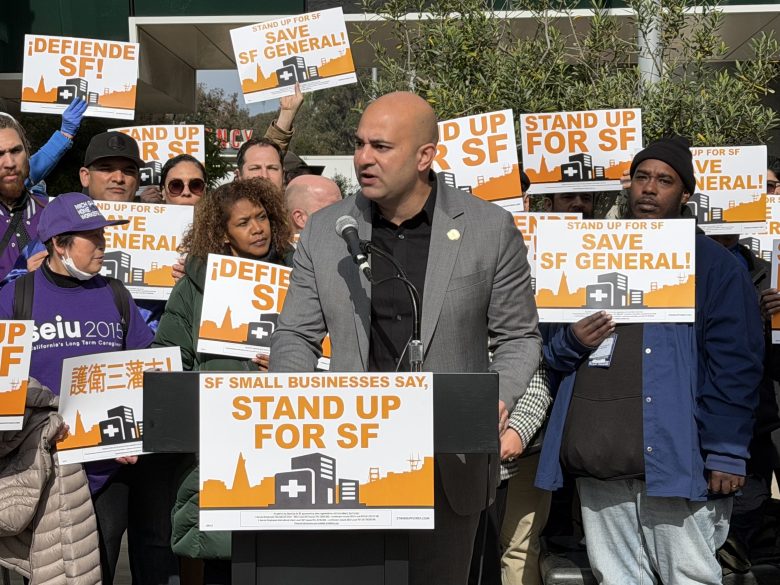
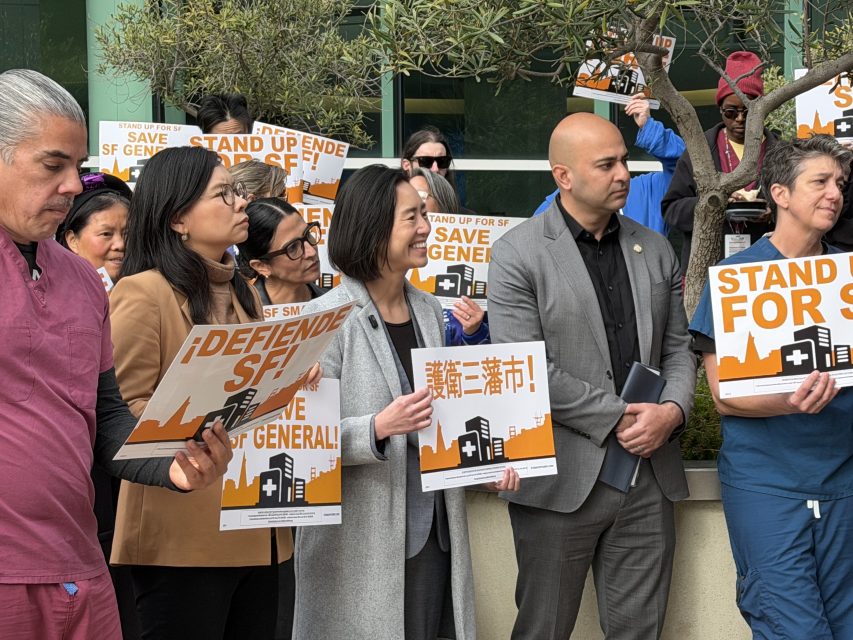
Mahmood celebrated the measure at a rally on Wednesday and pointed to the need: “$400 million in federal dollars is how much will be cut from San Francisco by the Big Ugly Bill.”
The city was already projected to be short hundreds of millions this budget cycle, but cuts in President Donald Trump’s Big Beautiful Bill mean the city is now facing a billion-dollar deficit. Healthcare and food benefits were hit particularly hard.
At the rally, Mahmood also pointed out that Trump’s bill significantly reduced taxes on corporate profits. Asking businesses to contribute “a fraction” of their savings to the city is not a big ask, he said.
The overpaid-CEO tax “shows that we don’t have to choose between a strong economy and stronger communities,” Mahmood added.
“We’re putting an overpaid-CEO measure on the ballot to help pay for these essential services and make sure that the budget is not being balanced on the backs of our workers and the working family,” said Kristin Hardy, the regional vice president for SEIU 1021, one of the unions spearheading the move.
The measure has generated some comparisons to the statewide “billionaire tax,” which would require people with a net worth of more than $1 billion to pay a one-time five percent tax.
Though the CEO tax also focuses on the wealthy, it taxes businesses, not individuals. And its structure is far less novel: The initiative essentially dials up the existing tax that the city levies on businesses, which voters passed in Nov. 2024.
The measure will be challenged by the San Francisco Chamber of Commerce, which is collecting signatures for its own ballot initiative to essentially keep tax rates the same and exclude businesses that make under $7.5 million.
David Harrison, the director of policy for the Chamber of Commerce, said that the CEO tax will hurt the city’s economic recovery by making it harder to attract businesses to the city.
It will “add direct costs and potentially lead to the closure of grocery stores, pharmacies, and retail we’re counting on for the city’s economic recovery,” he said.
“This couldn’t be a worse time to talk about raising taxes in San Francisco,” he added.

Hardy, the SEIU vice president, said support from Mahmood and others shows “that this is not just a labor problem or a working family problem. This is a San Francisco problem.”
“There’s a lot of times when we’re allied together, and there might be sometimes when we’re on opposite ends,” she added.
In Mahmood’s election in 2024, most of the large unions in San Francisco supported his opponent, Dean Preston, including SEIU 1021 and 2015, which organized the rally and have backed the CEO tax financially. They also backed Sauter’s opponent, Sharon Lai.
Mandelman, for his part, is holding out hope that labor leaders and business leaders can work out a compromise before the Feb. 2 deadline to pull measures.
“I don’t think that the CEO tax is the right direction for San Francisco,” he said. “But I also don’t think that cutting hundreds of millions of dollars of services for vulnerable folks is a great move either.”
Xueer Lu contributed reporting.
So our mayor is ok with > 100x corporate pay gaps???
Hurray for the K economy /s
The point is that neither the mayor, the BOS or voters for such a proposal would change the least thing. Corporate HQs would simply move eksewhere.
It’s not based on HQ or office, it’s based on gross receipts
It’s not based on hq’s or offices, it’s based on gross receipts.
Public sector labor has been reduced to the fundraising arm of the political class. The ethical conflict here is that the public wants policies that solve problems while labor wants to sustain and increase member headcount. Sometimes these overlap, most often they do not. And this gifts even more millions to conservative mayors to do with what they would.
For years I have criticized SF’s corrupt dysfunction that’s enabled by city funded nonprofits from the left as depriving voters of honest government. Our neighbors intuitively grasp this.
Democrats shunned such criticisms for decades and kept kicking the can down the road. Now that labor wants to fundraise for state government with the billionaire wealth tax, the right wing has responded by critiquing government corruption under the Democrats.
They are not incorrect even though government could never attain the levels of waste that venture capital has. Over the past 25 yr, >$1t in VC has sloshed over the Bay Area. Perhaps 20% of that has turned into profitable firms. It would take decades for state or local government to rack up that much waste, fraud and abuse. Fortunately, California voters are smart enough to reject Republican lunacy. But that is not a ringing endorsement of Democrat slop.
Mark Carney broke the spell about US imperial benevolence. Israel broke the spell on its invulnerability with Gaza. Soon enough the spell that San Francisco and California’s Democrat patronage corruption network will also break.
People will stop putting signs in their windows.
From that rupture hopefully a citizen led political movement will arise into the vacuum.
We want businesses to come, stay and grow in the City.
We want them to employ people.
Stop w all the damn taxes. We need to incentivize not stifle SF growth.
If you need a job to live then do not support this.
Agreed, non-profits are the ones to be cut. What a waste of money at times.
Our budget is crazy high, we can loose 800M no problem.
The city vacillates between giving Twitter a pass on taxes and taxing its CEO. It’s like a honey trap. And frankly, I don’t want to end up like Oakland, where the wealthy literally created a “City of Millionaires” to maintain their independence.
Stop funding non-profits that ensure perpetual homelessness, poverty, and drug addiction. If we bring those services into City Hall, they will be cheaper and more accountable.
Before you even get into the merit or demerit of this proposition – this comes from the same kind of mindset that’s brought us all that ragebaiting about how immigrants were supposedly taking our jobs and how they were a net drag on society etc. etc. Same vibes, painted in a different color.
Such categorical criticism aside though, how about we look at how well we fared with a comparable proposition, 2018’s prop C gross receipts tax for the benefit of homeless services:
1. Did businesses move out over it? (Yes, Stripe, Block come to mind, there’s probably more)
2. Did it attract any new? (Somebody name one)
3. Does homelessness/drug destitution look markedly better for it? (Not seeing it)
In tech, H-1B visas most certainly stole jobs from US techies and most certainly pushed computer science salaries down.
We should outsource Venture Capitalists, founders and CEOs who are whining about the wealth tax to Hyderabad.
You’re missing the point, this is about taxes and foot traffic in San Francisco vs. Oakland or South City. But I get it, the question needs to be asked: “Job creators”, what happened to that? It was of course always a lie, but this proposition isn’t the answer. It’s just another money grab.
To indulge in digressing, no doubt, corporate tech is now almost fully taken over by “the wrong people”, as they used to say back when jovial graybeard system programmer types where still around. We now have reached a point where the tech industry has transformed into a fight pit full of people who are incentivized to walk over the next guy to try to “get ahead”. Or, more so today, not getting axed.
Alternatively, the H1-B folks simply helped a correction in the pay level of IT folks, who were overpaid by global standards.
If you can be replaced by someone at half your pay, then you are living on borrowed time and/or have the wrong skills.
“the CEO measure taxes businesses, not individuals’
Well, it has to. The City has no constitutional or legal ability to tax individuals on their income, capital gains, wealth or estates.
But of course punishing business is ultimately a self-limiting exercise since there is no way to compel any business to operate in or be based in SF. There is a reason why many malls, technology parks and other major employment centers are located just outside of the city/county limits, e.g. Serramonte, Brisbane, Burlingame and further south.