


For many years, loyal readers of San Francisco voter information pamphlets could reliably be entertained by Republican gadfly Terrence Faulkner. He often penned up to four dissenting arguments regarding items on a single San Francisco ballot and rarely, if ever, did voters see things his way.
And we do mean penned: Faulkner submitted his ballot arguments handwritten and in all caps. One can only imagine the joy of Elections Department officials when transcribing missives such as the following 2014 masterpiece opposing Proposition B:
Giacomo Casanova, in “The Story of My Life,” tells of being 8 years old in Venice with a nose bleeding problem in 1733:
“Stepping out of the gondola, we entered a hovel … (M)y grandmother gave the witch a silver ducat, whereupon the crone opened a chest … put me inside it, and closed it. … (S)he rubbed my temples with a sweet-smelling unguent and … told me my hemorrhage would continue to subside so long as I did not tell … what she had done to cure me …”
Prop. B, incidentally, called for public transit funding. It passed with more than 61 percent of the vote.
Faulkner appears to have handed his baton, if not his pen, to Larry Marso, a Republican attorney who has emphasized his “principled opposition” to the city’s “progressive” Republicans. He has submitted the sole argument against Prop. M, the sweeping proposed overhaul of the city’s business tax structure.
Prop. M is a consensus measure crafted and backed by every last vestige of political San Francisco — and opposed by Larry Marso.
“Man,” says one longtime city politico who is, of course, backing Prop. M, “I do love that guy!”
With minimal opposition, lockstep organizational backing and a campaign fortified by $500,000 from Google, $250,000 from Airbnb and $110,000 from Ron Conway, Prop. M ought to do just fine (if voters haven’t gone blind by the time they get to the 13th of 15 measures on the ballot and if they can parse its bewildering ballot language).
But what would it do? The legal text for Prop. M is 112 pages — not quite twice as long as Kafka’s “Metamorphosis,” but the effect is not dissimilar.
By July 2023, it was resplendently clear that post-pandemic San Francisco would be forced to scrap its business tax structure. That’s when a city report revealed that San Francisco’s five largest companies pay some 24 percent of its business taxes. The 100 largest companies paid 58 percent of the taxes.
So, that’s precarious. When 0.04 percent of the city’s businesses pay a plurality of the business taxes, and 0.7 percent of the businesses pay a majority of it, the city is exposed.
Those top-five companies each pay $80 million to $100 million a year. And, while the city has never named them, does it really need to? Think of a cloud-based software outfit with an eponymous, even-more-phallic-than-most downtown office tower, or a search engine named after a really big number. Stuff like that.
If any one of them uprooted and moved to Austin or San Mateo or Kuala Lumpur, it could blow a hole in the budget akin to the general fund support for street repaving or the libraries or the Recreation and Parks Department. This would be a problem even in boom times, which we’re not in.
At present, San Francisco business taxes still lean heavily on the payroll tax, in which companies are charged based on how many workers they have actually doing work in the city. This is, clearly, a remnant of the pre-remote-work era; there is every motivation for the city’s heavy hitters to actively keep workers out of the office, and keep Downtown moribund.
San Francisco’s tax burden, meanwhile, is far higher than in even nearby cities, meaning the companies paying the lion’s share of the city’s business taxes are shelling out millions of extra dollars for the fleeting benefit of having offices in San Francisco that workers don’t work in.
Prop. M would address these problems in a manner both offensive and defensive. It would heavily shift the tax structure from payroll taxes to “gross receipts,” a tax on the business a company does in this city. This would, in a stroke, remove tax incentives that reward businesses for keeping workers out of the city.
But it would do more: Taxing a company on its San Francisco sales rather than its San Francisco headcount unsubtly reduces the tax savings for that company if it were to leave the city. That’s because it enables the city to still tax a company even if it does opt to leave. Or even if it never had a foothold here.
This is complicated legislation, but this much isn’t: If you’re moving to broaden your tax base beyond the top-five or top-100 businesses, you are reducing the tax burden on the wealthiest and most influential companies — and shifting it elsewhere.
Giving a break to the richest and most powerful businesses is not an easy or intuitive sell to voters. You won’t see anything about this in the upbeat Prop. M ad campaign, which is called “Revitalize SF — Yes on M, Save SF Small Business.” And that’s because the city is not only giving tax relief to, in Robin Leach-speak, the rich and famous, but also to the poor and unknown.
And that is an easy and intuitive sell. Prop. M alters the definition of a small business exempt from gross receipts taxes from a company doing about $2 million in yearly revenue to one grossing $5 million. This represents thousands of extra businesses of the sort San Francisco voters care about. The controller estimates that 88 percent of San Francisco restaurants will be exempt, and 50 percent of retailers currently on the hook for gross receipts taxes will suddenly find themselves off of it.
So, the fattest cats will get a break. And so will the thinnest cats. But you know who won’t get a break? The in-between cats. In essence, any company with a low headcount and high gross receipts is pinched. That would be law firms, hedge funds, architectural firms, management consultants, accounting firms and others. They may benefit from more business from their fat-cat clients. But we also may see mid-sized businesses of this sort leaving town.
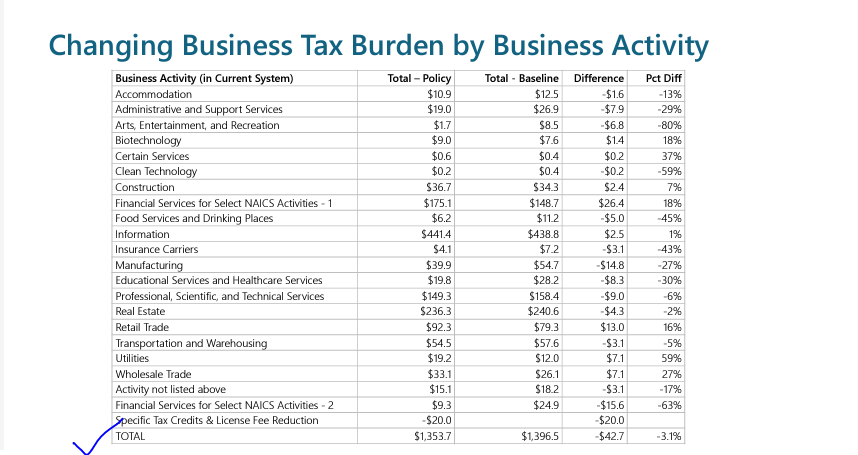
The city has crunched the numbers and laid bare the prospective winners and losers if Prop. M passes. “Arts, Entertainment and Recreation” outfits stand to see their tax burden reduced by 80 percent, “Food Services and Drinking Places” will save about 45 percent. Little surprise: The city wants you to eat, drink and be merry while countering the doom-loop narrative.
The losers, too, are not wholly surprising. “Retail Trade” will pay an estimated 16 percent more — which, when you factor in the new $5 million small business exemption, translates into very big retail. “Utilities,” meanwhile, would pay 59 percent more.
Why utilities? Well, some industries can’t uproot their buildings (or pipelines) and go elsewhere. And since “utilities” is, by and large, PG&E, this is hardly a sympathetic target. Could PG&E lobby the state Public Utilities Commission to charge San Francisco ratepayers more? Perhaps, though it’s unclear if the company could raise rates on a single municipality.
City officials cooly noted that when PG&E recently moved its headquarters to Oakland — and thereby eluded San Francisco’s payroll tax — it certainly didn’t reciprocate by reducing San Franciscans’ utility rates.
There is one other loser in Prop. M: Prop. L. If the consensus business tax reform measure receives more votes, it will nullify the proposed tax on robotaxis and ride-hail companies to fund Muni. But you won’t be seeing this in any commercials.
There are two other reasons San Francisco’s government is hoping you’ll vote for Prop. M, and you won’t see them in the forthcoming happy-go-lucky ad campaign either.
One is that, absent a “yes” vote, pre-pandemic tax increases that voters opted to delay in 2020 will commence in January 2025, meaning that every business would see hikes across the board.
And the other is due to a December 2023 lawsuit against the city from General Motors, seeking $121 million in back taxes and penalties based upon its own interpretation of San Francisco’s abstruse tax code. Other aggrieved companies have intimated they will follow suit and the city has, thus far, socked away more than $400 million for “claims and litigation risk.”
It’s uncertain if that $400+ million will ever be recouped by the city, and you don’t horde the better part of half a billion dollars in reserve because you’re so damn certain of your legal footing. But the city is betting that Prop. M would, at the very least, result in more than $100 million a year in future collected taxes being used for city services, rather than being stockpiled in a massive and growing “claims and litigation risk” fund.
The city, however, would rather you focus on the thousands of small businesses that stand to benefit. That’s not surprising: Those happy tales would figure to be the sweet-smelling unguent that subsides San Francisco’s hemorrhage.
Ah, gross receipts again. IIRC, prop C uses that as the basis for determining a business’s extra contribution to “address homelessness”. Meaning, you disproportionately get penalized for simply touching other peoples’ money as you move it from one place to the other. Stripe, Square and more promptly pulled up the sticks and decamped town. I suspect this also motivated X to leave town, considering their ideas for adding some payment function to their app. (And yeah, I know, Musk made a lot of noise with some unrelated BS). It stands to reason, more will follow if prop M passes. And there’s more: If Newsom signs SB1047, outfits like OpenAI, Anthropic, Databricks etc. which train AI foundation models will likely leave town as well (the state, as it were).
Yes we belove our restaurants and all, but they’ll never pull nearly as much water as the above do. So we’re counting on tourists and jaded out-of-work baristas-to-be locals to prop up the place instead. Doesn’t look like a winning hand to me.
Thank you for elucidating some pretty murky stuff!
If you want to make sure Prop L passes to Fund the Bus, it really helps to leave M blank! (Or, if you actively don’t like M, vote no. Either way helps L.)
If L and M both pass, and L gets more “Yes” votes, then both take effect. But if L and M both pass, and M gets more “Yes” votes, it nullifies L.
I like Prop L.
I hate the killers, PGE.
What to do?
I am very familiar with the tax and all of this – and in the end, it will come back to taxpayer’s bills. Trust me on that. Looking at about a 40% increase for our company – which is already high (in the millions of dollars). Not a solution we are looking for and I’ll be voting No…
Eliminate propositions. Make elected officials do their jobs.