


At Mayor London Breed’s ebullient State of the City speech last week, she told the known world to never bet against San Francisco — a dictum that, sadly, can be successfully countered by the good people of Kansas City, Missouri.
The March 5 election was a great one for the mayor, who saw all of her chosen issues prevail. She delivered a commensurately high-energy speech about this city’s bright future: “This is the year of the dragon, and we will soar again.”
But, as observers tweeted out the platitudes, they also began sending pictures of a small woman seated right at the front, amid all the movers and shakers who helped deliver Mayor Breed an election-day success. Was that … ousted Chicago Mayor Lori Lightfoot? Indeed, it was.
This felt a bit like Banquo’s ghost haunting Macbeth — if Macbeth had made a point of inviting him, and if everyone else could see him, too. Like Breed, Lightfoot was the first African American female mayor of her city. Dogged by voters bewildered about issues of crime and safety and her own tendency to alienate key allies, she became the first Chicago mayor in decades to lose a re-election bid.
Rendering matters even more bizarre, Lightfoot appeared to be outfitted in the same blazer she wore in a 2022 viral video of her buying a case of Modelo.
Breed is facing similar challenges to Lightfoot heading into her own re-election bid in November, and is saddled with polling numbers so bad that they border on evil. To create such optics for herself was strange. But this is a strange town, and last week was a strange week.
Before the election, I wrote that its biggest takeaway, no matter who or what won, was that the grotesque level of spending on a lowly March primary portended that wild and truly alarming amounts of money would pour into the crowded and epochal November ballot. That still feels right: Wealthy donors and their matryoshka of interconnecting groups got most of what they wanted. Once again, San Francisco voters revealed that the mere fact that a swath of candidates or ballot propositions are backed by a coterie of free-spending billionaires is not, in itself, enough to push people to vote against them.
I also wrote that there was nothing on the ballot that would help the mayor as much as the closure of the flagship Macy’s in Union Square hurt her. That feels right, too: Breed did not invent online shopping, or in any way perpetuate the nationwide downfall of department stores. But when you’re the mayor, people blame you for all the bad things — and may or may not laud you for all the good things. As Al Pacino’s Mayor John Pappas put it in “City Hall,” if “a sparrow falls in Central Park, I feel responsible.” And now, The North Face and Zara — no sparrows, those — say they’re abandoning Union Square, too.
In short: Breed has accumulated issues and baggage that outweigh the outcomes of last week’s election. But the results of that election will loom larger for others: Breed is not the only person on November’s ballot.

Turnout in March’s election is tracking toward around 46 percent — a shade more than half of the massive number of voters who are expected to go to the polls in November. It will be a wholly different electorate; many, if not most, of November’s future voters did not vote in March’s election.
It doesn’t seem likely that many of these November voters will give much, if any, thought to the just-concluded election, let alone be driven to throw down for Breed because of the ballot measures the mayor championed in it. Reaping credit for those measures is further complicated by mayoral contender Daniel Lurie essentially co-opting Prop. E and the SEIU moving to block the immediate implementation of Prop. F.
But, whether future voters focus on it or not, the most lasting outcome of March’s election was the resounding victory of the tech- and old money-backed slate of candidates for the Democratic County Central Committee, which ran the labor-backed slate off the field. As of Sunday, the “Democrats for Change” held 18 of the 24 seats. And the outcome is even worse for the “Labor & Working Families” candidates than you’d think: Because elected officials like Sen. Scott Wiener and treasurer Fiona Ma have spots on the DCCC, the progressives figured they needed to not only win a majority, but take 17 of the 24 seats.
Well, that didn’t happen.
The Democrats for Change outspent the Labor slate by a fantastic degree — maybe by a factor of five or greater, if you include the difficult-to-track barrage of slate mailers. But left-leaning slates won in the past despite such discrepancies. What changed?
A lot. First of all, the on-the-ground effort and organization we saw in prior contests from a labor-heavy movement didn’t materialize — which should be embarrassing for the losing side. The issues voters are focused on in 2024 didn’t help, either. There is no progressive approach to the problems of drug addiction and chaotic street behavior as bite-sized as hire more cops and arrest people. The issues progressive candidates would rather talk about — evictions, affordable housing, jobs — are not front-of-mind right now.
As a result, it’s hard to pin down what the Labor & Working Families position is on homelessness, crime, drug-use, etc. The only substantive information voters were given is that the opposition was funded by billionaires. You can’t win elections this way; this became a matchup of “something” vs. “nothing.” “Something” won.
There is a value to making an affirmative case for oneself. That was demonstrated by the marked contrast between the DCCC races and the attempt to unseat two sitting judges — contests funded by the same people and groups. Incumbent Judge Michael Begert won handily, and Judge Michael Thompson won comfortably.
That’s because this wasn’t merely a well-funded attack on the concept of the judiciary but, rather, on two real judges with real records and real qualifications and a real high level of institutional support — who also mounted an affirmative case for themselves (yes, that was Michael Begert with the Michael Begert sign at Mission and Silver streets).
Unlike the DCCC candidates, the incumbent judges weren’t outspent by quite such a grotesque margin (2:1, though it may have been worse due to the vagaries of funding slate mailers). Even educated voters often find themselves confused at the concept of a Democratic County Central Committee, and perplexed by having to vote for its members. But everyone knows that judges exist, and has, at least, a semblance of knowledge regarding what they do.
Finally, Harlan Crow notwithstanding, it remains unseemly to be perceived as trying to buy one.
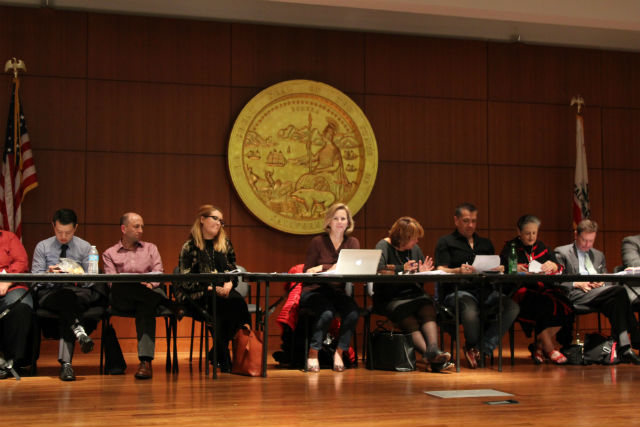
Wouldn’t it be a fun semantic twist if the Democrats for Change went and endorsed the six-year incumbent mayor?
And that may happen. But Mark Farrell will be making his play, too (and one of the new DCCC members, Jade Tu, is his campaign manager). Half a dozen progressives could throw their votes one way or another and be a factor. But you know who’s not getting an endorsement from a DCCC with just six progressive members? Aaron Peskin.
In a November election featuring tens of thousands of low-information voters, a DCCC endorsement is important. Not Taylor Swift important, but important. But that’s not traditionally so in the mayor’s race. London Breed won without it. So did Ed Lee. There are polls in which Breed has name recognition well exceeding 90 percent — and those polls are not good ones for the mayor. Voters, even low-information voters, know who London Breed is. And most of them are not happy. The DCCC endorsement can only help her so much.
But it would be a boon for Farrell. And it figures to be a factor on down-ballot races like supervisor — for the next four years. If progressive supervisor candidates allow for a dynamic in which, like the progressive DCCC candidates, they do not make an affirmative case for themselves and do not address the issues voters are concerned about now, they will lose. If they handle things more like the judges, they may not. In a race between known people, a third-party endorsement matters less.
We can get an idea of how things may go in November based upon how supe candidates running for DCCC did in March. In District 1, 48.3 percent of voters supported Marjan Philhour in her March DCCC race, compared to 41 percent for incumbent District 1 supe Connie Chan. As the two will face off in the general election, this figures to be relevant.
Bilal Mahmood, who will challenge Dean Preston in District 5, performed better outside of his district than within it: He was backed by 28.4 percent of District 5 voters in his DCCC race and came fourth on the slate — compared to third in the whole Assembly District.
Those are still decent numbers for Mahmood. But Trevor Chandler appears to have more work to do. He finished fourth in Assembly District 17 as a whole, but is currently 16th in District 9, meaning he did far worse in the district where he’ll run for supervisor.
Across the city, only Districts 9 and 11 voted in greater numbers for the progressive DCCC slate. But it’s worth noting that these tallies only track how Democrats have voted. In the general election, Republicans and independents will be participating, too.
November is a ways off, and an obscene amount of money will be poured into most every race to tell you things are great or things are terrible. Will San Francisco “soar” like a dragon? Do dragons even soar? Perhaps the perceived behaviors of an imaginary creature are a fitting analogy for an election that seems to come down more to vibes than actual statistics and facts.
How exhausting. A case of Modelo sounds downright necessary. Where’s Lori Lightfoot when you need her?
Additional reporting from Will Jarrett.


Thank you for this analysis. I still can’t get over the fact that my district in the Mission voted last year to re-install that fool Gabriela Lopez on the school board after the city recalled her. Fortunately the rest of the city outvoted us. But that vote doesn’t bode well for us choosing a sensible supervisor in November.
One turn of events that could potentially be a boost to Breed is Peskin being seemingly committed to run. I see that as a blow to the other moderates moreso than Breed, and she might have a better chance of garnering transfers if she can manage to be the last moderate standing.
Peskin is a wildcard factor, but it does reason that his entrance would put Breed firmly on top of the other moderate candidates. It’s shaping up to be a barn burner.
If progressives allow conservatives to frame the debate on crime and fentanyl and respond with their own half baked plans they will lose.
Progressives used to have a full spectrum political program, not just housing, poverty charity and labor but Muni, transportation, ecology, Rec and Park, Ethics, police reform. Now all they’ve got are poverty nonprofits and public sector unions expecting to be paid and freezing everything else out.
Following Berkeley’s cognitive theorist George Lakoff, progressives need to reject the alt right framing and establish their own proactive frames that appeal to voters’ values on issues like justice and security, not criminal justice but a full spectrum just society, not more cops security but ensuring that everyone’s secure and as an antidote to the fear merchants.
Corruption is unjust. Keeping people in a perpetual state of fear threatens their security. Can the progressives shake off the dominion of the nonprofits and unions to make a relevant appeal to the voters and if elected, be trusted to carry it out?
It really is like Democrats at all levels and of all political stripes have taken a mandate to commit as many unforced errors as possible.
I like the way you’re thinking. IMHO, progressives in San Francisco have no plans, whatsoever, for fixing its problems. To be a progressive here today means to complain incessantly about national and international trends while constantly saying crime here isn’t so bad.
If that’s all they got, they deserve to be voted out.
To be a progressive here is to shout from the rooftops that fear mongers are trying to keep people in a perpetual state of fear–cycling, walking, being a Jew, being gay, crime–such that they’re pliable politically.
I think folks overestimate the value of a DCCC endorsement. I was inundated with slate card mailers–probably got about 20. The DCCC slate card was in the pile, but so were some others that appeared to be “official” Dem Party slate cards.