

Good morning, Mission, and welcome to Virus Village, your (somewhat regular) Covid-19 data dump.
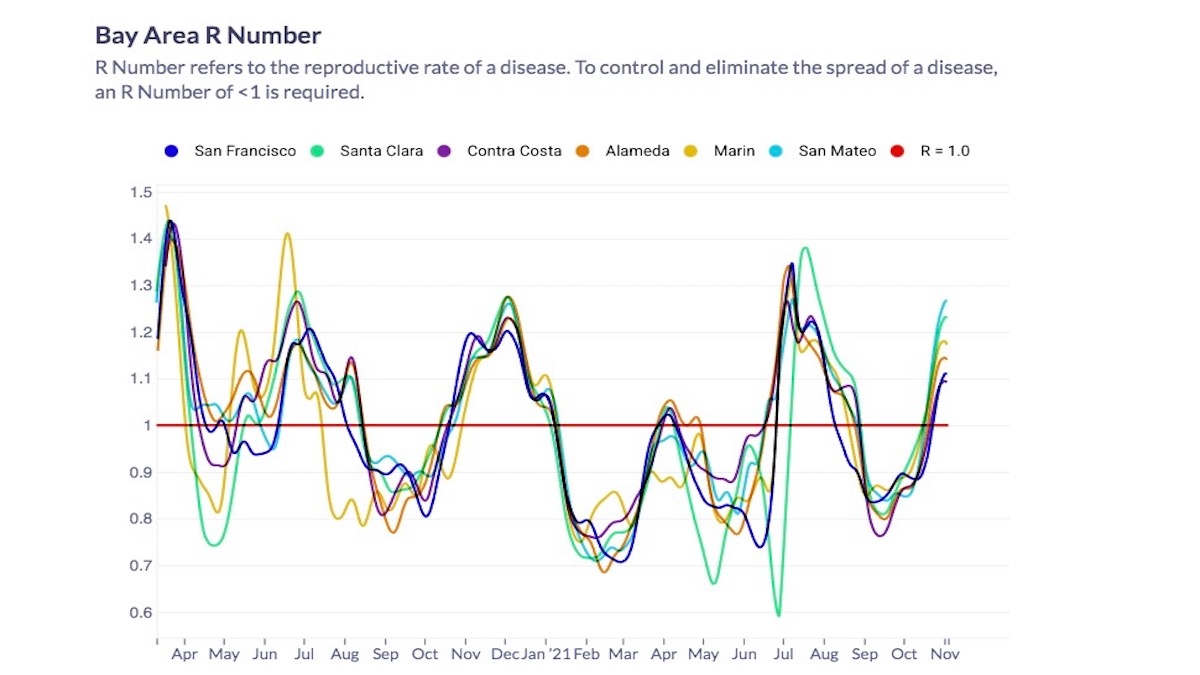
Good news, bad news. Case numbers and positivity rates haven’t moved much, but hospitalizations are now down below 40 for the first time since July 17. On the flip side, R Number models are showing increased rates of transmission locally and throughout the state.
Stop the presses! The San Francisco Department of Public Health has resumed reporting on vaccination status of hospitalizations. See summary notes below, but the whole page is worth checking out.
With The Vaccine now approved for residents 5 and older, the Mission Wellness Pharmacy is expecting a wave of new vaccinations. If you’re older, here’s where to find a booster.
At yesterday’s Grand Rounds, University of California, San Francisco epidemiologist George Rutherford noted a 26 percent rise in California cases (and a 6 percent rise in hospitalizations). Despite these numbers, Rutherford said he is “not at all convinced we’re not going to have another surge this winter.”
Few expect a repeat of last winter, but the virus has a way of confounding expectations. Also speaking was Dr. Paul Offit, who answered a number of the questions/doubts about The Vaccine.
Covid cases are on the rise in Europe. And, the highly vaccinated Singapore has also seen a rise in cases. But, as previously noted, case numbers may be less threatening than last year.
Pfizer announced a new pill to treat covid. Another game-changer? TBD.
Activists are now protesting Moderna, which received in excess of $10 billion US dollars to develop and produce $20 billion in profits, and won’t share its technology with the rest of the world.
The prolonged shutdown of public schools has predictably been intrumentalized for political purposes. Now a local wino, who escaped recall thanks to his Trump-clone opposition, is threatening to do it again if the kids don’t get vaccinated. Will masking grade-school kids suffer a similar fate?
You have to ask?
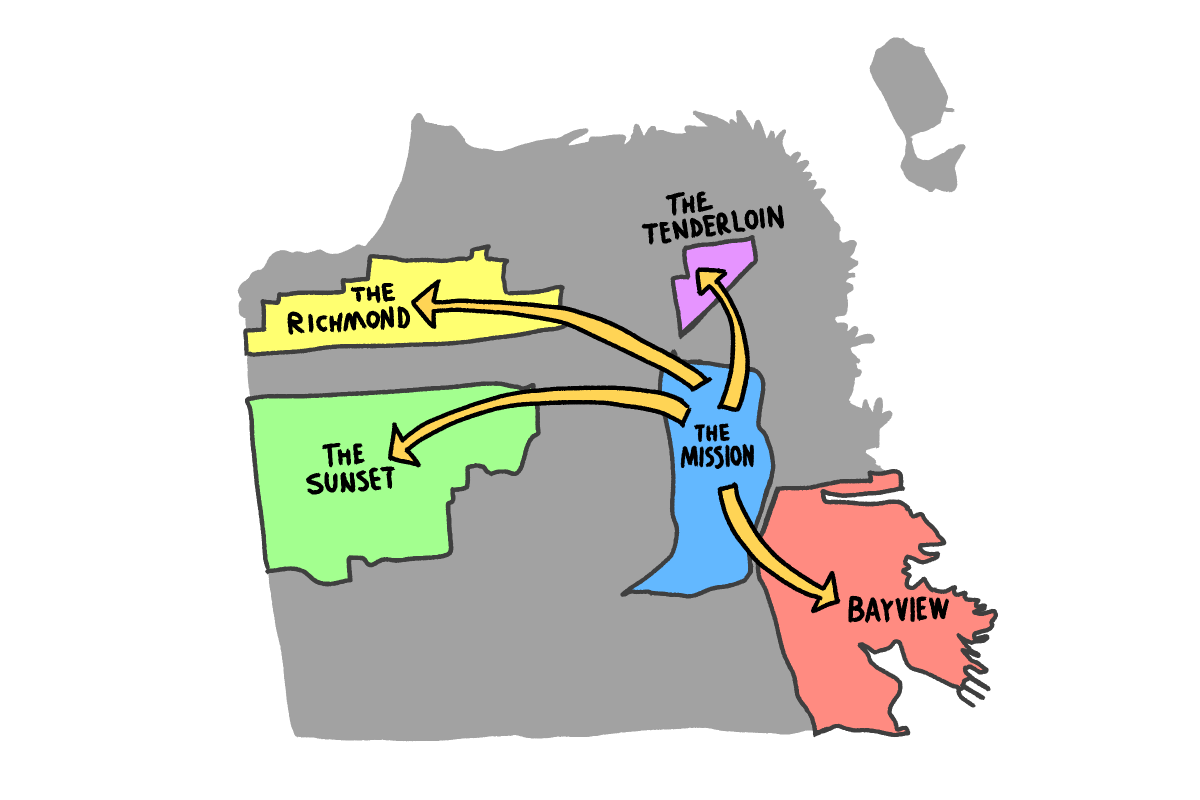
Finally, some rare covid humor.
Scroll down for today’s covid numbers.
The U.S. Centers for Disease Control data used for the chart lags behind the data supplied from the San Francisco Department of Public Health. As of Nov. 4, DPH reports more than 81 percent of all San Francisco residents have received one dose, and 76 percent are completely vaccinated. Better than 79 percent of those over 5 are fully vaccinated. On Nov. 4, the seven-day rolling average of shots per day was 287. Of 118,000 SF seniors eligible for boosters, only 23,000 have received one. Another 52,000 boosters were given to those under 65 who are at greater risk of hospitalization. For information on where to get vaccinated in and around the Mission, visit our Vaccination Page.
On Nov. 1, DPH reports there were 38 covid hospitalizations, or about 4.3 per 100,000 (based on an 874,000 population). In the month of September the hospitalization rate for unvaxxed residents was 64.8 per 1000 cases while for vaxxed residents it was 20 per 1000 cases. The picture when age is factored in provides a more nuanced view. Fully vaxxed seniors (over 60) have higher rates of hospitalization than younger unvaxxed residents. DPH says its data comes from hospitalizations caused by covid, not another medical condition.
Since the beginning of the pandemic, around 50 percent of SF covid hospitalizations have been treated in only two hospitals. Why? The latest report from the federal Department of Health and Human Services shows Zuckerberg San Francisco General Hospital with 7 covid patients and 9 ICU beds available, while across the Mission, CPMC had 6 covid patients and 2 ICU beds available. Of 51 reported covid patients, 27 were at either SFGH or UCSF, with at least 64 ICU beds available among reporting hospitals. The California DPH currently reports 80 ICU beds available in San Francisco. SFDPH won’t say.
Note: DPH uses dated population figures for neighborhoods. Between Sept. 1 and Oct. 31, DPH recorded 287 cases in the Mission or a rate of 49 per 10,000 residents. During that period, although Bayview Hunters Point had the most cases (303), Chinatown had the highest rate, 88 per 10,000 residents. Rates of 50 per 10,000 or above were recorded in 19 neighborhoods with the lowest numbers in Presidio (12), Treasure Island (9) and Seacliff (7).
On Oct. 28, the 7-day average of daily new cases in the City was 51, or approximately 5.8 new cases per day per 100,000 residents (based on an 874,000 population). The 7-day average case rate among vaccinated residents was 5.0 per 100,000 fully vaccinated residents and for unvaccinated residents 10.6 per unvaccinated 100,000 residents.
DPH uses dated population figures for racial and ethnic groups. As of Oct. 31, White San Franciscans recorded 702 cases or 40.3 percent of all October cases, Latinxs 309 or 17.7 percent, Asians 365 or 21 percent, Blacks 106 or 6.1 percent, Multi-racials 46 or 2.6 percent, Pacific Islanders 16 or .9 percent and Native Americans recorded 4 cases in October or .2 percent of the month’s total.
Between Sept. 1 and Oct. 31, the Mission recorded a positivity rate of 1.8 percent. During that time, Chinatown recorded the highest rate at 4.1 percent while the rest of the City’s neighborhoods recorded rates below 3 percent, with 29 recording rates below 2 percent. Glen Park had the lowest recorded rate at 1 percent.
As of Oct. 31, DPH reports the Delta total (August through October) has reached 90 and the cumulative covid-related death toll to 667. Last spring’s surge resulted in approximately 90 covid-related deaths recorded between August and October. September and October numbers should be considered “less reliable” meaning updates are likely. As of Sept. 30, DPH reports 16 covid-related deaths among fully vaccinated residents.
Covid R Estimation raised its San Francisco R Number above 1 to 1.11 and lowered its estimate for the California R Number to 1.12. The ensemble roughly agrees with rising transmission rates. The current average for the San Francisco R Number is .93 and for California’s R Number, it’s .98. Two models in the ensemble now show SF above 1.
In October, San Franciscans aged 0-4 recorded 48 new cases, 5-11 138, 12-17 45, 18-20 18, 21-24 83, 25-29 251, 30-39 442, 40-49 239, 50-59 208, 60-69 147, 70-79 76, and for those of us aged 80 and above there have been 47 October cases recorded.