


Good morning, Mission, and welcome to Virus Village, your (somewhat regular) Covid-19 data dump.
The recent rains did little to dampen the virus, which continues to circulate around town at relatively low levels.
Will The Vaccine for kids five to 11 make us all safer? The FDA Vaccine committee seems to think so, approving emergency use based on a Pfizer trial of 2400 kids. UCSF researchers agree and think it will be safe and effective. Bay Area public health officials will base a decision to remove adult masks after 8 weeks of child vaccinations. Sorry, kids — masks off in bars, but not in schools, which rankles some local doctors.
Although SFDPH insists that covid transmission in schools is very low, it has provided no data on infections since June 11. Let’s hope they have some.
The decision to vaccinate kids and to provide boosters for practically anyone else has raised a lot of questions about the immune systems and what constitutes immunity. As The Atlantic’s Ed Yong explains, it’s complicated.
Now that the pandemic has provided Big Pharma with record profits, what are they going to do with all that dough? Since the beginning of the year, they’ve been paying off politicos to defeat drug price controls.
Do public private partnerships work? It certainly did for Pfizer and Friends in the context of production and marketing of The Vaccine. So far, the concept has failed to get around Big Pharma’s global vaccine intransigence.
But then, should public healthcare be considered charity?
Many cops, people sworn to protect the public, have refused to get vaccinated. Are they scared of needles? In 2020, more police officers in Georgia died of covid than violence or accidents.
Facebook has received no small amount of criticism in the past days, though little of it has focused on the internal struggle to curb anti-vax disinformation. The Facebook business model seems to make self-censorship something of an oxymoron.
Congrats to Supervisors Hlary Ronen and Myrna Melgar for proposing an ordinance to provide sick leave for domestic workers. It will be an uphill struggle, especially since the U.S. is one of only six countries in the world that can’t, or won’t, mandate paid sick leave for all workers.
Until The Vaccine arrived, the lack of national and local health data facilitated a clumsy and ineffective public response to the virus. This was particularly true for racial and ethnic minorities who were among the hardest hit. The National Commission to Transform Public Health Data Systems has some good ideas on how to fix the system, but any improvements will require political will. Any good ideas on how to fix that underlying condition would be widely welcome.
Scroll down for today’s covid numbers.
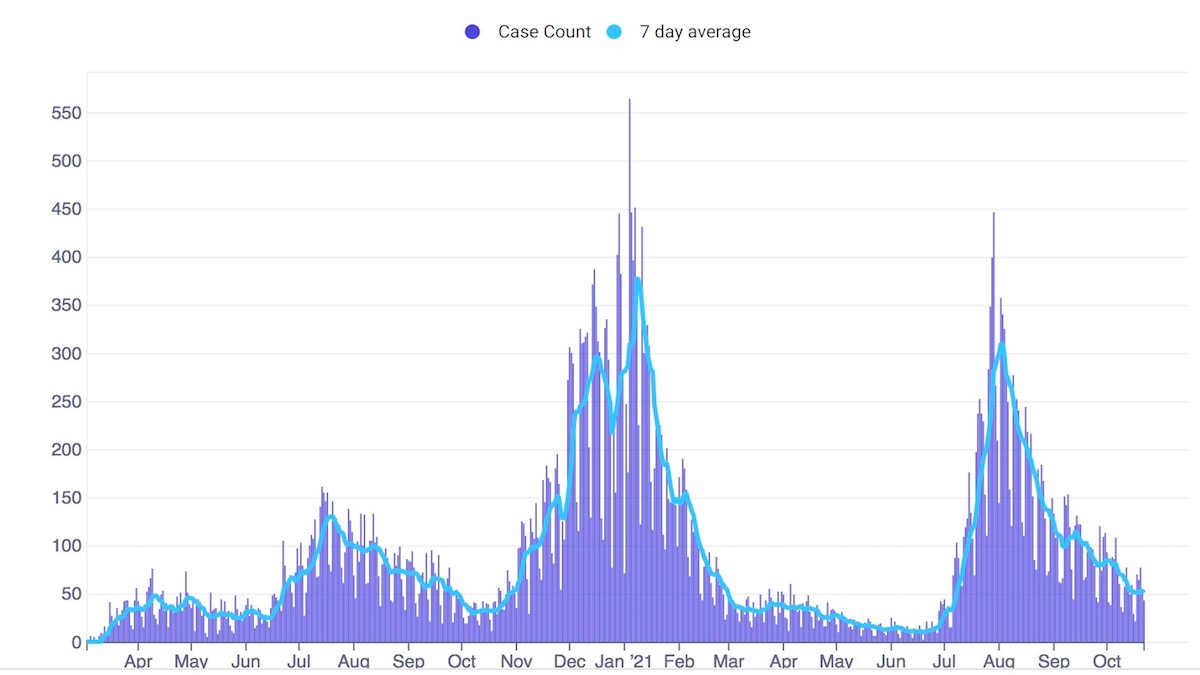
The U.S. Centers for Disease Control data used for the chart lags behind the data supplied from the San Francisco Department of Public Health. As of Oct. 26, DPH reports more than 81 percent of all San Francisco residents have received one dose, and 76 percent are completely vaccinated. For those over 12, better than 89 percent have received one dose and 84 percent are fully vaccinated. New vaccinations, though low, keep on truckin’. On Oct. 26, the seven-day rolling average of shots per day was 245. For information on where to get vaccinated in and around the Mission, visit our Vaccination Page.
On Oct. 21, DPH reports there were 42 covid hospitalizations, or about 4.8 per 100,000 (based on an 874,000 population). Only 10 remained in ICU. DPH has not reported breakthrough hospitalizations and deaths since Sept. 17 in order “to conduct a thorough review of data quality and completeness.” According to the CDC, there were 36 new admissions for the seven days ending Oct. 24 (-16.28 percent from the previous seven days). For the week ending Oct. 24, covid patients accounted for 2.49 percent of hospital beds (no change from the previous week) and 4.69 percent of ICU beds (-1.32 percent from the previous week). As of Oct. 18, the CDC says that, of more than 189 million vaccinated U.S. residents, 41,127 patients with a covid vaccine breakthrough infection were hospitalized or died (though 26 percent were either aymptomatic or not covid related). Note: 85 percent of the deaths and 66 percent of the non-fatal hospitalizations were among those 65 and older.
The latest report from the federal Department of Health and Human Services shows Zuckerberg San Francisco General Hospital with 7 covid patients and 6 ICU beds available, while across the Mission, CPMC had 4 covid patients and 3 ICU beds available. Of 54 reported covid patients, 29 were at either SFGH or UCSF, with at least 75 ICU beds available among reporting hospitals. The California DPH currently reports 79 ICU beds available in San Francisco. SFDPH won’t say.
Note: DPH uses dated population figures for neighborhoods. Between Aug. 23 and Oct. 22, DPH recorded 329 new cases in the Mission for a rate of 56 new cases per 10,000 residents. Over that period, DPH recorded 405 new cases in Bayview Hunters Point or 107 new cases per 10,000 residents, the only neighborhood with a rate in excess of 100 per 10,000 residents. SOMA and Chinatowna had rates over 80 per 10,000 residents and another 22 neighborhoods have rates over 50 per 10,000.
On October 19, the 7-day average of daily new cases in the City was 50, or approximately 5.7 new cases per day per 100,000 residents (based on an 874,000 population). The 7-day average case rate among vaccinated residents was 5 per 100,000 fully vaccinated residents and for unvaccinated residents 9.5 per unvaccinated 100,000 residents.
As of October 20, White San Franciscans had 464 recorded October infections, or 39.9 percent of October cases; Asians 254 or 21.8 percent, Latinxs 204 or 17.5 percent, Blacks 78or 6.7 percent, Multi-racials 28 or 2.4 percent, Pacific Islanders 10 or .9 percent and Native Americans had 2 recorded infections or .2 percent of the month’s cases so far.
Note: DPH uses dated population figures for neighborhoods. Between Aug. 23 and Oct. 22, DPH recorded 23,577 tests in the Mission or a rate of approximately 401 tests per 1,000 residents. Only Sunset/Parkside recorded more tests. FiDi/Southbeach had the highest testing rate at 609 tests per 1,000 residents, while Bayview Hunters Point recorded a rate of 535 tests per 1,000 residents. Chinatown, which has recorded a relatively high number of infections and a relatively high positivity rate during Delta, had the lowest rate of testing at 245 per 1,000 residents.
Covid-related deaths in San Francisco have always been among the most ambiguous numbers. The City no longer bothers to define what constitutes a covid (or covid-related) death. Nonetheless, five new deaths have been recorded in October bringing the Delta total so far (August – October) to 79 and the cumulative covid-related death toll to 656. September and October numbers should be considered “less reliable” meaning updates are likely. For over a month, DPH has “temporarily paused” reporting the vaccination status of covid-related deaths in an attempt “to conduct a thorough review of data quality and completeness.”
Covid R Estimation raised its San Francisco R Number to .98 and revised its estimate for the California R number upward to 1.1. The ensemble slightly lowered its average for the San Francisco R number to .72 while raising its California R Number average to .92.
As of Oct. 21, DPH reports 2 October cases in nursing homes (“Skilled Nursing Facilities”) and 0 deaths in October. Only 2 covid-related deaths were reported in September. In Single Room Occupancy hotels (SROs), DPH reports 37 cases and 1 covid related death so far in October.
More local Covid-related things that need to get covered: many local Halloween kids’ events being listed everywhere– mostly geared towards big groups of (unvaccinated) kids under 12, presumably. But no stories anywhere about proposed safety measures or precautions for Halloween this year. Why isn’t that being discussed?
Mark,
“it has provided no data on infections since June 11. ” If you scroll all the way down that page you’ll see another link, “Updated data on COVID in SF schools”. This points to, https://sf.gov/information/updated-data-covid-19-cases-among-san-francisco-children-and-schools.
I have no idea why they don’t integrate that new data on the main school page.
Many thanks John