
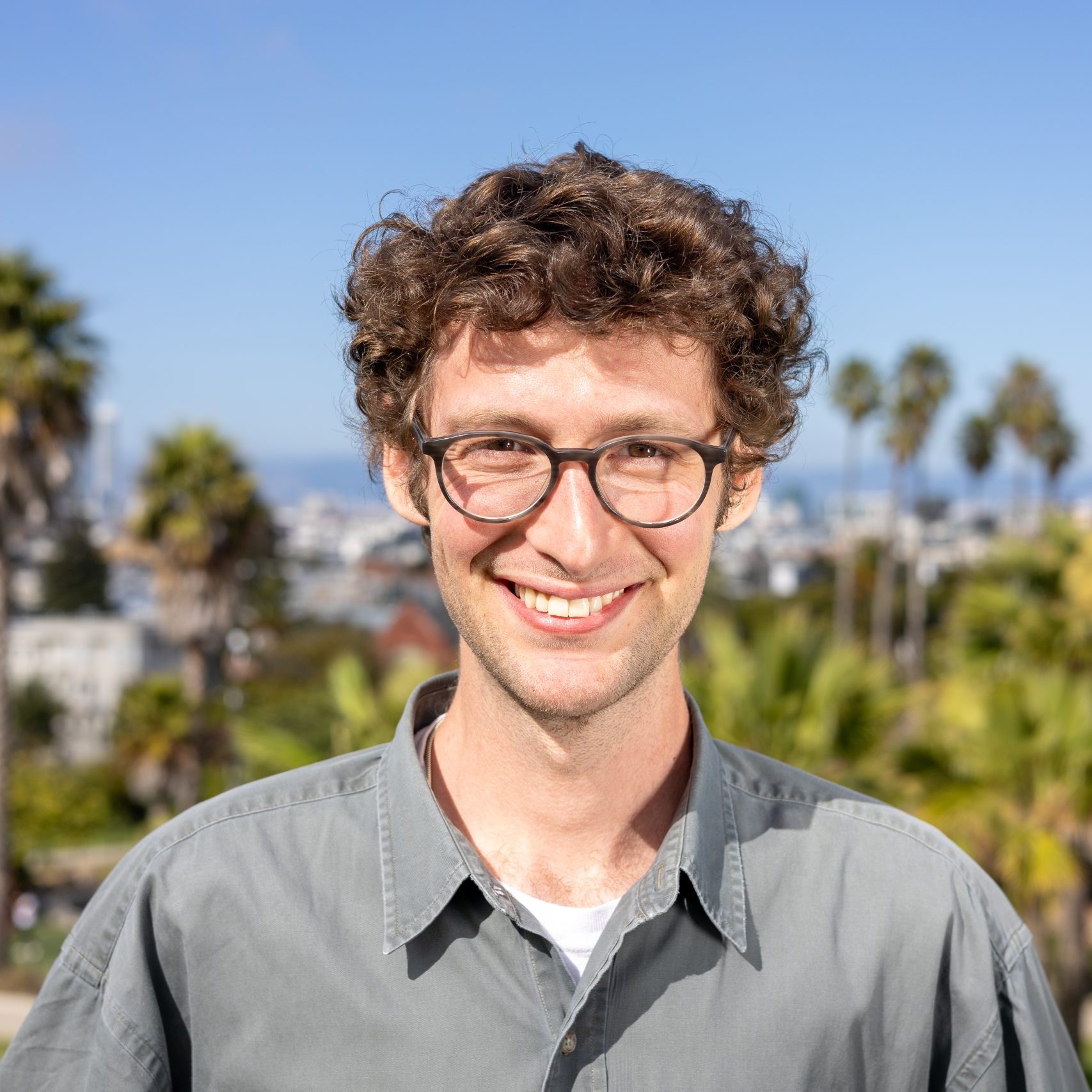

“City on the Edge,” Jonathan Weber’s history of the tech industry and its influence on San Francisco city politics, begins in the early ’90s, shortly before the advent of the first major web browser (Mosaic) or the first banner ads (on HotWired, the online presence of Wired magazine).
Early internet users in the Bay Area used it for things like communicating outside of mainstream channels and keeping up with the hottest raves in town.
The book ends in 2025, with the inauguration of Mayor Daniel Lurie. In between, the local tech economy booms and busts in cycles, while literal busloads of tech workers flood the streets (and the housing market), and the industry goes from a sliver of San Francisco’s economy and culture to a major political and economic force.
Weber — who was the first-ever Silicon Valley reporter for the Los Angeles Times and, most recently, the founding editor of the San Francisco Standard — was on the scene for much of it, as tech changed San Francisco, and San Francisco changed tech.
His newly published history of the era, “City on the Edge: Technology, Politics, and the Fight for the Soul of San Francisco,” published by Simon and Schuster, sheds new light on the political forces that shaped this changing relationship behind the scenes.
Mission Local recently sat down with Weber at an Outer Richmond cafe to hear more about the local power brokers who shaped the global tech industry, the contested terminology of the “doom loop,” and the boom-and-bust economy of the city.
This interview has been edited for flow and readability.
Mission Local: Let’s start off where you start the book: In the 1990s, in the South Park neighborhood of San Francisco, which you describe as a community of artists and creatives on the periphery — on the edge — of Silicon Valley and of the tech industry. How did that shape the industry as San Francisco became more central to it?
Jonathan Weber: Technology, in the early days of Silicon Valley, was silicon semiconductors, chips, military hardware, computers, and they were mostly sold to businesses. It was a pretty technical industry. It was run by engineers — and marketers, certainly. But really, engineering was at the center of the culture.
With the advent of the internet, and in particular the advent of the World Wide Web, there was suddenly a different set of skills that were needed — around design, around writing, around visual presentation. That shifted the nature of what we think of as “tech.”
Evan Williams, the founder of Twitter, has a quote about this. He was like, the Valley is about tech, it’s about engineering. And the city is the Web. It’s about writing. It’s about art. It’s about creativity. It’s about design.
So the tech shifted, and it made creative skills much more important. And, at the same time, there was this preexisting creative community in San Francisco that was very curious about tech, that was a descendant of certain countercultures and subcultures. Those two things collided to create an explosion.
ML: You dedicate a chapter of the book to the “Twitter Tax Break” [a 2011 payroll tax exemption for companies along mid-market passed before Twitter’s IPO].
JW: Right. In 2009, which was when the tax break was put together, the city was in bad shape, economically. The financial crisis did a lot of damage. But tech was up and coming.
Even though the economy was melting down, social media was rising, and Google was rising, and a whole new generation of companies were just starting. There was a lot going on, and Twitter was a flagship of that movement.
Twitter was threatening to leave the city, and the city thought it was very important to keep Twitter in the city, and we got the Twitter tax break.
The story I tell there about the Twitter tax break, which is previously untold, is that Willie Brown was really at the center of that. He was good friends with the guy who owned the building, Alvin Dworman, who was a very interesting character.
[Dworman was chairman of ADCO, a New York-based real estate company that owned the Western Furniture Exchange and Merchandise Mart at 1355 Market. In 2011, the city passed a tax break that applied to companies that leased office space in Mid-Market, which happened to be where the Merchandise Mart — renamed Market Square — was located. Twitter signed a lease and moved into several floors of the building].
I’m not alleging anything corrupt there. Willie didn’t get paid for his involvement in that. But he was doing what Willie does. He was facilitating the deal. A lot of people thought it was a good idea, so he brokered it.
He does deny doing this, but I’m confident of my sources. There was a model for this, which was a tax break for the development of Mission Bay.
So Alvin Dworman sold the building to Shorenstein right before the tax break was passed, but I’m certain that the contract for that sale was contingent on that tax break passing. He sold it for $120 million, but then he also had a profit participation if Shorenstein resold within a short period of time, which they did.
They spent about 200 million on the renovations and upgrades. And then they sold 90 percent of it for $900 million five years later. So, that was a huge windfall. One of the biggest deals in the history of the company.
So, if you want to look for who made money, it was Shorenstein, way more than any of the tech companies. That profit dwarfs what Twitter would have owed. So that just puts the “giveaway to the tech industry” thing in perspective a little bit.

ML: We see in the book the way that the internet changed news media. How do you see the news media landscape of San Francisco today?
JW: It’s a real mixed bag. At the moment, the San Francisco news ecosystem is relatively healthy, in some ways. There’s of course the Chronicle, you have the Standard, which is a substantial operation now, and you’ve got Mission Local. You’ve got other small operations — The Gazetteer, 48 Hills, The Frisc, Coyote Media, Public Press. There’s a lot of stuff out there. So that’s great.
But it’s also true that if you compare that to the ’90s, for example — you had two big dailies. There were just a lot of stories every day — way more than there are now. Just a lot of coverage. Staffs were much larger.
And then you had two very strong alt-weeklies, in SF Weekly and The Bay Guardian, which both supported some quite good longform journalism of different kinds.
There were four publications that had a real city-wide footprint. That was pretty powerful. I don’t think there’s really quite the equivalent.
The internet destroyed the business model of print media, full stop. I worked at the LA Times, which is a great example. At the LA Times, we had a great reputation for our journalism, and the Times made tons of money at that time, $200 million a year in profits. It was insane.
But a lot of the journalists were under the very false impression that those profits were related to the quality of the journalism. They were not! The profits were the result of a distribution monopoly.
The Times had a giant printing plant in downtown Los Angeles that cost $800 million to build. Trains came into the building with rolls of paper right for the presses. Outside, there was a fleet of 2,000 trucks that would take those papers all over L.A.
That distribution infrastructure was massively expensive, and impossible to replicate. So if you wanted to sell your car, or you had a message you wanted to get out to more or less everyone in Los Angeles, they were the only game in town.
They had a structural monopoly on the distribution of information locally. The internet just destroyed that in a stroke.
National political journalism is arguably in reasonably decent shape. But at the state and local levels, not so much.
ML: You write that, at the height of the pandemic, the tech companies enjoyed a “boomlet,” and meanwhile, you say that “downtown San Francisco was dying.” What were the political choices that preceded that?
JW: Cities and governments in general, they’re not famous for being fast-moving. They tend to be reactive to problems. I think that you can criticize the government for lack of foresight, particularly that there was going to be extreme demand for housing.
I don’t think the city did a very good job of getting ahead of that, particularly during the Newsom administration in the 2000s. In the salad days of the 2010s, it was easy to brush problems under the rug. During the Ed Lee administration, he was a go-along, get-along kind of guy.
There were probably hard choices that were avoided in terms of how to deal with growing homelessness and the arrival of fentanyl and some of these other problems.
ML: Coming out of the pandemic and with the election of Daniel Lurie, you say that his election was a “radical shift.” Part of that was, as you write in the book, that his campaign catered to the perception of the doom loop.
JW: Well, the reality of it. There seems to be a point of view out there that the doom loop thing was a manufactured narrative. I don’t think that is true.
ML: Okay, can you describe the doom loop?
JW: It just refers to a phenomenon where, if the conditions downtown are shitty, then companies aren’t going to want to be there and people aren’t going to want to work there, and then that will reduce the value of the buildings and so forth.
It will reduce the amount of economic activity, that will reduce the tax base, and that will reduce city investment, and therefore that will make it worse. Disinvestment will lead to more disinvestment, essentially.
So that’s the doom loop. It was an academic paper that kicked off the discussion. When I started at the Standard in the fall of 2021, it was when the city was just barely reopening. I insisted that we would be four days a week in the office, because I didn’t think I could really start and run a startup news operation remotely.
We were down there [in Showplace Square] every day, and it was a hellscape. I’m sorry. People consider that an ideological term, but, you’re walking to work and there’s a fire burning, cars starting to light on fire. The street is lined with tents and there’s nobody around except for some junkies stumbling around.
People want to say that was a made-up thing. But, you know, I was walking around in some of the more highly impacted areas of SoMa and the Mission, and it was really bad. Inexcusable conditions, nothing else you could call it.
ML: You’ve described two things. Are those necessarily correlated? In the popular vernacular, “doom loop” has come to describe what you just described, the “hellscape.” But really it’s about disinvestment of business. Are those two things the same?
JW: Well, they’re related in the sense that the hellscape creates the doom loop. I’m not saying every part of downtown is like that. But, to the extent that people don’t want to go downtown because of street conditions, that is ultimately going to cause disinvestment in downtown.
If you’re a company and you’re deciding where your company should be, it’s much more expensive to be in San Francisco. The taxes are higher. Everything is more expensive. One of the main reasons you’d want to be in San Francisco is the employees want to be in San Francisco.
So then, suddenly, your employees don’t want to be in San Francisco. They don’t want to come into that slightly scary office. They don’t want to get on the BART. So then, you’re like, “well, what am I doing here?”
ML: Going back to Lurie’s election, in what ways was it a radical shift?
JW: Specifically what I was referring to there was really the end of the Willie Brown machine. Willie was elected in ’95, and every subsequent mayor until Daniel Lurie was a protege of Willie’s, and was part of his operation. Arguably, that operation even goes back to Feinstein’s administration.
And now you’ve got Lurie, who’s not dependent on that system in the way that all these other politicians were.
One thing I’ll add on this theme: I talk in the book about the “city family” — this system that Willie ran. And one of the things that’s interesting about that is that it’s not really a moderate-progressive thing. There are progressives that are part of the family too.
Ron Conway, he was kind of city family, so there was a little bit of a tech thing there, too.
Now, that city family thing is not really a thing. Lurie and his business coalition is really the power. And that’s a different coalition.
ML: People often describe San Francisco’s economy as a series of booms and busts since the Gold Rush. How do you think that plays out for people on the ground? For workers, renters, homeowners, what does that look like?
JW: It does make for a particularly transient population. San Francisco is a place where people come and go more than many other places, and I think the booms and busts are a big part of that. People flock here for the booms, and then there’s a bust and a bunch of people leave.
And of course, the thing about the booms and the busts is that a bunch of people get rich. Who gets rich is some combination of luck and skill and timing.
In the dot-com bubble, because things happened so quickly, there was a difference of six months. If you sold your company six months earlier, you made a huge fortune. If you didn’t, you had nothing.
Then these fortunes compound. People who made money in the dot-com boom, they invested in Web 2.0. And then if that worked out, they invested in smartphones, and now with AI.
ML: You spend some time in the book describing the ways in which local politics helps these cycles along. How did city hall’s relationship with the tech industry develop?
JW: In the beginning, there wasn’t much of a relationship. The business was quite small — 10,000 jobs, maybe, out of several hundred thousand in the city.
So it really wasn’t a focus of anyone in city government. And the tech businesses didn’t really want anything from the city. They didn’t need anything from the city. So they coexisted, ignorant of each other, in a certain way.
It’s funny because in the arc of the book — and I didn’t really plan it out this way, I’m not an outliner — the beginning of the book is more about the rise of tech. And then the politics becomes gradually more and more important.
It wasn’t until much later when two things happened: Tech became a steadily larger part of the city’s economy. But then, on top of that, the companies started getting involved in things that were traditionally city jurisdiction, like ride-hailing. Uber and Airbnb. They were in the city’s business.
When I got here in 1990, there wasn’t a single tech company in town, practically. But over the next 30 years — a statistic from Ted Egan, the city economist, is that in 1991, the percentage of jobs in the city that were in tech was about 2 percent. By 2019, that number was 35 percent. So that really shows the breadth of the transformation.
“City on the Edge” is out now. Jonathan Weber is scheduled to give several talks around San Francisco in promotion of the book. Find more information about dates and times here.

Lol at my boy from the Avenues trying to say the Doom Loop wasn’t real
lol at my boy from his own ass trying to say he read the article
I haven’t seen the book yet, but note that in an interview on The Daily Beast, Jonathan Weber called Connie Chan a “nimby”. Does Connie Chan call herself that? I don’t know.
Nice to see someone come out and state plainly what everyone who spent time downtown and in SoMa already knows – street conditions were atrocious and city leaders’ failure to do anything about it dug the hole much deeper than it had to be. We will be living with the consequences for decades.
Ok, you set up the question: what “had to be” as you saw through your crystal ball or whatever?