
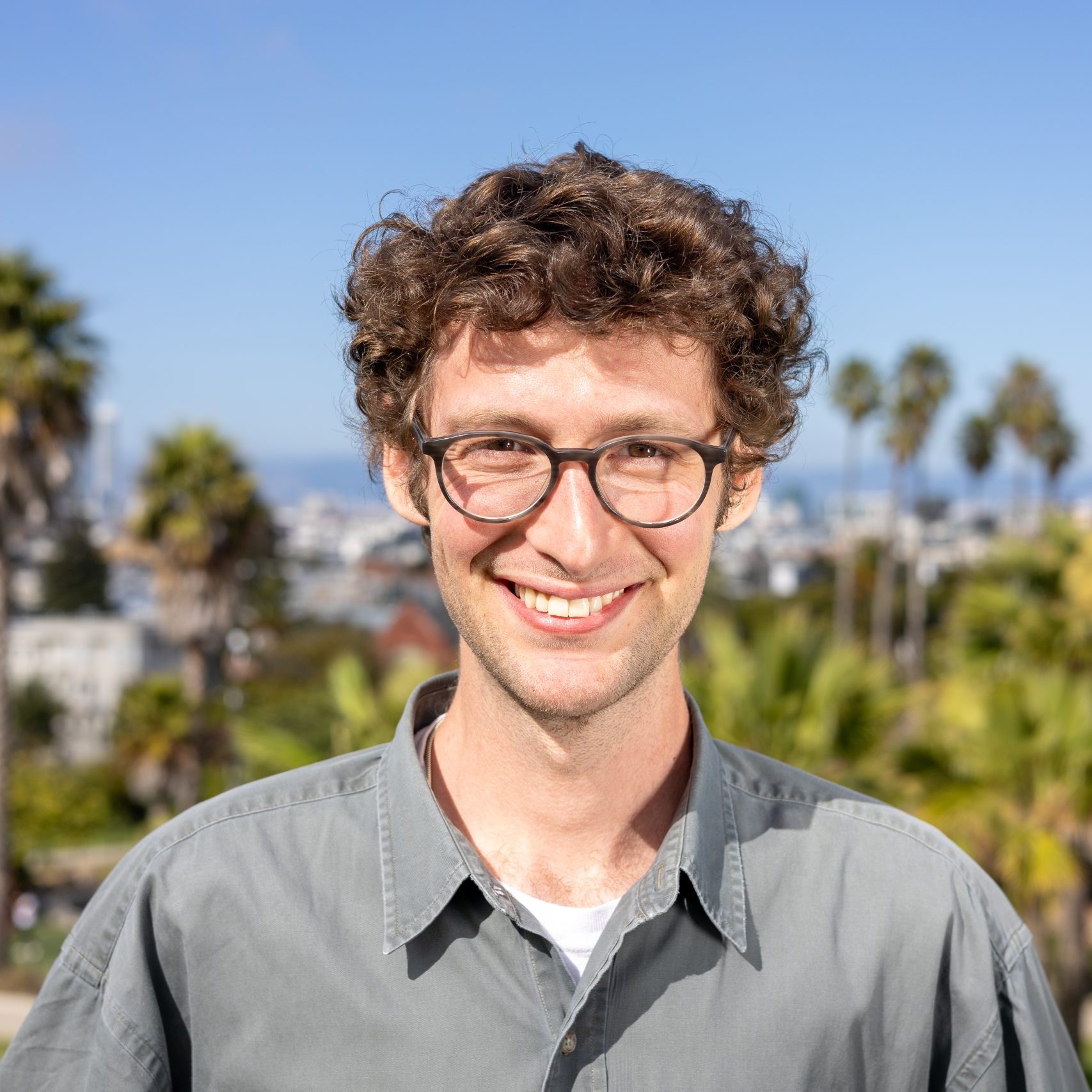

It was a relatively quiet first day in San Francisco Superior Court today for seven pro-Palestinian activists, despite what they are facing.
All seven have been charged with felony conspiracy and a litany of misdemeanors, including “false imprisonment,” by District Attorney Brooke Jenkins over an April 2024 pro-Palestine demonstration on the Golden Gate Bridge. The charges could see six of them put away for up to 14 years, and one for up to 15.
The severity of the charges has been a dominant theme for the defendants since they were filed in August 2024.
“Now, more than ever, we need to fight to protect our right to protest and our right to dissent,” said River Allen, one of the defendants, on the courthouse steps before their first day in court.
Allen and 25 others were arrested on April 15, 2024, after they blocked the Golden Gate Bridge for over four hours. Jenkins later charged 18 of those protesters with misdemeanors, and the remaining eight received felonies. Many of the misdemeanor charges were dismissed, and only the seven felony charges remain.
“District Attorney Jenkins is the first district attorney to use false imprisonment against protest,” Allen said. “It’s not lost on me that we are being charged with false imprisonment, and meanwhile, Palestinians in Gaza are fighting for their life in a literal open-air prison.”
Protesters have blocked the Golden Gate Bridge going back decades; AIDS activists famously did so in 1989, chaining their arms together.
But the Golden Gate Bridge and Highway Transportation District and Jenkins came down hard on the April 2024 demonstrators. The bridge initially sought $163,000 in restitution from the group before dropping its demands last year.
The criminal trial is the last measure left. Much of Friday morning’s proceedings were administrative: The judge coordinated with attorneys over scheduling and set a date for selecting a jury.
Finding members who can sit in an impartial jury, Judge Teresa Caffese said, will likely depend “on peoples’ personal beliefs surrounding the reason we’re all here.”
Which is to say, how they feel about Israel, Palestine and America’s involvement in the Middle East.
But some minutes later, Caffese took a moment to address “the elephant in the room” and sought to set individual beliefs aside:
“I’m the judge,” she said. “Not a sitting member of Congress.”
“This is a criminal case. The defendants deserve a fair trial.”
The group appeared for the first time in court for this trial Friday, four of them in person, three remotely by web conference. Some half dozen friends and family members appeared in support of the seven co-defendants.
Each of the seven has their own attorney, but the group will be tried together by the district attorney’s office. Allen is represented by Public Defender Nuha Abusamra.
“The public defender’s office and the defense team in general are ready to fight this case zealously,” Abusamra said. “In the defense’s opinion, this is an overcharged case for protesting against genocide in Palestine.”
The protesters have argued that the charges are unprecedented.
The district attorney’s office declined a request for comment. In a press release announcing the original charges, which were filed in August 2024, Jenkins said: “While we must protect avenues for free speech, the exercise of free speech can not compromise public safety.”
“As a result of the protest, hundreds of motorists were trapped on the Golden Gate Bridge and US 101, who had no choice but to remain imprisoned on the freeway for several hours,” the DA’s press release continued.
The trial is expected to last three months, which would place the end of the trial some two years after the original charges were filed. Since then, the codefendants have weathered the proceedings together. Some have lost work following their arrests, Allen said.
“It has taken a toll on my life and on my codefendants’ lives,” Allen said. “But I will say, the intent from the district attorney’s office was to create a chilling effect, to divide movement, to make people feel demoralized and isolated. And it has had the opposite effect.”
“I feel very close to my co-defendants,” Allen added. “We’ve become a great part of each other’s lives. We go camping, we take each other to doctor’s appointments.”
The false imprisonment charge is patently stupid. Well, except for the fact that Jenkins is using it to smoother protest – at least protest that AIPAC finds undesirable.
Ten or twelve years ago, SFPD shut down all of the Union Square Macy’s store. The prevented anyone from entering, but because their brains were doped up on donuts and coffee, they forgot (actually they simply didn’t care) that all of the many hundreds of people in the store were stuck inside. No cops were charged with false imprisonment, or even reprimanded for being fools.
So someone else did something wrong once so we never hold anyone accountable. Stop the what aboutisms…
You are dismissive of just how often the DA’s “discretion” amounts to politically motivated punishment of “unpopular” opinions. The second set of quotation marks is a rhetorical gesture that questions and ultimately rejects the claim that it is unpopular to support Palestinians. That gesture also rejects the assumption that only popular causes and popular people matter.
In a democracy the opinions of “most” people do matter.
And I doubt that support of Hamas and anti-semitism is a majority opinion.
I won’t do the poll, but Palestinian doesn’t equal Hamas or anti-semitism. But, my point was that aren’t doing much right if we only allow protests that are approved by the majority.
Are you gonna start charging CHP people when they hold up an entirefreeway cause they’re practicing how to do a traffic break?
Convict these performative, malignant narcissists. Their agenda should not be forced on others in the USA …like they do in Palestine. Palestine has never been and never will be … “free”.
They deserve what they get, the law is the law. If everyone decided it was OK to shut down our bridges protesting their global cause of the week people would start losing their jobs from missing work, hospitals would become overwhelmed with a backlog of patients from days of missed appointments and surgeries, small businesses would suffer immensely from lack of business (can’t cross the bridge, guess i’ll work from home). Almost everyone feels strongly about something, but it doesn’t mean they get to negatively affect hundreds of thousands of people for their cause. Protesting unnecessary war and death shouldn’t lead to additional people dying from lack of medical care or doctor access at our hospitals.
“The law is the law” is an incoherent fantasy.
How can you live in 2026, with Donald Trump and Bibi walking free, with the 2008 banksters living high on money they stole by ruining our housing, job and life plans by the millions, with open political corruption everywhere in San Francisco, how can you live in that world and say that we are governed by the rule of law as taught in 9th grade civics?
And how about you? Did you ever roll a stop sign? Ever fail to report income for taxation? Did you turn yourself in?
I don’t yet have an opinion about the bridge case, maybe I never will. But this obtuse “law is the law” bullshit doesn’t help anyone. Would you say the same thing about civil rights marches in the 1960s? The world is a complicated place and I suggest you get used to that.
Marching for civil rights is not illegal and never has been.
Obstructing, harming, delaying and inconveniencing others is.
Well, that’s stupid. We know Dr. Martin Luther King found out it was illegal. He wrote a letter about it while he was in the Birmingham jail. And we know many Civil Rights Movement activists were killed by crackers (and cops) – maybe not legally, but certainly with impunity so it comes to the same thing.
We are constantly delayed and inconvenienced by cops, politicians, abortion foes, sportsball fans, Christmas shoppers, newly crafted booze zones that are saving the city (so they say), and drunk drivers who sometimes kill a whole family. How many of them are rotting in prison to make sure the next time life will be more convenient for some?
I was just pointing out that it is possible to exercise free speech without causing delay and distress to others. Knowing the difference could keep you out of that prison.
That actually sounds like a really good idea. Maybe yen some shit would actually change.
14-15 years for all, please and thank you judge.
The right to protest does NOT include the right to shut down a vital transportation link.
It’s especially galling that these selfish morons weren’t protesting a local or even a California issue.
I hope they are convicted and serve significant jail time. We need such a ruling as a deterrent.
If these selfish morons can shut down the Golden Gate Bridge over Gaza, where does it end? People upset with the Hungarian elections or regional elections in Argentina, or whatever, are going to shut down our bridges? We need to stop this.
This is how civil disobedience works – you intentionally flout the law to bring visibility to a cause and take the punishment. Entitled SF protesters who went ridiculously above and beyond in causing a negative impact on working class people trying to get to their jobs think they should be allowed to skip the latter part.
By the way, the AIDS activists blocked the bridge for 45 minutes. These bozos chained themselves to vehicles and blocked the bridge for more than 4 hours.
You’d need be an imbecile to accept such charges. Did Rosa Parks accept her punishment, or did she fight? MLK Jr.? They fought, of course.
Free speech does not extend to causing harm to others. That crosses a line and a false imprisonment felony charge seems fair here. After all, the protesters could be facing federal and terrorism charges, as has happened in some similar cases in Europe.
This guy knows all about traffic laws, constitutional law, even laws in other countries! His game is so strong he can reach conclusions lightning quick long before the actual lawyers are finished with the case! It’s amazing to watch.