

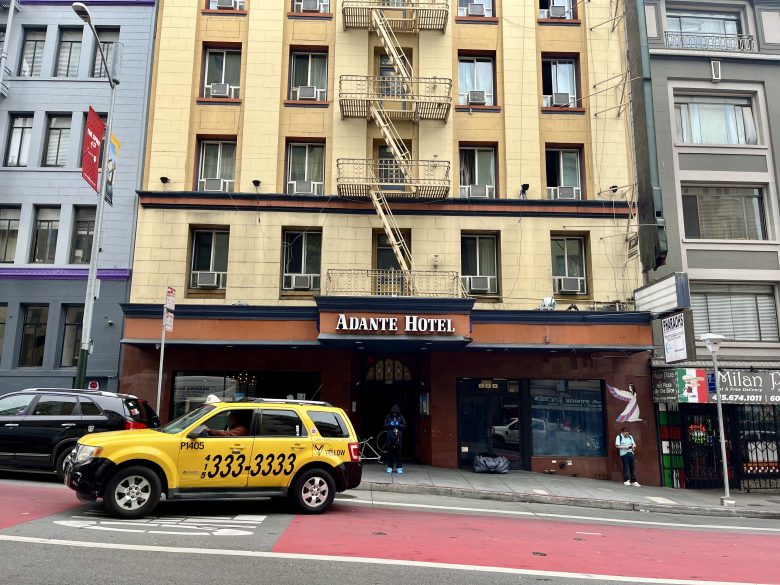

San Francisco is on track to lose over 450 shelter beds as the city began closing multiple homeless shelters in the Tenderloin area in recent weeks.
Among them: The Adante and the Monarch, two of the city’s last remaining covid-era converted hotels on Geary Street, ended service in recent weeks, and the Ansonia Hotel at 711 Post St., a 280-bed shelter at the edge of the Tenderloin, is slated to close within a year.
The closures are the latest blow to Mayor Daniel Lurie’s 2025 scrapped pledge to open 1,500 shelter beds within his first six months in office. They also align with the city’s shift away from longer-term shelter stays in favor of short-term shelter services, often in conjunction with law enforcement and sobriety rules.
Reasons for the recent closures vary. The city has been slowly shutting down converted shelter-in-place hotels since the pandemic as its leases have ended — over 180 residents at the Adante and Monarch were moved to different locations, according to District 5 Supervisor Bilal Mahmood.
Mahmood has long pushed to redistribute shelters in the city away from neighborhoods like the Tenderloin where they have historically been concentrated.
“The principle of geographic equity is important, and one the Tenderloin community has been advocating for years,” Mahmood said. “We are now exploring siting more effective services, like sober centers, outside of the Tenderloin or through expansions of existing sites.”
Mahmood said that all residents staying at the Adante and Monarch hotels were moved to new shelter or housing, but it is unclear where the residents were placed.
For 711 Post, which opened in 2022, District 2 Supervisor Danny Sauter said the decision to close was to lessen the “negative impact” on the Lower Nob Hill neighborhood.
Residents in the area have sought to close the shelter at 711 Post for years, claiming that street conditions have deteriorated as a result of its presence there.
“Since taking office, I have spent a significant amount of time considering the future of 711 Post,” Sauter said in a statement. “By all measures,” the shelter “was not meeting the standards that we should set for services in our city.”
Urban Alchemy ran the site under a $27 million contract since its opening, but announced earlier this year that the nonprofit no longer wished to operate it.
Urban Alchemy spokesperson Jess Montejano said that running 711 Post was causing “reputational impact” and caused the nonprofit more problems than it was worth, but that Urban Alchemy was proud of the work it achieved there and the over 200 people that moved from the shelter into permanent housing.
Claims from the neighborhood that the shelter contributed to worsening street conditions were overblown, Montejano added.
“We worked really hard to keep that shelter clean and safe both inside for our guests and outside for the neighborhood,” Montejano said.
Urban Alchemy came under intense scrutiny from the city last year, in part due to spending at 711 Post.
Lena Miller, Urban Alchemy’s founder and CEO, said the nonprofit adjusted to meet the city’s requests, including absorbing 30 additional beds, and went over budget.
The homelessness department issued a corrective action notice regarding the overspending, but spokesperson Emily Cohen said at a September budget hearing that the shelter was seeing “high service outcomes.”
It remains unclear why the city continued to move towards closing 711 Post — Montejano was unaware that it was shuttering and declined to comment. The closure was in the works even as Five Keys Charter Schools & Programs, another nonprofit, took over operations on April 1.
Sauter did not respond to questions about who decided to close the site.
Five Keys operated nearly 100 rooms at the Adante as part of the RESTORE partnership with the Department of Public Health, which offered opioid addiction treatment to shelter residents. At both the Adante and the Monarch, a 100-room transitional shelter operated by WeHOPE, residents had their own rooms and received two meals per day.
As existing shelters have closed, the city has begun opening new ones with what the mayor refers to as “the right kind of beds.”
In August, the mayor’s office announced three new sober shelters — some 70 beds in the Mission, about 65 beds at the former Marina Inn, and about 60 beds at the new Hope House in SoMa.
Some, like the Eleanora Fagan Center in the Mission District, allow short stays of 30 to 60 days. Others, like Wells Place in the Marina, allow residents to stay for up to two years, but require those residents to work or study and save money during that time to become financially independent.
In coming weeks, the city is also expected to open a RESET center at 444 Sixth St. in SoMa, a sheriff-run “tough-love” facility for people detained for public intoxication. Last year, a “police-friendly” stabilization center for officers to take people in crisis, also opened at 822 Geary St.
“The city remains focused on standing up treatment beds at the right level of clinical intensity to help people succeed on their pathways out of homelessness,” wrote a spokesperson for the Department of Homelessness and Supportive Housing.