

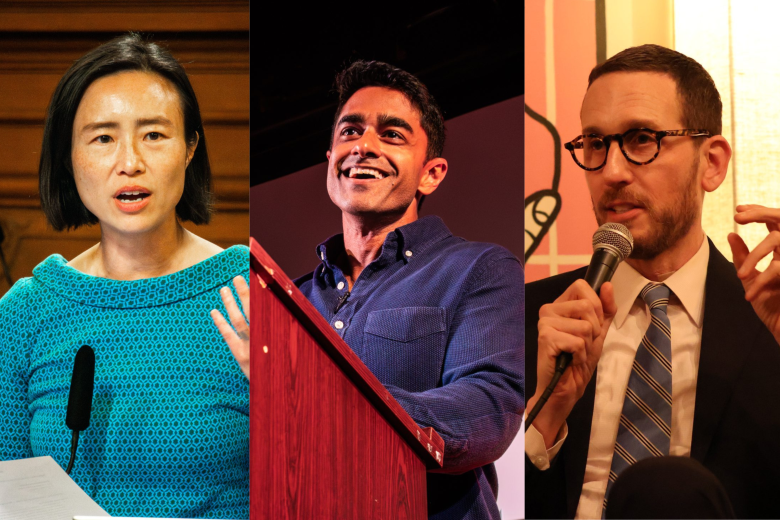

At a testy debate Tuesday night, three candidates to succeed Speaker Emerita Nancy Pelosi as San Francisco’s congressional representative stuck to their lanes, while taking jabs at their opponents.
For state Sen. Scott Wiener, that meant emphasizing his legislative record. For just about every topic raised — AI safety, healthcare, immigration — he pointed back to one or even several bills he had authored on the issue.
He’s written a bill to expand insurance coverage for mental health and addiction, for instance, and is currently working on another that will allow people to sue Immigration and Customs Enforcement for violating their constitutional rights.
“We need to take that federal,” Wiener said several times about state legislation he’s passed.
But Saikat Chakrabarti, tech multimillionaire and former chief of staff to Rep. Alexandria Ocasio-Cortez, sees Wiener’s establishment credentials as a liability.
“In D.C., I’ve met tons of career politicians and state legislators and saw why they get nothing done,” he said. “They go there, they say yes to whatever leadership wants them to do, they sell their votes to the highest bidder and that’s why nothing changes.”
Chakrabarti thinks that the current Democrats cave to President Donald Trump and on budget demands too often. Once he gets to Congress, he plans to form a coalition that won’t back down, even if party leaders want to.
“That’s going to ruffle some feathers,” he said. “If you want someone who’s going to get along to go along, then I’m not your guy.”
Supervisor Connie Chan, meanwhile, emphasized her immigrant roots and held the line for local progressive groups.
She asked Wiener about his decision to save Bay Area public transit using a sales tax rather than a business tax — a choice that angered some of the state’s unions.
“Why is it that when you have a chance to actually have progressive taxation you chose to actually vote for a regional sales tax where every voter has to pay?” she said. “Now I will have to hold my nose and vote for it.”
Wiener shot back. “We could have said, ‘let’s do a business tax’ and the whole thing falls apart. Or we can say, ‘let’s do a sales tax,’ which can pass.”
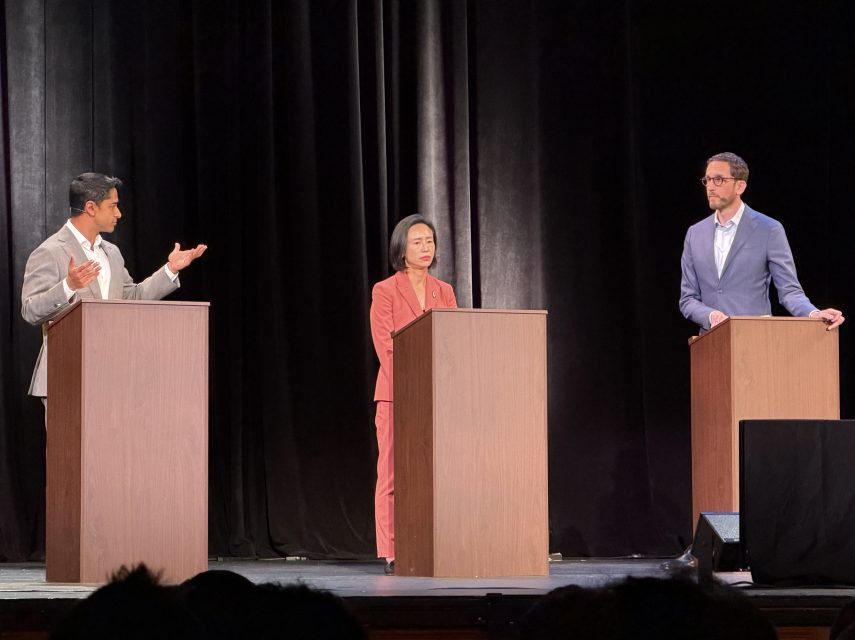
A business tax he explained would likely have failed in the legislature, been vetoed by the governor, and led to two of the five counties involved in the tax withdrawing from the agreement.
And he didn’t stop there with Chan. “You also opposed some of the early funding measures that we tried to do to save Muni and BART from collapsing,” Wiener reminded her referring to a 2023 effort to increase bridge tolls to fund public transit. That measure was supported by every member of the Board of Supervisors except Chan.
Candidates discussed foreign policy at the debate — with Chakrabarti changing his past stance on Taiwan.
In January, he told Mission Local that if push came to shove and China invaded Taiwan, the United States “should defend Taiwan.”
On Tuesday night he shifted. “I would not commit to sending military forces,” he said. After the debate, he said that he “misspoke” during January’s Mission Local interview.
Wiener declined to say what military aid he would send but spoke in favor of defending Taiwan’s democracy. “We should not tolerate Taiwan being conquered,” he said, comparing the situation to Russia’s invasion of Ukraine. “I don’t want to send American troops, but it is important for us to support Taiwan’s defense.”
In January, Wiener and Chan both dodged the question. On Tuesday, Chan continued to duck. “The United States should always be an agent for peace,” she said.
The candidates also revisited Gaza, which was the subject of a viral moment during the first debate because Wiener refused to take a stance on whether Israel was committing genocide in Gaza. After several days of intense backlash he changed his mind and put out a video saying he had decided it was a genocide.
On Tuesday, Wiener explained that he opposes offensive weapons sales to Israel but supports defensive weapons sales.
Chan also opposed offensive weapons sales to Israel but declined to comment on defensive weapons sales Tuesday. In January she told Mission Local that she thinks defensive weapons could be sold to Israel, but only if they were accompanied by humanitarian aid and a ceasefire.
Chakrabarti took the most anti-Israel stance, opposing both offensive and defensive weapons.
“Not only should we not be providing funds to Israel, we should be exploring how to stop this genocide, including looking at sanctions on leaders of Israel,” he said.
With the candidates fast approaching the June 2 jungle primary date, where only the top-two vote-getters, regardless of party, will advance to the general election in November, the race is heating up. Tuesday’s debate — which was moderated by KQED and hosted by City Arts & Lectures, Commonwealth Club World Affairs and Manny’s — was significantly more testy than previous outings.
That included an in-person rehashing of the recent social media feud that’s sprung up between the candidates about campaign finance and Chakrabarti’s San Francisco bona fides.
Chakrabarti only voted once in San Francisco from 2009 to 2020. He also listed a house in Maryland as his primary residence — which he says happened when he bought a home for his parents but made a mistake on one document.
That hasn’t stopped an independent expenditure committee from spending $65,000 on mailers accusing Chakrabarti of being a carpetbagger, though.
“Who’s funding these attack ads?” Chakrabarti said. “They’re being funded by crypto billionaires who are Trump donors, by tech VCs, including [Y Combinator CEO] Garry Tan, who, the week that the mailers went out, co-sponsored a bill with you, Scott Wiener.”
Wiener clapped back. The bill is to break up Big Tech monopolies and is supported by start-ups and consumer advocates, he said.
As for the mailers, “let’s be clear, Saikat Chakrabarti already has spent more of his tech hedge fund money than everyone else combined, including outside campaigns” Wiener said. Chakrabarti has spent $1.6 million so far, with $1.5 million coming from his personal wealth.
Wiener continued: “I’ll get my little, tiny violin out.”
As with so many such affairs that play chiefly to the interests and prejudices of bourgeois political insiders and not to the interests of the working class, what was NOT mentioned in this story is of greater significance than what was mentioned.
Did the topic of President Trump’s attack on Iran even come up?
Thus far, the United States’ criminal and unprovoked attack on Iran has resulted in throwing the entire world into peril.
How long will voters be fooled into voting for any clown based on how nimble they are at rearranging deck chairs on the Titanic?
Zero mention of Marie Hurabiell? Really? She was excluded from this debate for an arbitrary reason: a 2025 KQED deadline that ignores the actual 2026 deadline the Secretary of State required for entering this race. That is truly ridiculous.