

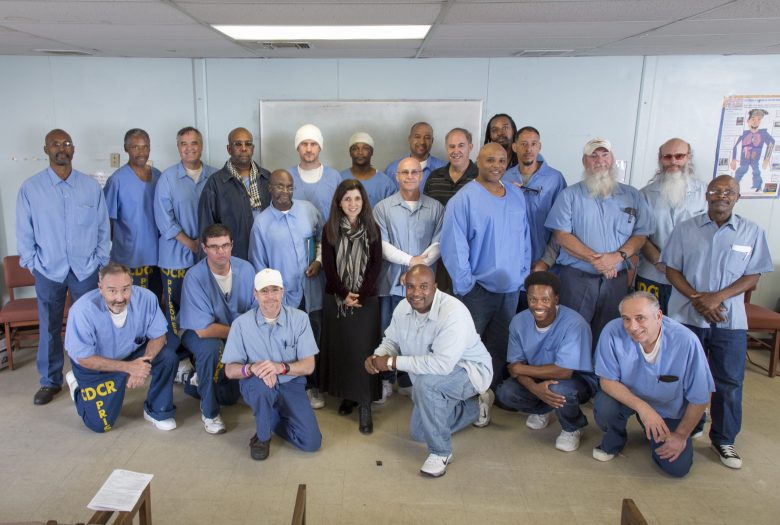
The William James Association has been offering writing and arts programs in prisons across California for decades, but now those classes are on the verge of disappearing.
The Santa Cruz-based nonprofit has provided art programming in prisons since 1977. At one point, it employed 79 teachers in 17 different prisons. Today, it only has 34 teachers at 10 facilities, said Henry Frank, the nonprofit’s communications director.
Even those programs are now at risk. The California Arts Council, which has been funding the organization for years through the California Arts in Corrections program, told the nonprofit that this year it would only allocate funds to its programs in Centinela State Prison and High Desert State Prison.
One of the eight facilities being dropped is San Quentin Rehabilitation Center, a men’s prison across the bay from San Francisco in Marin County. The William James Association has offered courses at San Quentin for over 25 years, and staff and teachers have established a relationship with the prison administration.
“When we found out that we were not awarded eight of the 10 prisons that we applied for, I was devastated,” Frank said. For the past three months, the nonprofit has dipped into its reserves to pay its eight teachers at San Quentin for half their hours, but even those funds will run out by the end of May, he said.
Frank, who was also incarcerated at San Quentin and took classes offered by the association, said the courses didn’t just teach him valuable communication and interpersonal skills but made him part of a community.
Even something as simple as being called by his first name, instead of a prison identification number, made a difference, he said. “I was just Henry in there. I was an artist just like everybody else in there.”
Frank said that San Quentin will still have some programming offered by other groups, but if the William James Association can’t find funds to continue its programming after May, both students and teachers would suffer the loss.
The California Arts Council did not reply to Mission Local’s request for comment.
Zoe Mullery, who works for the William James Association, has been teaching a popular creative writing workshop at San Quentin since 1999. Every week, she drives from the Mission District to San Quentin to teach her class, called Brothers in Pen.
“It’s just really a shame to be so short-sighted as to not fund a program that creates a ton of stability and longevity in the system, which is a really hard thing to come by in a prison setting,” she said.
Mullery said her two classes have about 12 people each, with a waitlist of roughly 200. Once people enroll, they stay in the class for years, workshopping their stories in a community where they feel supported, she said. Some of them even go on to become professional writers after their release.
Once a year, Mullery organizes a literary reading, where people in the class get to read their stories to an audience from outside.
“It just really breaks down people’s stereotypes of who’s in prison, and it also really allows people in prison to have a very non-prison experience,” she said, “just being seen for being a writer and getting to talk about their writing.”
Joe Krauter, who was incarcerated at San Quentin from 2013 to 2019, said he was in Mullery’s class for almost the entire time and wrote horror and science fiction. The group would gather in a circle, Krauter said, and everyone would read their work and receive feedback.
“It’s some of the most beautiful experiences I’ve ever had in my entire life. To meet these people, hear their stories, where they come from, laugh with them, cry with them, be amazed by their works,” he said.
The class also allowed him to develop better communication skills, he added. “Without it, I might not have paroled.”
Rahsaan Thomas was also a student in Mullery’s class.
Thomas said one of the stories he wrote during the class was about his brother being shot in front of him. Writing about it in a fictional form, he said, allowed him to start healing.
“The first time I ever read it was in class, and the reception was so good it just encouraged me to be able to talk about it in the future without it being fiction, the real story,” he said.
After his release, Thomas went on to become a successful writer, filmmaker and a podcast producer for Ear Hustle. He also created the San Quentin Film Festival and founded Empowerment Avenue, a nonprofit that helps incarcerated people publish their work.
“I was in that class almost every Wednesday for ten years. I can’t imagine what it would be like if it was taken from me,” Thomas said. “It’s not just a class. It is a self-help group.”
This isn’t the first time the nonprofit has faced funding cuts, Frank said. In the past, it continued programming in San Quentin thanks to smaller grants from community foundations and teachers who volunteered.
The William James Association plans to apply again for funding from the California Arts Council next year, Frank said, but there’s no guarantee it will be awarded. In the meantime, the nonprofit needs to find funding to keep classes running through the rest of this year.
While there are other classes at San Quentin, none focus on teaching creative writing long-term like Mullery’s class does, Thomas said.
“When you take away that class, you also take away that connection to a writing community in the inside and one on the outside, and that just can’t be good.”

Newsom is rich and he loves his inmates. Newsom can pay for the teachers himself. It might be the first decent thing he’s ever done if he does that.
I am a formerly incarcerated individual who was not exposed to these programs. I, although know Zoe and the power of her abilities to create community and effect change. This reporting is greatly appreciated. Thank you.
Thank you for this interesting and valuable article. I also want to say how much I enjoy listening to “Ear Hustle”.
San Quentin should not be like a country club!Or anything like that! You don’t go there to get REWARDED! You got sent there because you SCREWED UP ON THE LAW! And the idea is to make it so you NEVER go back again!
San Quentin isn’t “a country club!Or anything like that!” It’s a prison that offers some educational and art classes. Education and connection with resources outside a prison helps people with reentry so that they “NEVER go back again.”