
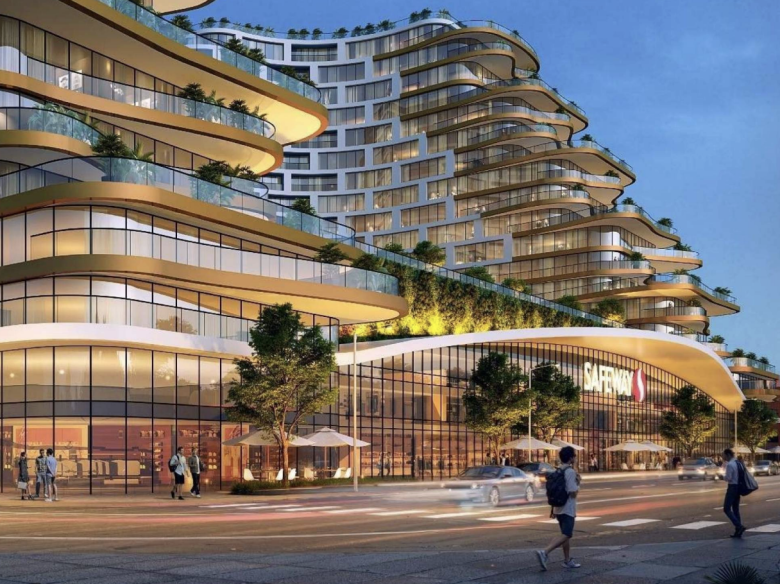

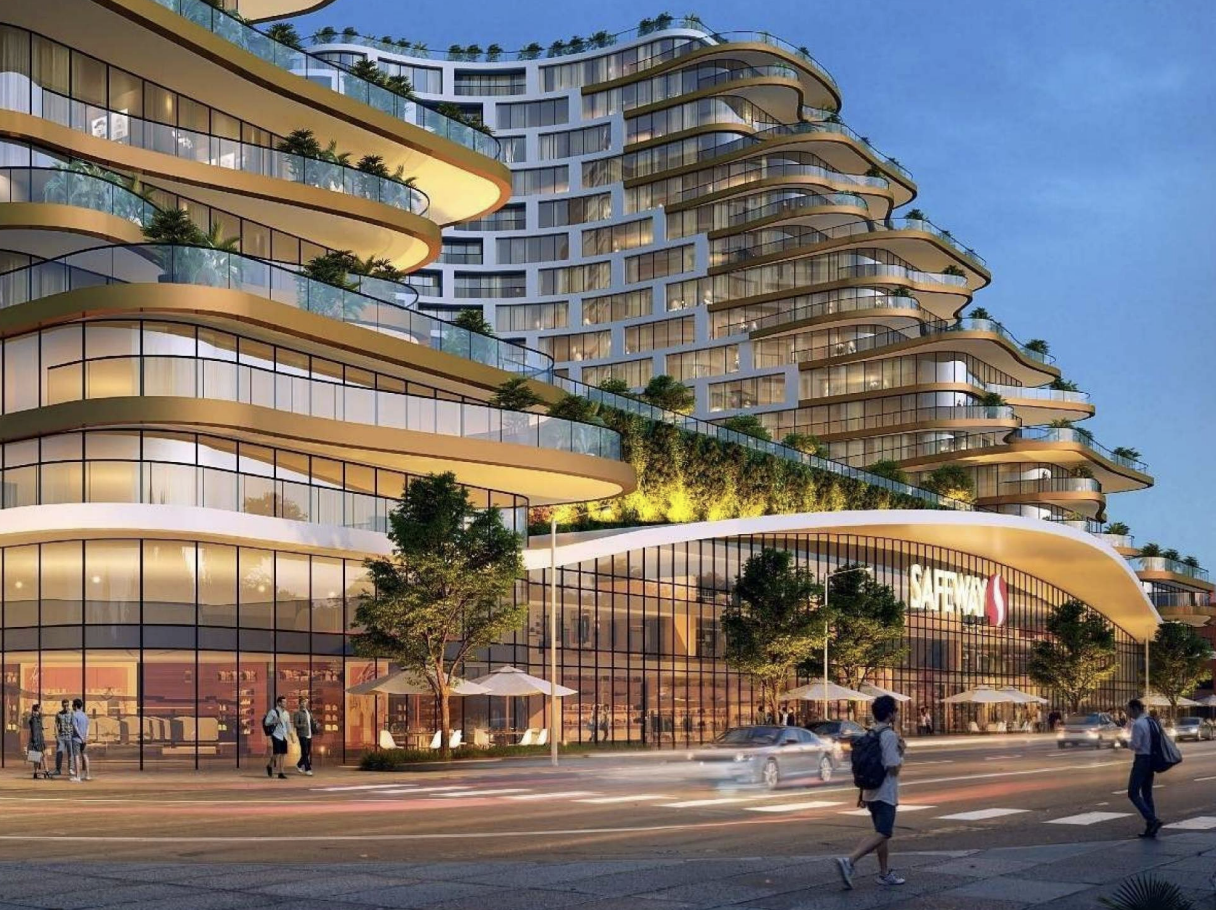
The 25-story, nearly 800-unit housing complex slated for the Marina Safeway site is, to borrow the “Princess Bride” phrasing, inconceivable. And not just for Marina neighborhood types or opponents of large developments — even developments that don’t resemble the tail end of a Princess cruise ship, as this one does.

Such an eventuality was inconceivable for sci-fi futurists, too. Take a brief respite from our bleak present-day with this clip from the 2014 Disney animated film “Big Hero 6.” A boy and his flying robot soar through the Abundance-on-steroids future city of “San Fransokyo.” It is a realm maximized for development, a clean and well-lighted “Blade Runner” cityscape of rows upon rows of skyscrapers keeping Salesforce Tower company.
And yet, even in this futuristic vision, there are no tall structures in the Marina. All Aquatic Park is missing from its present-day iteration is Aaron Peskin emerging from the waves.
Mayor Daniel Lurie and District 2 supervisor Stephen Sherrill have raised strong objections to the Marina Safeway development; they have shaken their fists with great vengeance and furious anger. Erecting a massive, opulent housing complex in which only a piddling 11 percent of the units are slated to be affordable, over the lamentations of the district supervisor and the popular mayor, used to be, you know, inconceivable. Now it’s conceivable.
That’s because state laws have changed radically since the era when “Big Hero 6” was a gleam in an illustrator’s eye. It no longer matters what a mayor or a supervisor or their disgruntled constituents think about a development’s size or impact or aesthetics. Municipal elected officials or unelected neighborhood groups or power brokers can no longer wheel and deal. Local litigants cannot tie up projects in court. In many ways, the city’s planning department has been reduced to the referee at the professional wrestling match.
With this in mind, a group of around 20 Marina residents gathered in front of the Armistead Maupin Safeway on April Fool’s Day. They protested the proposed 25-floor tower as an out-of-scale cash grab, and pined for a six-to-eight story project of the sort proposed for other Safeway sites.
“Our call to action is to boycott Safeway,” said organizer Erin Roach, the president of the Marina Community Association. “The city has no power to stop this. They’re now just under ministerial approval. So we can appeal to Safeway as the landowner. Who’s going to profit from this? Why should we give them our business if they don’t listen to us?”
Roach summed up the call for a boycott as “desperate measures for desperate times.” It is that. But it would also seem to be a classic no-win scenario. If, by some alchemy, large enough numbers of Marina-dwellers affect the grocery giant’s bottom line, it reinforces the decision to put housing on this site posthaste. If they don’t make a dent, it reinforces the powerlessness of not just this citizens group but the city writ large to do a damn thing here.
In the end, the April 1 gathering served as a demonstration of something larger: It exemplified the legal sea change that, for good or ill, has left this and other California cities with little in the way of local control.
Mary Rose Hayes stood along Marina Boulevard on April Fool’s Day holding a green-on-white sign reading “No 250ft Marina Tower!”
“I’ve lived in the neighborhood for 60 years. I’ve been shopping at the Marina Safeway since 1965,” she said. That’s well more than a decade before the store was immortalized as a heterosexual cruising site in “Tales from the City.”
“I’m 87 years old and I plan on sticking around for a bit longer. So I would really like to see this not happen in my lifetime.”
Here’s hoping Hayes sticks around for a good long time. But, on the development front, she’ll probably be disappointed — and not just because this project will top out at 297.5 feet, not 250.
All signs indicate that this is happening and likely happening fast by San Francisco standards. Broadly, that’s for two reasons: It’s a lot harder for the government or other oppositional groups to deploy legal impediments. And, on the private side of things, the singular attractiveness of this lucrative site will likely elicit the financing that eludes so many of the nearly 75,000 approved but unbuilt projects scattered throughout the city.
Let’s start with the public side. In the past, there were so, so many ways the city could’ve derailed this project that nothing resembling it would ever have been proposed. Even as recently as, say, 2022, a hulking tower in an area zoned for four stories would’ve required a majority of the Board of Supervisors to make a legislative alteration to the city’s zoning ordinance. The wishes of the home supervisor would have very likely been adhered to in this matter.
There would be planning commission meetings, planning commission votes and then more votes by the Board of Supervisors. And then, after all that, if things got that far, there would be a mandated environmental analysis. The soil beneath the Marina is a mixture of 1906 rubble, Cream of Wheat and toxic cooties from the aptly named “Gas House Cove,” so that analysis would make for interesting reading.
On top of whatever it revealed, any Tom, Dick or Harry could bring up his pet theory on lurking environmental concerns — which could be rational but didn’t have to be. The city would be duty-bound to give it all a fair hearing.
And then, after all that, any permit issued by any city department was eligible to be challenged via a “Discretionary Review.” A 297.5-foot tower is not a kitchen remodel and many permits are required here. The leverage these layers upon layers of process gave the city’s elected and appointed gatekeepers was significant.
Seen one way, it was a means to extract community amenities, open space and affordable units from developers. Seen another, it was a sop to politically aligned nonprofits. Or a potential kill switch Or all of these. It could be all of these. Regardless, that’s gone now.
And now the private side: Folks tied to this project are optimistic not just that it’ll get built but get built quickly. Ground broken before the next Super Bowl. People living here before Stephen Sherrill or Daniel Lurie would have to run again. You know: Quickly.
And why is that? Because a giant Princess Cruise derrière in the sky towering over a part of the city that even sci-fi futurists didn’t dream would be the site of massive high-end housing complexes is a gold mine.
Banks like gold mines. Banks finance gold mines.
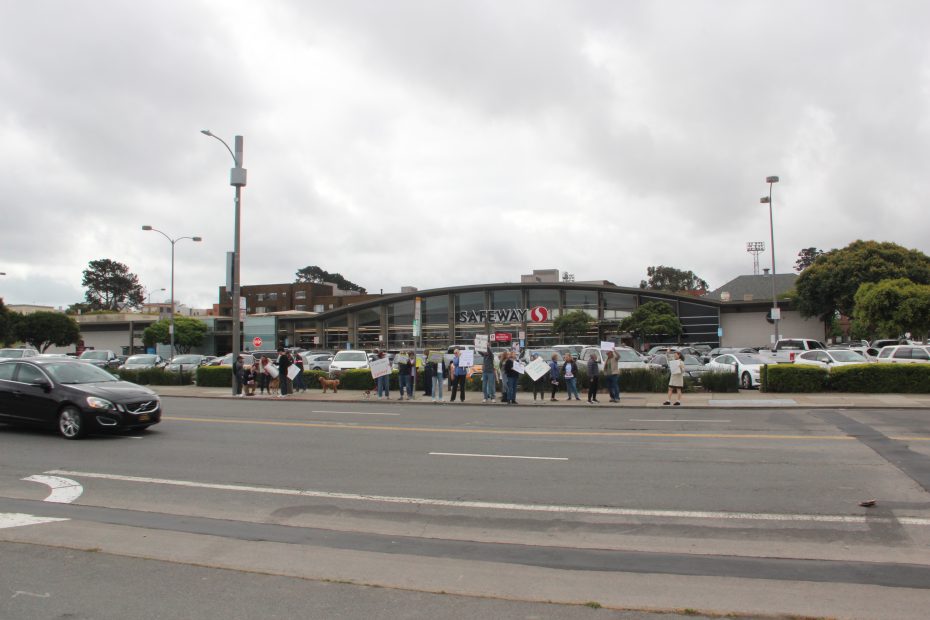
No elected officials showed up at the April Fool’s Day Safeway protest. District 2 candidate Lori Brooke said she supports her neighbors’ call for a boycott. The mayor’s office blew off the question. Sherrill answered the question twice without answering the question.
A small group of neighborhood folks calling for a boycott of a multibillion-dollar corporation is a symbol of the futility of this city attempting a headlong charge against state laws expressly designed to emasculate this city.
But the 11 percent affordable Princess Cruise derrière is, itself, a symbol of the limitations of these laws to actually facilitate significant development. This project is all but certainly going to get financing because this project is exceptional. But not every project is exceptional. And there’s only so much local or even state law can do to counter global capital. If merely approving a project resulted in its construction, San Francisco would have scores of thousands of additional built units. It doesn’t.
That’s something for Marina denizens to think about as the Safeway is shuttered for however long it takes to complete this development. In the meantime, the Grocery Outlet is set to open this summer at NorthPoint.
“Big Hero 6” didn’t foresee that, either.
Additional reporting by Nicholas David