

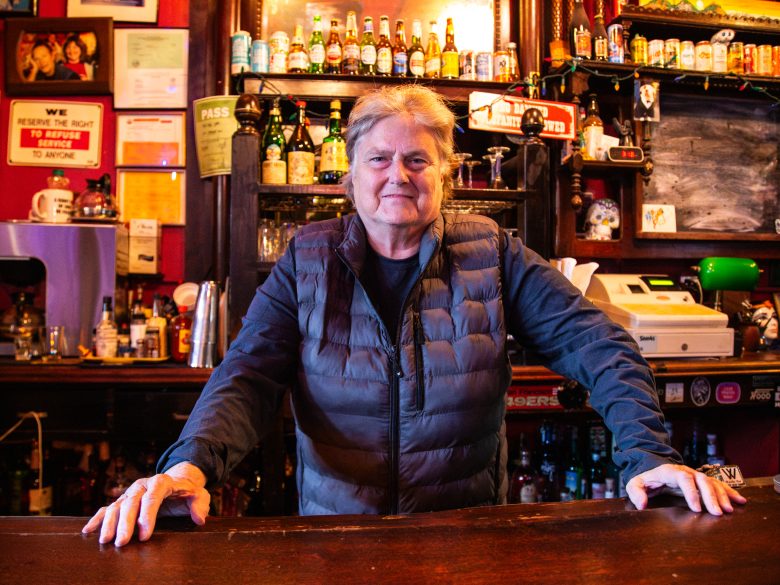

Billie Hayes is the quiet steward who has kept Bernal Heights’ Wild Side West alive since 2010.
A soft-spoken Southerner and self-described “coal miner’s granddaughter” with a military background, Hayes believes that the crew of people tending the bar includes the ghost of former owner Patricia Ramseyer.
Hayes didn’t believe it at first when several of her longtime bartenders reported seeing glasses spontaneously fly off the bar where she keeps a makeshift altar in honor of Ramseyer.
“I’d laugh, but then I was down here one day, and all of a sudden this glass went flying,” Hayes said. “She’s checking up on us.” She told the bartenders not to worry. “She won’t hurt you unless you’re doing something wrong!”
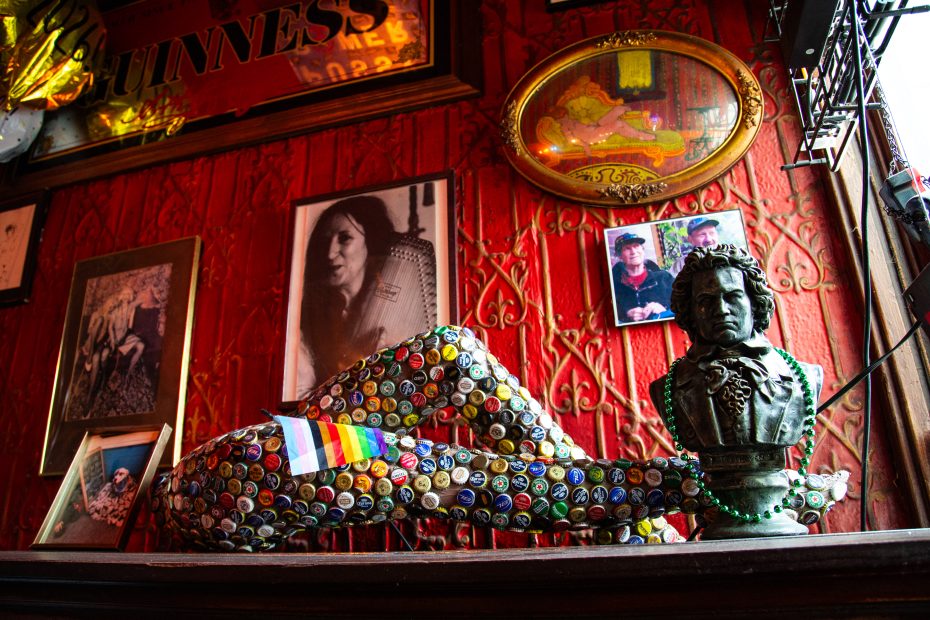
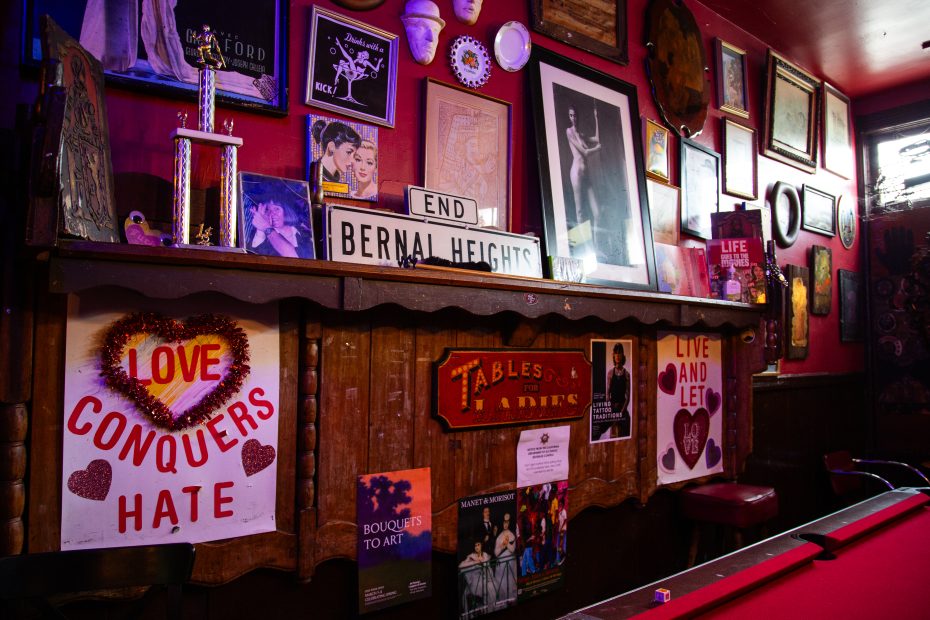
Hayes runs Wild Side West largely from behind the scenes. She makes the occasional appearance, but trusts a close circle to tend the bar, a cozy space with portraits of nude women, a collection of high-heeled shoes, and a pair of mannequin legs adorned with bottle caps.
Hayes met Ramseyer, the former owner, three decades after Ramseyer and her partner, Nancy White, opened the original Wild Side West in Oakland in 1962.
When Wild Side West first opened, it was illegal to employ women bartenders; female bar owners either had to serve drinks themselves, or hire a man to pour. The state law wouldn’t be overturned until 1971.
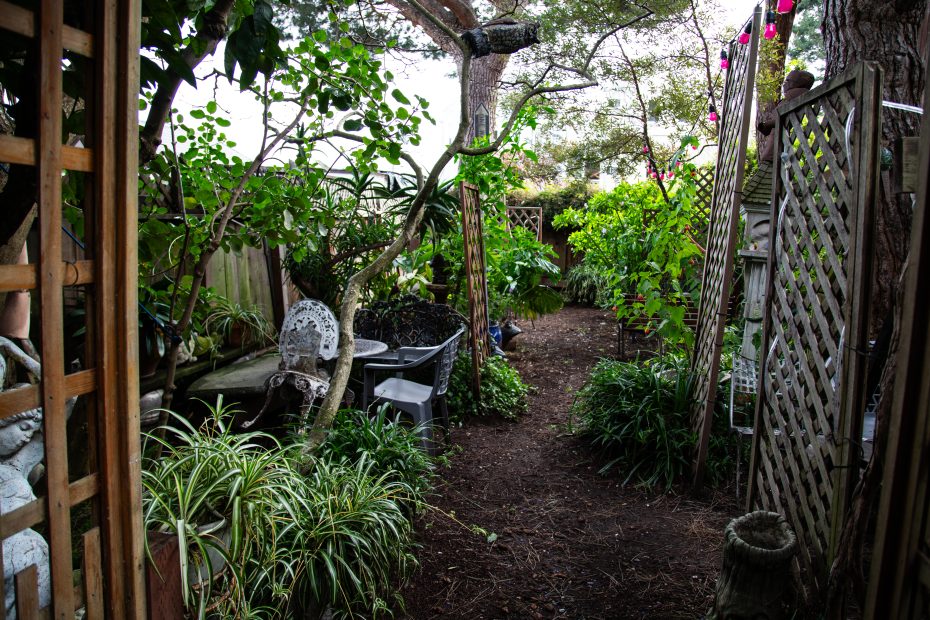
The duo moved the bar to North Beach in 1964, and later to its current location, at 424 Cortland in Bernal in 1977. At the time, being openly lesbian was regarded by many as an invitation for violence. Among the lush plant life in the current location’s back patio are sculptures made from toilets that angry residents threw through the bar’s windows long ago.
Despite the hostility from outsiders, when Hayes first set foot in the bar in the late 1980s, the overwhelming feeling was one of safety.
“We walk in, it’s all dark, and I’m just thinking to myself, ‘oh, wow,’” she said. “You could be comfortable and you didn’t have to be worried. You could be different, but you knew you belonged.”
After that, Hayes became a regular. She and Ramseyer became friends after Hayes offered to buy her a beer one night, even though she knew Ramseyer was the owner.
Ramseyer was charmed. “
She said, ‘Wow, nobody ever does that for me.’” recalled Hayes. “And I said, ‘where I was raised, you want to make sure everybody has something. That’s Southern hospitality.’ She really liked that,” Hayes said.
Ramseyer became a mother figure to Hayes, and Hayes helped care for Ramseyer when she fell ill.
As Ramseyer’s health declined, she began hinting at her hopes for the bar’s future. White, a show-tune-singing lawyer who handled much of the nuts-and-bolts of the bar’s operation, had died in 2008.
One day, Ramseyer asked Hayes what she would do with Wild Side West if it was hers. Hayes told her she couldn’t imagine it being anything other than what Ramseyer and White had created.
“It’s a refuge, a home. Why would I change it if it’s not broken?” Hayes said.
At Ramseyer’s memorial in 2010, Hayes found herself talking with a group of older women she didn’t recognize, and learned that they were customers of the bar from its North Beach days.
They had come to pay their final respects to Ramseyer and the safe haven she provided to women. When they patronized the bar, they were working in North Beach’s strip clubs, and safe havens were hard to come by.
“I never wanted to run a bar,” Hayes said. But she wanted to keep what Ramseyer and White had created alive. “It’s part of our community. It’s a place where you go if you lost somebody, or somebody got married. It’s like a family. We all come together.”
When Frankie Chamberlain, a beloved employee at Good Life Grocery down the street, died, Wild Side West patrons raised glasses of wine and put Dolly Parton on the jukebox to honor “the mayor of Cortland Street.”
These days, Hayes relies on her small team of trusted employees to sling drinks and maintain the more-than-100-year-old building, which has the maintenance issues expected of a survivor of the 1906 earthquake. Hayes doesn’t tolerate trouble, but counsels her bartenders to treat people kindly.
“Yes, lesbians run it, but everyone is allowed to come in here,” Hayes said. “The only thing that keeps you out is if you’re a jerk.”
When people come into the bar experiencing a mental illness episode or strung out on drugs, Hayes said she tells her staff, “Defend yourself if somebody comes after you, but don’t demean them. Just talk to them and say, ‘Maybe come back some other time, because right now you’re not really in a good space.’”
And Wild Side West is the kind of good space worth protecting. Hayes may not have planned to fall into this line of work, but now that she has, she plans to stay rooted in San Francisco, along with her bar, her community, and the occasional supernatural visit from Ramseyer.
They don’t have sushi there.