

From cancelling a federal student loan repayment program to attempting to cut diversity programs, the Trump administration’s attacks against higher education have thrown universities into uncertainty.
Workers at the University of California have found what they think might be a solution: unionize.
On Wednesday, workers in communications, marketing and sales at the University of California, representing 2,000 people statewide and 200 in San Francisco, voted at an 82-percent clip to form a new union with United Auto Workers.
It marked the third time in recent months that UC workers formed a new union with UAW. Student services and advising professionals unionized in April, and research professionals followed suit in September.
In total, that represents 12,000 new union members working for the University of California system.
“There’s a lot of exciting energy in the labor movement right now, and especially at UC,” said Rebecca Griffin, a member of the new communication workers union’s organizing committee and communications director at UCSF’s Bixby Center for Global Reproductive Health.
The creation of the Communications, Marketing, and Sales Professionals Union (CoMaS) brings the total number of UC workers represented by UAW to more than 60,000.
At UCSF—one of the city’s largest employers, with 39,000 employees according to UC data—about 1,600 workers have joined one of three new unions in the past 12 months, according to union estimates.
The three unions have similar demands: higher wages, increased job security, protections for international workers and more flexible work arrangements.
More than that, union leaders say this is also a way to defend their workers as attacks coming from the federal government have meant budget cuts, layoffs and hiring freezes.
“We’re realizing that, by forming a union like this, we now have a platform to protect the important work that we do that we care so much about,” said Eve Perry, a data scientist at UCSF and member of the Research and Public Service Professionals bargaining team.
In March last year, faced with financial uncertainty due to proposed federal budget cuts, UC implemented a systemwide hiring freeze.
In July, the Trump administration attempted to pull $584 million in federal funds to UCLA over the university’s supposed failure to fight antisemitism on campus. In exchange for releasing those funds, the federal government later demanded a $1.2 billion settlement from the University.
Most recently, four public health programs within UCSF have faced cuts due to the government’s plans to undo $600 million in Centers for Disease Control and Prevention grants.
UC’s unions have been fighting back. In September, UAW successfully filed a lawsuit against the Trump administration over the $1.2 billion fine. The university system did not join the lawsuit.
UAW is also working with UC on a state bill that would put a $23 billion bond to fund scientific research across California on the November 2026 ballot.
Potential strike brewing
Two of the recently formed UC unions are currently in contract negotiations. Negotiations for Student Services and Advising Professionals started in July, and Research and Public Service Professionals commenced in October. But eight months in, negotiations are grinding to a halt.
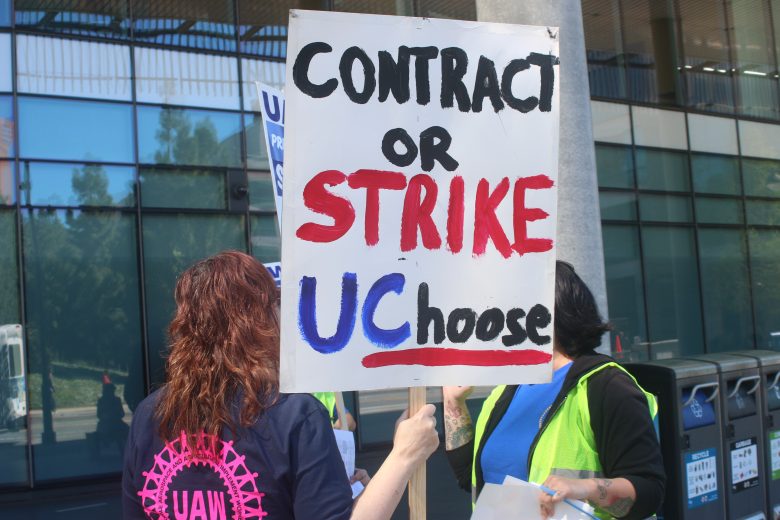
On Thursday, UC workers across the state walked picket lines as a “last chance” measure. In San Francisco, 100 employees held a demonstration before the Weill Neurosciences building in Mission Bay.
Three UC unions have already voted to authorize a strike, with 93 percent voting in favor out of 23,300 voting members.
Union leaders say the university has not been acting in good faith in the negotiations and engaging in unfair labor practices.
In an emailed statement to Mission Local, the University of California’s Office of the President said it “strongly disagree[s]” with the unions’ claims.
“These negotiations are complex because they encompass multiple bargaining units that cover academic student employees as well as newly represented staff employees transitioning from policy-covered roles into union-covered positions,” the statement read.
“Our focus is on making real progress while ensuring any agreements are financially sustainable and workable across the entire UC system.”
Asked about the newly formed union, the Office of the President acknowledged its formation, and added that “UC respects our employees’ right to choose whether to organize” and “look[s] forward to working with them in good faith.”
The unions will decide whether to strike by Sunday. If a work stoppage occurs, it could come as early as next week, said Riley Stockard, graduate student researcher at UCSF.
Across the state, that would represent close to 40,000 people on strike. At UCSF, that would be about 2,000 people.
“I think it’s a really important time for people just to see the power of the labor movement and understand, how more full and strong we are when we are working in solidarity with one another,” Griffin said.
“I’m very excited to see what we and other UAW unions at UC can get done.”
UCSF owns property all over Berkeley and San Francisco, and this makes them arrogantly think they’re the biggest kid on the block so they don’t have to comply with County or municipal regulations.
go workers! do not trust the UAW leadership and thier contempt for the working class. hold strong!!
I am one of those UCSF communicators who voted to join the union. The last year has been incredibly stressful. With NIH research funding on hold while the federal administration scoured our research for mentions of DEI and LGBTQ, and the threat of layoffs hovering over our heads, staff, especially non-academic staff, felt expendable. The university has some large real estate deals both in process, like the renovation at the Parnassus campus, and pending, like constructing the new research labs in Dogpatch. The university holds equity in reserve to ensure working capital is always on hand, but instead of dipping into that to ensure staffing levels remained steady, leadership chose to cut programming and lay off staff. There was a lot of money earmarked for future growth, while people who had given decades of service were being let go. This felt like the right time to bring an added layer of protection to our jobs. Unions are not perfect, but they do provide the essential advocacy and oversight that ensure worker protections are a reality, not just a policy. I voted to unionize to ensure we are treated as the essential part of UCSF that we are.
I appreciate your reasoning and candidness. Yours is a tough predicament to be in and you and your co-workers have my best wishes.
I am glad that you aren’t blind to what you are getting into.
To feel the world on one’s shoulders is a great responsibility when bread and butter issues– and even issues of basic health and safety, life and death– are also at stake.
It is hard to feel strong and not be bewildered when confronting the rush of daily events, especially the way they are spun by a media that is less and less free.
People are afraid of tomorrow. Rightly so.
We should never forget that we face dark and dangerous forces that are well-practiced in dividing the working class.
But those forces are pitiful when compared to our overwhelming and decisive power when once we become united.
Not for some future pie in the sky or to release steam by shouting slogans. The most powerful human force has been, is, and will always– belong to the working class.
I hope no matter what, you and your colleagues will follow Will Lehman’s exciting political campaign to become president of the UAW.
He is under no illusions, but he advances an uncompromising perspective that is grounded on a firm understanding of history, and a faith in humanity’s potential to save itself.
I once served three (!) department directors as an administrative aide temp at UCSF. I was earning the best wages I had ever earned at that point of my lifetime, so I tolerated a lot of petty bullying from not a few truly obnoxious people.
I mostly made coffee for them. What more can I say?
When 9/11 happened, we all sang “solidarity” in a Kumbayah in our courtyard. I was laid off just after that because there was no avenue afterwards for a permanent job.
Chewed up. Spat out.
Probably shaved a few months off my lifetime, but I learned a few things.
One: avoid spending any part of your precious lifetime working with disagreeable people or in a job that is tailor-made to exploit you.
I didn’t dislike all my coworkers at UCSF, but I cringe when I imagine the good ones enduring the toxic environment I left behind!
Many had pressing responsibilities that were far greater than ones I had.
I want to study this news more carefully but my immediate thought is:
To affiliate with Shawn Fain’s UAW is a big mistake. Fain is a big phony who promises a labor-wide strike in 2028.
A nation-wide general strike should have happened yesterday. Growing austerity, fascism, and war are the imperatives driving fast moving events today.
In full view, Trump is launching wars around the world and a war against the working class in the US. In full view, he is constructing a dictatorship when we should be celebrating 250 years of having a government “for the people.”
Neither the Democrats (including its left-wing in the DSA), or the major trade union leaders and bureaucrats have done anything substantial to block all that is happening.
Shawn Fain, who was once on board with Biden, is now on board with Trump— their alliance is critical for retooling our economy for war to cope with a capitalist economic system in crisis.
I urge thoughtful UCSF workers to be leery of self-serving union functionaries who somehow manage to flourish while working conditions predictably worsen for those they are supposed to represent.
Read about Shawn Fain.
And read about Will Lehman, a true working class hero.
Lehman is an autoworker and genuine socialist who courageously (and smartly), ran against Fain in the last corrupt UAW election. He is running again this year.
Lehman wants to bring real democracy to the UAW. He wants to unite workers, not divide or isolate them— principally in a fight for socialism.
Why?
Because the root of all war, austerity and dictatorship is capitalism.
It cannot be reformed. The proof is all around us.
Bull. ANY union can be reformed through elections.
Leaders do not happen in a vacuum. I think the UAW has a huge membership, and there are many people in leadership positions across the organization. Fain will keep his job as long as he works for the members. If he gets too cosy with management, then he will be ousted. It’s not about him. It’s about the workers.