

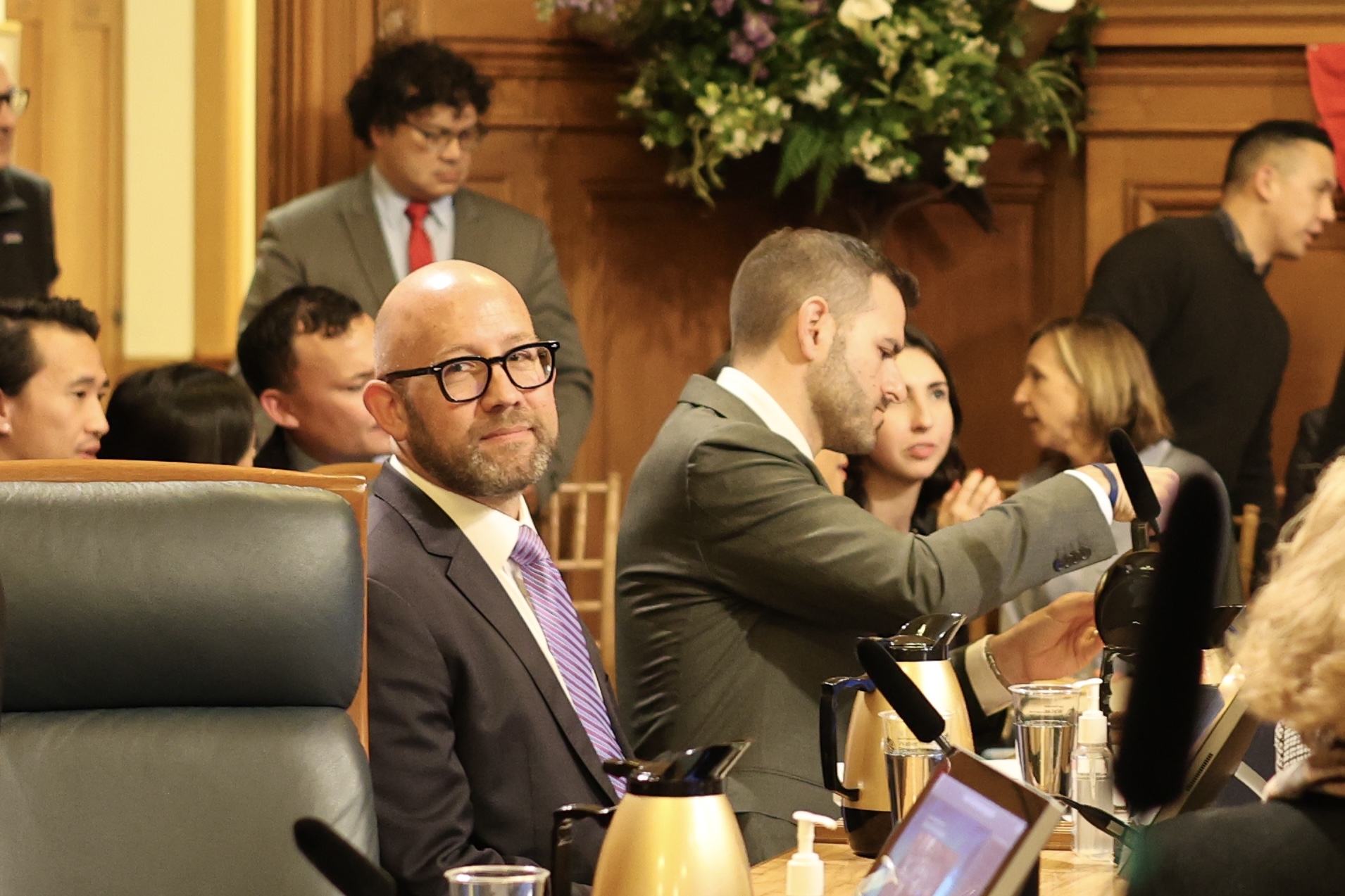

San Francisco supervisors on Tuesday held an informational hearing on recommendations to cut or weaken the power of dozens of city commissions — and indicated they will not pursue any controversial suggestions.
“I don’t think we’ll touch many of the live wires,” Board President Rafael Mandelman said.
Instead, Mandelman announced that he was planning to draft a charter amendment with only select “non-controversial” recommendations from a report by the Commission Streamlining Task Force, as Mission Local reported Monday.
“There are in that report and in that charter amendment, a host of recommendations that are non-controversial … I think,” Mandelman said to a ripple of laughter from the crowd of about 80 people. Eliminating city commissions has engendered strong opposition, and supervisors have been reticent to expend political capital on the task.
On Tuesday, even suggestions that had previously received little opposition were criticized by public commenters.
That included proposals to loosen strict experience requirements that make it hard to find members for some commissions. One person on the Ballot Simplification Committee must be a reading education specialist, for instance.
But making it easier to fill roles “should not come at the expense of expertise and lived experience,” one person said.
The only suggestion that seemed truly non-controversial was getting rid of defunct bodies.
The board’s consideration of commission reform is the culmination of a years-long public process featuring dueling ballot measures and tens of millions in political spending. With Mandelman’s pledge to move forward on only the most anodyne of recommendations, the movement to cull San Francisco’s many commissions may end not with a bang but a whimper.
And, also: complaints. Some 60 public commenters laid into the board and the Commission Streamlining Task Force for more than two hours.
The city’s contemplation of commission streamlining was sparked by rival ballot measures in the November 2024 election. The since-defunct political pressure group TogetherSF and others sunk some $9.5 million into the campaign for Prop. D, which would’ve arbitrarily capped city commissions at 65. Its proponents argued that commissions made government inefficient.
But, despite a massive warchest, only 43 percent of voters found Prop. D appealing. In the end, 53 percent opted for Prop. E, backed by $117,000. It created the Commission Streamlining Task Force to consider the city’s many commissions one by one.
But the task force was soon accused of going beyond its mandate. Instead of just culling inactive bodies, it also recommended stripping away decision making and oversight authority, moving bodies from the charter to the administrative code where they could be tampered with more easily and merging commissions with similar mandates.
At Tuesday’s meeting, Supervisor Shamann Walton issued a sharp rebuke of the task force.
“Proposing to change bodies that the community voted on that are in the charter, proposing to eliminate independent oversight of law enforcement bodies, all those things are just mind boggling to me,” he said.
He also criticized the pursuit of government efficiency “at the expense of diversity, at the expense of community voice.”
And members of the public agreed. In over two hours of public comment, over 60 commissioners, former commissioners, appointers, and others showed up to defend their current or former posts. It was an ample demonstration of the fierce resistance — and political consequences — the Board of Supervisors would incur by culling active commissions.
“I promise to make it my 2026 magnum opus to make sure everybody knows who votes here,” one commenter said. “Everybody’s going to find out where you stand.”
One woman, who came with her children, said she brought them because “I wanted them to see what side of history you were going to stand on. Were you really going to stand on the value of community first?”
The board seemed prepared to answer yes.
For Mandelman, pursuing uncontroversial changes makes sense. The task force’s charge, he said, was to “think through what was the most reasonable, rational version of our charter.”
“But that’s not what politics is.”
In a city that’s suffered one corrupt mayor after another for decades the last thing we should be doing is changing the rules to make the mayor even more powerful. This is an executive power grab.
Great reporting on this one. The moment I saw the stupid shit the “Prop E” commission was proposing to mirror Prop D was absolutely bonkers.
The public by and large doesn’t want anything more than to remove commissions they don’t need or will need.
I called this out previously on October last year, and it’s good to see that intent of Prop E followed.
Two grenades, one to go, since Lurie preparing his next election.
Those poor children.
At least it wasn’t church.
I get the consolidation of power reservations as well as the disempowerment of public input, but we need to streamline so as to stop fiascos like the $1.7 million toilet. That debacle is not an isolated incident.
“Eliminating city commissions has engendered strong opposition, and supervisors have been reticent to expend political capital on the task.” This should read, “Eliminating city commissions has engendered ‘vocal’ opposition… The mayor and every supervisor who was up for election ran on eliminating the labyrinth of commissions. What happened?
Another farcical chapter in San Francisco governance. A insane amount of do nothing commissions and yet politicians haven’t the backbone to take the recommendations of an independent body who were voter approved. We (voters) should put the independent recommendations back to voters. This is why voters are wary of returning power to supervisors.
Nice to see some skids applied to city hall and its billionaire pals.
That’s because the whole purpose of “commission reform” was to justify an executive power grab, not because anyone seriously thought having too many commissions was a major issue. And the executive power grab is still happening. One of the most damaging proposals of 2024’s Prop D which we rejected was to let the mayor remove his appointees at will, which would turn them into mayoral puppets. That isn’t in this charter amendment because it’s simply been shifted to one of Daniel Lurie’s other charter amendments (endorsed by Mandelman).
Similarly, Daniel Lurie doesn’t actually care or think it’s a problem that ballots are too long. He thinks YOU care and will buy this as a reason to make it harder to put things on the ballot that rich people don’t like, such as taxes on the rich – another of his “reforms.”
Number of commissions, number of things on the ballot, whatever supposed annoyance they’ll think of next: it’s all manufactured issues to take away checks and balances and erode democracy.
Mandleman who is famously working with the Mayor on revising the city charter to give this “moderate” Mayor more power. That’s a hard no.
perhaps the people appointed to the commission streamlining taskforce are interested in doing their job and wanting to make government run more smoothly and efficiently which would be great but having attended the hearing on the civil service commission and learning they were voting on making changes to the powers of the commission without even having met with the CSC members made me question if getting things done quickly was actually going to come out with the best decisions or just allow the taskforce to reach the conclusions that the mayor had wanted ahead of time since it was putting more power into the hands of the mayor. glad we still have some checks and balances in the form of the board of supervisors.
What if we had one 21 member city commission to address any and every thing SF? Common sense is here, believe it or not. But the top 21 common sense minds to hear from experts from all 165 current boards and commissions and everyday citizens could do more to move SF forward then what we currently have, in my humble opinion. And for the record, I’ve been before quite a few of these commissions and was on an advisory committee of the Human Rights Commission. Commissions are needed but why are they such a useless joke today?