
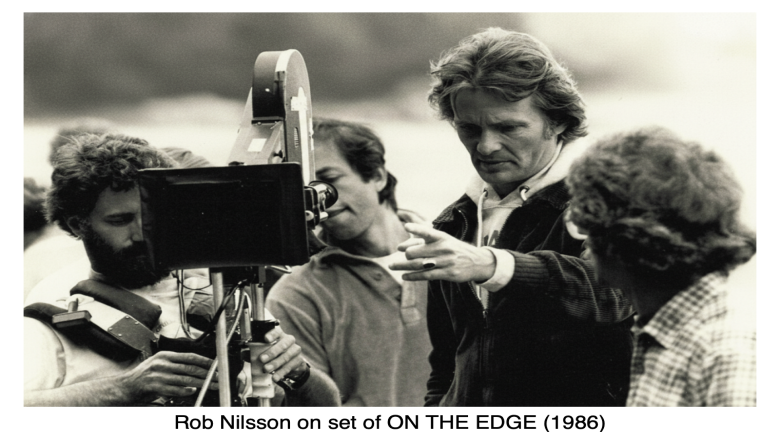

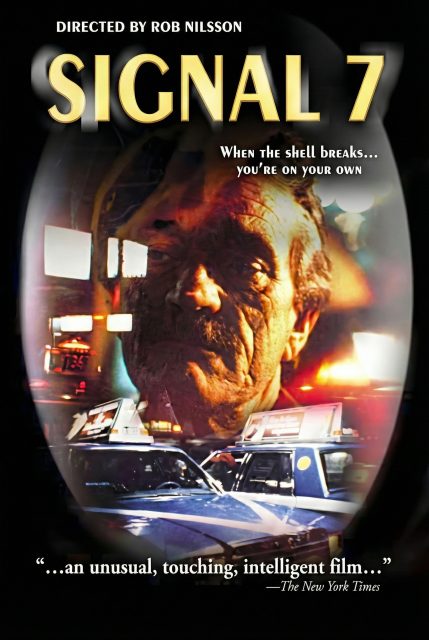
Rob Nilsson has been making films for over half a century, much of which he spent living and working in San Francisco’s Tenderloin District. He’s won prestigious awards like the Camera d’Or at the Cannes Film Festival and the Grand Prize at Sundance, even earning the approval of Francis Ford Coppola, who presented Nilsson’s film “Signal 7” at the 1984 Telluride Film Festival.
But despite all the industry accreditation, the 86-year-old fancies himself a staunch populist — a fiercely independent, anti-Hollywood, anti-commercial filmmaker who makes art for and about the common people. In the ’70s, he co-founded the San Francisco radical Marxist film collective Cine Manifest. And in the ’90s, he founded the Tenderloin yGroup, a weekly drama workshop for unhoused people and inner-city residents alike, some of whom he went on to cast in his films.
Today, Nilsson has remastered his entire filmography and is screening select titles as part of his Points Around the Bay Film Retrospective at his home studio in Berkeley, where he currently resides and leads his Citizen Cinema drama workshops. He’s as uncompromising and passionate as ever, warmly welcoming Mission Local into his dimly lit studio for an interview.
All proceeds from his home studio showings will be donated to the Faithful Fools Ministry, a street ministry in the Tenderloin where he once held his weekly drama workshop, as well as to the Tenderloin Museum.
The two films discussed in this interview, “Fourth Movement” and “Imbued,” will be screening on Mar. 12 and Mar. 26, respectively. You can RSVP to attend here.
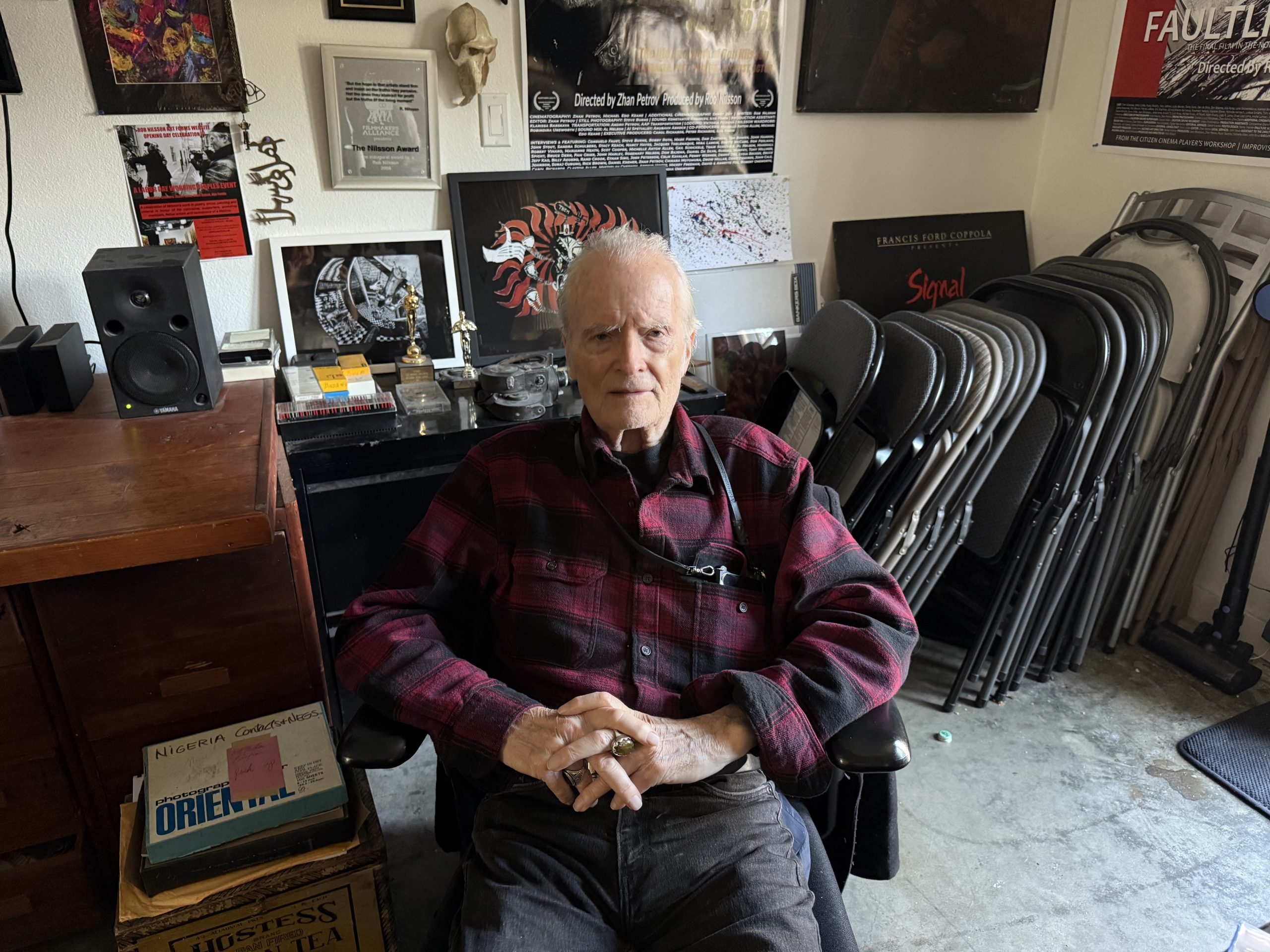
Mission Local: Out of all of the films you selected for your Points Around the Bay Film Retrospective, two in particular stood out to me, which are “Fourth Movement” and “Imbued.” What was your thought process behind choosing two lesser-known, deeper cuts? They’re not nearly as well-known as the other selections that have won big awards and cast bigger stars.
They’re also both set in San Francisco — “Fourth Movement” follows multiple characters in the Tenderloin on Trump’s 2016 election night, and “Imbued” is about a lonely gambler who unexpectedly meets a call girl in his San Francisco condo.
In addition to being filmed in San Francisco, what’s so special about these two films?
Rob Nilsson: Well, first of all, “Fourth Movement” I do because it was made out of my Citizen Cinema drama workshop group here. That’s a group that came together through various other workshops like the old Tenderloin yGroup I used to run. And I thought, let’s start with one of the best things we made together, which also happens to be about Election Day 2016, which had a very tragic result in the selection of this fool that we now have that we can laughingly call a president.
And so the film follows the idea of these women going through the streets while the news is coming in about what’s going on in the election, the people they meet and the circumstances that they find. And they all end up going to a new Tenderloin jazz club that’s opening up.
And so in some ways, it’s jazz against nonsense. Jazz with the aspirations of women, and at the end, against the insanity of this country at that particular moment. So that’s why I chose to screen “Fourth Movement.” Also, because people probably haven’t seen the film for a while. And plus, I’m just very pleased with it.
And then, why did I choose “Imbued?” I chose it because of Stacy Keach (who plays the gambler). Now, are you familiar with him?
ML: Never heard of him until seeing your film, I’m afraid.
RN: Maybe not in this generation. But in my time, he was a major actor — one of the great American stage and screen actors. And I felt that for people who don’t know the workshop, and don’t know what I’ve done, but who know Stacy’s work, they might be attracted by him.
But also, it’s set in San Francisco, at the top of a high-rise. It’s about a gambler running a football pool out of a borrowed high-rise apartment. I really think it’s beautifully shot, and I just love the film.
And I love Liz Sklar. She’s a local actress, very well known in the San Francisco theater scene. Wonderful actress, very bold, very perfect counterpart as the call girl to Stacy, who plays this lonely character at the top of a high rise.
So that’s all the reasons I can think of at the moment. I’ve also made 45 movies and half the time, I can’t remember what some of them are even about anymore.
ML: Tell me more about your choice to set “Fourth Movement” in the Tenderloin. Was that choice a political one? Artistic? Logistical? A bit of everything?
RN: Well first of all, when I came down into the Tenderloin, I was looking for my missing brother.
And 12 years later, I was taken in by the Faithful Fools Ministry, who allowed me to have my yGroup workshops there. And I came to know the area and many of its people. You know, the Tenderloin is a place of extremes where human life is threatened and transformed. There’s life and death in the streets, and there are people who can’t get by. On the other hand, people are more real. Sometimes, some of them are lost in a miasma of drugs and all the other things that you can run afoul of.
There are others, and their feelings and the ways they think are very acute because of what surrounds them — always something different, sometimes dangerous, sometimes extremely touching, sometimes dramatic, sometimes dour and boring.
But anyway, because I knew it because I spent a lot of time there. That’s why I went back, even though the film was workshopped here (in Berkeley). But I went back to the Tenderloin because I know the place.
ML: I see. And you mentioned the Faithful Fools Ministry. I saw that half of the proceeds from your home studio screenings will be donated to that organization, and the other half will go to the Tenderloin Museum.
RN: Well, normally, these are free screenings I have here. But this one time, we’re going to put up a bucket, and everything that comes in goes to them and the Tenderloin Museum. It’s because the Faithful Fools were great champions back then, from 1997 to 2007, and the Tenderloin Museum has shown all of the movies that we made there.
And the Tenderloin Museum is a wonderful place under the stewardship of Alex Spoto, who has done so much for us to make the screenings really top-notch.
ML: How did you come to found the Tenderloin drama workshop? For example, what were the cultural conditions of the city that enabled you to pursue that project? What was your personal inspiration? You know, what were the overall circumstances?
RN: Well, as I said, I was looking for my brother. I had just made a pretty successful film, “Heat and Sunlight,” which won at Sundance (in 1987). And I was standing in a building somewhere — I don’t even remember where — but it was overlooking the Tenderloin. And I said, “Wow, I wonder if he could be down there?” That’d be the natural place for a wandering schizophrenic, as he had been diagnosed as a young poet, you know, a dreamer and a wanderer.
(Nilsson’s brother, Greg, was eventually found in Los Angeles in the 1990s and the brothers were reunited).
I don’t remember exactly how, but I started the organization at the YMCA there, and later, somebody introduced me to the Faithful Fools, who invited us in. And they’ve been, to this day, great, great compadres who share the same idea, which is basically, you don’t go in there to try to convert people to Christianity or to try to tell them what to do. Instead, you try to see if you can be helpful.
And that’s what they are. They’re religious people, they’re Christian, they have their beliefs and they respect that. But they don’t push them on anybody. What they try to do is, what do you need? How can we help? What do we have to offer? And I think that that’s such a wonderful way of thinking about giving, about empathy, and caring for people.
ML: And you mentioned that the other half of the proceeds is going to the Tenderloin Museum, so I want to talk a bit about that. What does supporting that institution mean to you now, that it’s been a few decades since you lived in the TL back in the ‘90s?
RN: Well, life [in the Tenderloin] is, in many ways, the same, and in many ways different from anywhere else.
And now you have the Tenderloin Museum, which is there not to make some nice, middle-class, safe environment for people to go in and feel comfortable. Some of it is straight history about immigration — about immigrants from Cambodia, from China and all sorts of places.
But it’s also a lot about the scandalous people who were down there: the hookers, the musicians — including some of the greatest in the whole jazz world — and the cops who were either dirty or clean, the politicians who were either crooked or not.
So [the Tenderloin Museum] is not making moral judgments. They’re showing, as much as possible, the whole pastiche of the Tenderloin, all of it, without censorship. That’s mostly what I like.
And also in the back, which they’re developing now, it used to be Newman’s Gym — that’s where Muhammad Ali trained for the 1960 Olympics, right there in that gym. The actual place where the ring was is still marked, so you can go in there and see exactly where he trained. That part isn’t quite open to the public yet, but it will be in the future.
So you have great moments like that in there.
And Alex Spoto, too. He’s great. He’s a great musician, a great enthusiast, and he runs the institution. There’s a lot of energy in everything about it, and we learned a lot from him.
ML: On the world stage, the San Francisco Bay Area doesn’t often strike people as a major film capital like L.A. But for you, as a fiercely independent filmmaker here, how does it feel to have also gained institutional recognition, such as winning prestigious awards at Cannes, at Sundance, and even having an industry figure like Francis Ford Coppola present your film “Signal 7”? You know, you possess such a strong anti-Hollywood, anti-establishment ethos.
RN: Yeah. I don’t like the industry. It’s being done for money. It’s a way to make certain people rich.
I’m not saying they don’t come up with films occasionally that I like. But I really don’t like almost everything they do, and I don’t like the way they treat people. They put them up on pedestals, they make them millionaires, and they make them go crazy. Because what does all that mean? What does it mean to be a star? I mean, come on. We know who we like, and we don’t like. We live our lives in a much smaller context.
They’re being forced into being monsters. Some of them do it well, and some of them fall apart—and who cares? I mean, if the movie grabs you by the throat and you can’t get it out of your mind because it meant so much, that’s all that matters. It’s not about money.
And I’m sorry they spend so much. You might say, “Well, a lot of people get employment.” They do. But for what? How much good comes out of it, and how much really dubious behavior gets generated by artists who don’t know what they’re doing?
And you know why they don’t? Because they’re pushed by producers to do it their way. They’re not a poet sitting in a room hearing voices. That gets taken away, except for a very few. Like, for example, I think Sean Baker is great, and the Safdie brothers were better when they weren’t trying to act like Hollywood. But now I’m afraid there’s something supreme — “Mickey Supreme” or whatever…
ML: … “Marty Supreme?”
RN: Yes, “Marty Supreme.” I watched it and I couldn’t believe my eyes! And I walked out after about 40 minutes. And those guys have always loved their work, and now they’re doing it for money. Really? Come on!
ML: Do you think that being in the San Francisco Bay Area — which is farther away from Hollywood — has helped ground you and keep you from selling out like some of the other directors there?
RN: I think that’s one of the reasons I never wanted to go down there, because I knew I’d be subject to it. I can’t say I knew I would be tempted, but maybe I would give in.
You know, I did do one movie down there. It was a sci-fi thing. It was a Rod Serling script that I adapted called “A Town Has Turned to Dust,” which is set in a future where the Earth had already been destroyed. And I worked with Ron Perlman and Stephen Lang and people like that.
But I’m not pure. I was in “Miami Vice.” I was in “Beverly Hills 90210.” I’ve done a lot of work with Bobby Roth who does TV, so he hires me.
So I don’t want to pretend that I’m free and pure. I just want to say that when it comes to my own work, I don’t want to have anything to do with them. I don’t want to be judged and kind of monetized for their particular aesthetic, which basically is pretty weak, you know.
I could ramble on, but have you had enough?
ML: It’s actually quite enjoyable! Well, do you think that the “realness” of San Francisco and the Tenderloin — as well as having that geographic distance from Hollywood — has helped you cultivate that more authentic, anti-commercial feeling you’re going for? Like, has being here helped you stay true to yourself and the things that genuinely inspire you to make art?
RN: Well, I don’t know. But I mean, that’s what I’m trying to do.
I keep thinking: Why am I out here? Because people ought to pay attention. They don’t know what we’ve come to know in our workshops. They don’t see it. And when they do see it, it’s prettified — and that’s a shame.
I mean, humanity is not very clean, if you haven’t noticed. Our histories are based on the wars that we fight. And look what’s happening right now. Now we’re suddenly bombing every other country we don’t like. What’s all that about? It’s about imperfections — the Quixotic, the actually sick behavior that all of us are subject to. All of us get sick. We try to get well. We try to keep going.
ML: What carried over from the political spirit of Cine Manifest, the radical film collective you co-founded back in the 1970s, into your work in the Tenderloin a few decades later?
RN: You’ve done some real research. I’m impressed! Well, I believe in everyday people. I believe that the more you are surrounded by civic approval, or the wrong kind of political ideas, the sicker you become.
Cine Manifest said: Let’s look at the movies of people who are working toward the betterment of the everyday man and woman. Let’s start there.
And I don’t go much beyond that. I can’t proclaim some religious doctrine that’s going to save people, because no one’s going to get saved. I just like people who are themselves — natural. And if they become unnatural through politics, then I’m sorry, the politics has to go.
I’m more for the everyday person who stands on their own feet. They’re decent, they’ve studied. Not everybody has, and this is one of the things I believe, that if you don’t read, you are in deep trouble.
And right now, everybody’s looking here at the screen. And as somebody said recently — a young Black activist on KPFA — every time you look at a hundred things on your cell phone, that’s one book you never read.
The great writers — even the not-so-great writers — read them. Figure out what they knew. And the good ones are the ones who fought a society that was trying to control people, push them around and tell them what they had to do.
Democracy is about speaking out. But if you haven’t read, you don’t know what to say. I’m sorry. I wish there were some injection where you could suddenly have all of Shakespeare in your head, or Dante, or anybody. But no. You’ve got to work a little bit yourself.
So when you talk about Cine Manifest, yes, it stated its political goals. And for me, within that, I felt that I wanted to stand up for everyday people. And whoever does that, I’m with them. To the extent that I can stand up with them and for them, we can make movies, and I can live with my conscience.
ML: What did San Francisco and its art scene once enable you to achieve that the city no longer makes possible? Perhaps the rising cost of living? Cultural and attitude shifts? What do you think?
RN: Well, I think that San Francisco has hosted a lot of great movements. You know, Ferlinghetti, Kerouac, Gary Snyder — the whole literary scene of North Beach. And the California Figurative Movement, with painters like David Park and Elmer Bischoff. So it has been conducive to groups that are doing stuff that I still love more than most art that I see today.
So it’s hard for me to know who the genuine artists are, from the fakers, or those who have been caught up in a doctrine. They may not be fake, but they just think anything they do has to be right, because they’re artists.
So San Francisco has always been a place where innovation and new thinking can happen, and to the extent that it does that, that’s all I can talk about. You say, “What is there about the city?” Now, I don’t know. I don’t know. I know what I’m doing. I know what our workshops are. And I believe there’s a lot of other work being made. But right now, I couldn’t tell you what it is. I don’t have a favorite.
It’s interesting. What I really think is that society is largely stripped right now of any ability to discern what art is transformative. And that comes from everyday people — where you can see it, and how it affects you.
I kind of feel we’re in a stage now where we’re trying to fight off a real fascist attack, but we don’t know how to do it, particularly in art. I think we’ve gotten to the point where modernism has made us too accepting of mediocrity in the arts. And I think we’ve got to get past it.
ML: Okay, I have one last question for you: How can regular people in San Francisco today help preserve and support independent cinema and the local art scene against the odds? How can we continue to nurture that anarcho-creative spirit that you were once at the forefront of?
RN: I think you have to find a master, like how I found John Cassavetes. I got to meet him, and I got to talk to him. I showed him my work. And what you’ve got to do is go to the artists that have the things you hope you’re going to love, and then find out if your work stands up with them.
The current artistic climate is very permissive, but it is not particularly persuasive right now. It’s amorphous. I see people come over here, and they show me work, and I don’t always know what to say. So what do you do?
Well, you find a master. Find somebody you can believe in, whether you can meet them or not. Go and meet them. If they live in New Orleans, go to New Orleans.
I made a voyage from Boston to the Cape to meet Conrad Aiken, the poet whose work changed my life. And I wrote my thesis about him.
Go out and find your masters. Don’t listen to MoMA. Don’t listen to any officialdom. MoMA is a great institution — I mean, it’s great because there’s good work in there — but there’s also work that is not so good. And that’s not for me to say because really we have to rely on supporting what we know with our gut, and with our minds, and with our hands, and with our friends. We have to support that.
And to the extent that help happens in an official capacity somewhere, like in a museum or a gallery, that’s great. But find your masters. Find who you know who can teach. And once you’ve learned, then try to teach back.
ML: Even for people who are not artists, would you apply the same advice to them?
RN: Yeah, I would. No matter who they are, people should find their masters. I don’t know anyone who can just do it on their own. You find those who are better than you, deeper than you, have gone further than you, and have more courage than you, and you try to gain all of that for yourself through association.
ML: All right, that’s it. Thank you so much for telling me so many insightful things.
RN: Well, I don’t know how insightful they are, but they are what I’m able to muster up here. Thanks for coming over.